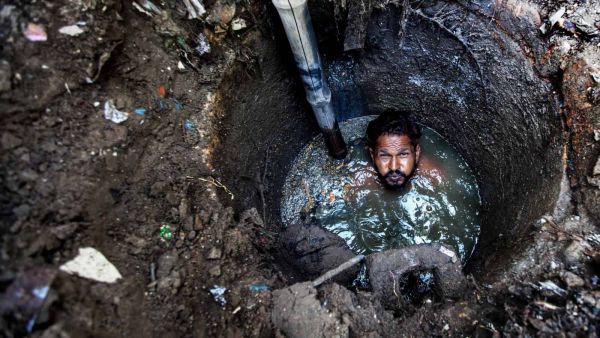
Hyderabad/New Delhi: In March 2014, the Supreme Court delivered its judgment in Safai Karamchari Andolan vs Union of India, a landmark ruling meant to protect the lives of India’s sewer and septic tank workers – overwhelmingly Dalit – who clear the country’s waste with their bare hands and bodies. The verdict capped more than a decade of litigation and directed the government to fully implement the Prohibition of Employment as Manual Scavengers and their Rehabilitation Act, 2013, which had been passed the previous year.
More than a decade on, that promise remains largely on paper. Despite the legislation and repeated Supreme Court directives, successive governments, regardless of which party is in power, have failed to enforce it, and the deaths have not stopped.
According to a recent survey by the Dalit Adivasi Shakti Adhikar Manch (DASAM), at least 55 sanitation workers died between February and June 2026 while cleaning sewers and septic tanks across the country. Eighteen of those deaths were recorded in June alone, nine of them in Delhi.

In a statement issued in New Delhi on Monday, June 29, DASAM condemned what it called the continuing deaths of sanitation workers during the hazardous manual cleaning of sewers, septic tanks, sewage treatment plants, open drains, manholes and other confined sanitation spaces. These deaths, the organisation said, expose a brutal reality shaped by caste violence, contractor exploitation, institutional negligence, weak law enforcement and systemic state failure, despite the legal prohibition under the 2013 Act, repeated Supreme Court directives mandating mechanisation and constitutional guarantees of equality, dignity and life.
On February 4, 2026, Shamim Razak Gazi, 26, a contract labourer with the Brihanmumbai Municipal Corporation’s (BMC) sewerage operations department, died while cleaning a 25-foot-deep drain in Goregaon, Mumbai. He was overcome by toxic fumes and then caught in a sudden gush of water. A second worker survived after being rescued.
Months later, on June 26, three more men died the same way. DASAM’s fact-finding team visited the families of Arun, Sandeep and Chand on June 27 at their rented homes in the Indra Jheel area of Sultanpuri, after the men were killed cleaning a septic tank at Marwah Printers in Delhi‘s Mundka Industrial Area.
“According to testimony, the workers first drained the water from the tank and were then pressured by the contractor to manually remove sludge from inside it,” DASAM said. “Sandeep entered first and collapsed due to toxic gases. Arun entered to rescue him and also collapsed. Chand entered trying to save both and also lost consciousness. All three died.”
All three were the sole breadwinners of their households, leaving behind children, spouses and elderly parents now facing acute economic uncertainty.
DASAM’s preliminary findings point to clear violations of the Manual Scavenging Act, labour safety law and Supreme Court directives on sewer deaths.
“These incidents reveal that workers continue to be sent into toxic confined spaces without oxygen support, gas detectors, breathing apparatus, protective gear, harnesses, or emergency rescue systems,” the organisation said, adding that what it calls “rescue-chain deaths” – where one worker after another goes in to save a colleague and is overcome – continue to claim multiple lives in single incidents.
The team recorded testimonies from family members covering not just the sequence of events, but also the workers’ employment conditions and how the authorities responded after the tragedy. Family members said the men were sent into the tank with no protective equipment, no safety harnesses, no oxygen supply and no gas-detection devices of any kind.
“These deaths contradict official claims that manual scavenging has been eliminated and mechanisation implemented,” DASAM said. “In reality, many deaths are never officially recorded as manual scavenging deaths and are instead misclassified as workplace accidents, toxic gas exposure, industrial accidents, drowning or contractor negligence, and remain underreported or undocumented, allowing authorities to evade accountability,” it added.
DASAM has also flagged what it calls serious anomalies in the case of Vinod Kumar, a sanitation worker who died in New Ashok Nagar in May 2026 while cleaning a septic tank. His co-worker, Dharmendra, was seriously injured in the same incident.
The organisation’s fact-finding found the family was refused a copy of the first information report (FIR), with no clarity offered on what legal provisions had been invoked, no information on any arrests and no effort made to fix criminal liability.
Investigators appeared instead to shift blame onto the workers themselves. Most strikingly, DASAM said, authorities failed to invoke either the Manual Scavenging Act or the SC/ST (Prevention of Atrocities) Act, despite the case’s evident caste dimensions.
This, DASAM said, is not an isolated lapse but a pattern. Police routinely decline to register FIRs under the Manual Scavenging Act, treating such deaths instead as accidents or negligence. Most sanitation workers are hired through informal contractors or subcontractors, with no written contracts, no insurance, no healthcare and no social security.
That layer of contracting is what allows the system to function with near-total impunity, where employers deny responsibility, municipal bodies distance themselves, contractors disappear, and prosecutions, let alone convictions, remain rare, it said.
Compensation, where it exists, follows the same pattern of neglect. The Supreme Court has directed that families of sewer and septic tank deaths receive Rs 30 lakh in compensation, but DASAM said many never receive it at all, while others get it late, in part, or through informal settlements outside any formal process.
Long-term rehabilitation, such as government jobs, pensions, housing, education for children and alternative livelihoods, is, the group said, “largely absent,” leaving already vulnerable Dalit and working-class families pushed further into poverty.
The damage is not confined to those who die. DASAM points to a wider and largely undocumented burden of harm carried by sanitation workers who survive. Respiratory illness, lung damage, skin disease, neurological disorders, chemical burns, chronic infections and psychological trauma, with virtually no occupational health monitoring in place to track any of it, to name a few.
“Manual scavenging is therefore not merely a labour issue but a manifestation of caste hierarchy, untouchability, structural violence, economic coercion, and institutional discrimination,” the organisation said.
DASAM has called for the immediate registration of FIRs in every sanitation worker death, invoking the Manual Scavenging Act, relevant provisions of the Bharatiya Nyaya Sanhita (BNS), labour law and the SC/ST Act, alongside independent, time-bound judicial inquiries into each case.
It wants the immediate arrest of contractors, employers and officials found responsible, a minimum of Rs 30 lakh in compensation for every affected family, government jobs for dependents and full rehabilitation covering housing, pensions, education and livelihood support.
The organisation is also demanding complete mechanisation of sewer and septic tank cleaning, a nationwide audit of sanitation practices across municipalities and private industry, criminal accountability for institutions that permit hazardous manual cleaning and a total ban on subcontracting sanitation work to unregulated labour intermediaries.
Central to its demands is a call to stop the systematic misclassification of these deaths. DASAM wants every sewer and septic tank death formally registered as a case of manual scavenging, rather than being recorded as negligence, accidental drowning, a workplace accident or toxic gas exposure.
“Such misclassification systematically erodes legal accountability and enables impunity,” the organisation said, calling for mandatory training for police, district administrations, labour departments, municipal bodies and judicial authorities on how the Manual Scavenging Act is meant to be applied.
DASAM has also urged the creation of dedicated monitoring committees at the national, state and district levels to track and prevent manual scavenging, enforce mechanisation, and oversee compliance by municipalities and private companies, alongside strict punitive action, including criminal prosecution, blacklisting, contract cancellation and licence revocation, against contractors, employers and officials found responsible for repeated violations.
DASAM argued that these continuing deaths amount to caste-based structural violence, violating Article 14 (equality before law), Article 17 (abolition of untouchability), Article 21 (right to life and dignity) and Article 23 (protection from forced labour) of the Constitution. “Sanitation workers are still being forced to enter toxic sewers and septic tanks with their bare bodies despite laws, court orders, and technological alternatives,” the organisation said.
“The deaths continue,” its survey report concludes, “because there is no deterrence and little accountability.”