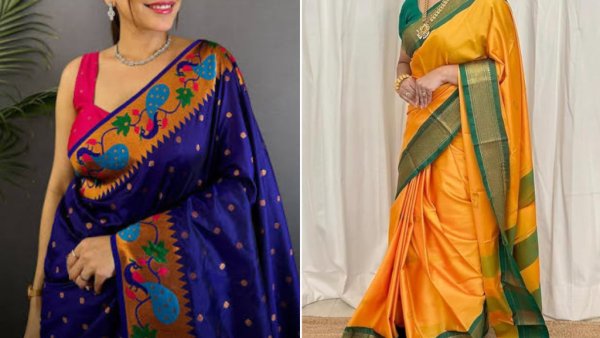
Considered as the grand garment of Maharashtra and the glory of the authentic Maratha culture, the Paithani saree is not just a garment but a rich historical heritage. A Marathi woman’s saaz is not complete without wearing paithani in any auspicious event or festival. But, there is an interesting history behind when this royal saree was invented and why the motif of the peacock is mainly woven on its layer.
1. Invention and History of Paithni Saree
The history of Paithni saree is more than 2000 years old. This weaving originated in the town of ‘Paithan’ (then Pratishthan) in Aurangabad (now Chhatrapati Sambhajinagar) district situated on the banks of river Godavari. During the Satavahana dynasty (2nd century BC to 2nd century AD) Paithani weaving got a real patronage and the art was discovered.
Viral Photo: ‘Dar Bhok…’ Paithani’s shorts go viral, rain of memes with the photo of ‘Bandekar Bhauji’
Paithan was a major trading center during that time. The artisans here used to weave extremely talam sarees using pure silk and gold and silver thread. These garments were so valuable and attractive that they were widely exported to countries like Rome, Greece and Egypt. Later, during the Peshwa period, Paithani got a big boost.
2. Why is there a peacock motif on the paithani?
Paithani saree says that what comes before the eyes is its richly woven layer and the peacocks swaying on it. There are some important reasons for having a peacock motif on the paithani:
After the wedding, the groom goes to the father-in-law! Children take their mother’s last name! Here in Meghalaya matriarchal system!
In course of time parrot (munia), lotus and tree motifs were also woven on paithani; But the ‘Peacock Paithani’ has remained the unique feature of this garment. Even today, Paithani maintains its golden legacy of historical tradition and holds the most honorable place in every woman’s closet.