
Meta’s latest WhatsApp feature has landed in a classic catch-22 situation. The company wants to enhance user privacy on the messaging platform by replacing phone numbers with usernames. But in India, the privacy layer is being viewed as a potential threat, as it can be easily violated by cyber criminals.
On June 29, 2026, Meta announced a phased global rollout of usernames, allowing users to reserve a unique handle beginning with an @ symbol and eventually communicate without sharing their phone numbers.
The company billed it as WhatsApp’s biggest identity overhaul since launch, arguing that usernames would reduce phone-number harvesting from group chats, limit exposure to SIM-swap attacks and give users greater control over who can contact them.
Within 48 hours, however, the Ministry of Electronics and Information Technology (MeitY) issued a notice directing Meta to suspend the rollout of the feature in India and explain, within three days, how it plans to mitigate the risks it could introduce.
According to the ministry, usernames “may materially increase the incidence of online fraud, phishing, digital arrest scams and impersonation attacks, by enabling bad actors to solicit and message victims”.
WhatsApp has been directed not to enable the feature for Indian users until the concerns are addressed.
As of July 2, the feature remains on hold in India even as users in select international markets have begun reserving usernames.
Meanwhile, as per a PTI report, the ministry has also sent similar notices to Telegram and Signal.
The Rationale Behind Assigning UsernamesEver since its inception, WhatsApp only operated on phone numbers. This made users vulnerable to losing their phone numbers and getting added to unknown groups.
With usernames, the WhatsApp gentry will now have a separate public identity. However, this does not make the mechanism susceptible to leaks either.
According to Anant Agrawal, the MD and CEO of Skillmine Technology Consulting, there are privacy benefits that come with the username rollout. Phone numbers themselves have become personally identifiable information routinely exposed through public groups and business interactions.
The feature also carries a broader strategic benefit for Meta. Several analysts see usernames as another step toward creating a common identity layer across WhatsApp, Instagram and Facebook, making it easier for the company to build a more integrated ecosystem for messaging, creators and businesses.
The Security QuestionWith more than 853.8 Mn users, India is WhatsApp’s largest market. Amid this, the government’s objections hold heft due to the country’s worsening cybercrime landscape.
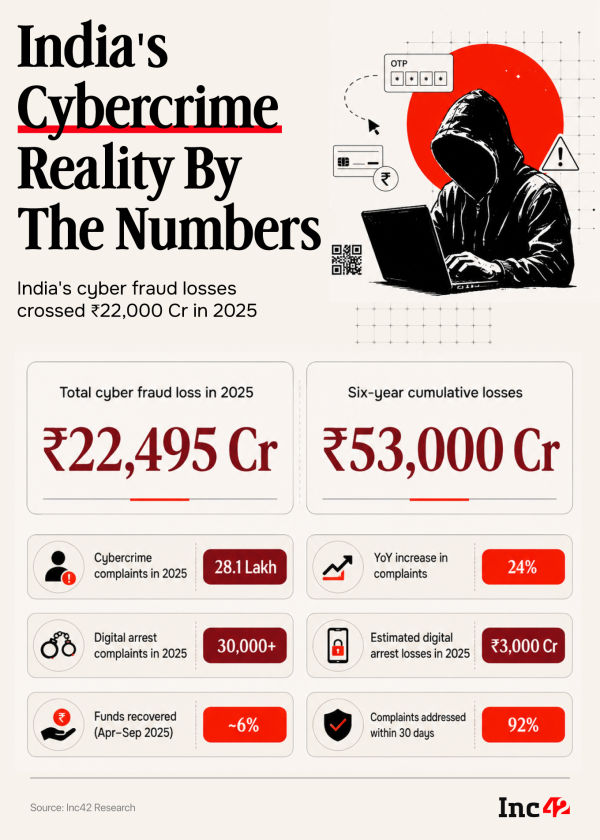
Indians lost an estimated ₹22,495 Cr (about $2.7 Bn) to cybercrime in 2025, while complaint volumes rose 24% year-on-year to nearly 2.81 Mn cases, according to data from the Ministry of Home Affairs. Cumulative losses over the past six years have crossed a total of ₹53,000 Cr.
“WhatsApp leads complaint volume among messaging platforms, largely because its chat layer sits right next to payment functionality (UPI, business account links, forwarded QR codes). When the messaging layer and the payment prompt exist in the same app, the entire fraud loop — comprising trust-building, pitch and payment — closes inside one environment, making the platform users vulnerable to cybercriminals, says Ankush Tiwari, CEO and founder of cybersecurity startup pi-labs.
Despite this, experts believe that a phone number still remains “the strongest form of identifier” because it uniquely identifies an individual in a way usernames do not.
“A phone number gives law enforcement a traceable identifier when a user is involved in fraud. That accountability becomes less straightforward if usernames replace visible phone numbers,” said Kaushal Bheda, the director of GovTech at cybersecurity firm Pelorus Technologies.
Malcolm Gomes, the COO at digital identity startup Privy by IDfy, believes usernames could open a broader gateway beyond investment scams.
“We see impersonation, recruitment scams, fake employers, and obviously financial frauds. WhatsApp is now used for business transactions, invoices, and receipts. Imagine suddenly getting a receipt or invoice asking you to complete a payment. How does someone know whether it’s genuine or not?” the COO said, adding that the shift is precisely what worries policymakers.
The government’s objections have also come at a time when there is an explosion of digital arrest scams in the country. More than 30,000 such complaints were filed in 2025 alone, while the Supreme Court estimated nationwide losses at nearly ₹3,000 Cr.
A decade ago, WhatsApp primarily carried personal conversations. Today, it has evolved into an infrastructure layer for businesses, customer support, payments, hiring and commerce, exposing netizens to more risks than ever before.
This makes us question: if fraudsters are already exploiting phone numbers, can restricting WhatsApp’s username move really protect users from abuse?
The post WhatsApp Username Debate: Will Hiding Phone Numbers Reduce Or Fuel Frauds? appeared first on Inc42 Media.