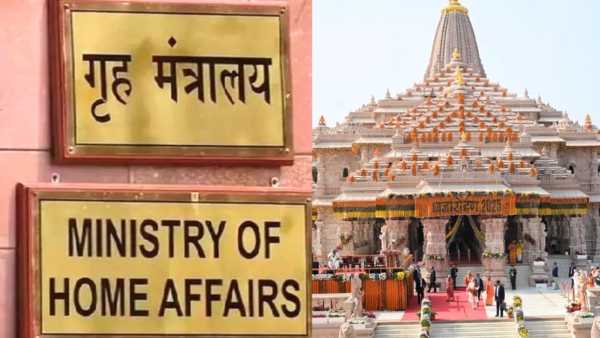
The Union Home Ministry had kept the government approved plan and the order related to the formation of Shri Ram Janmabhoomi Teerth Kshetra Trust in the confidential category. At the same time, the Central Information Commission, in an order of 2024, had justified the decision of not providing related documents under the RTI Act. The Commission had accepted the ministry's argument that their disclosure could pose a threat to the lives of the people concerned. This matter is related to the application filed by Neeraj Sharma under Right to Information (RTI).
He had requested to provide a certified copy of the plan related to Shri Ram Janmabhoomi Teerth Kshetra mentioned in the notification number CG-DL-E-05022020-215935 and approved by the Central Government through order number 71011/02/2019-AY dated February 5, 2020, and the government orders related to it.
After not receiving a satisfactory response from the Union Home Ministry, Neeraj Sharma approached the Commission with his appeal. During the hearing held in the Commission on June 18, 2024, the Home Ministry said that in view of the sensitivity of the scheme and all matters related to it, the entire collection of all documents etc. related to the formation of Shri Ram Janmabhoomi Teerth Kshetra has been kept in the confidential category.
In a notification issued by the government on February 5, 2020, it was said that the Center approved this scheme as per the order of the Supreme Court. It said, necessary provisions have been made in this plan for the functioning of the trust, which includes the management of the trust, rights of the trustees, construction of the temple and all necessary, incidental and supplementary matters related thereto.
During the hearing, the ministry argued that since the information sought is confidential and sensitive, disclosing it could put the lives of the persons concerned at risk. For this reason, information was refused under Section 8(1)(g) of the Right to Information (RTI) Act.
The Home Ministry also said that the Trust itself is an independent and autonomous organization/institution, with no financial, administrative or other interference from the Central or State Government and the Central Government became the founder of the Trust only in compliance with the Ayodhya verdict of the Supreme Court.
Accepting the arguments of the Ministry, the then Chief Information Commissioner Hiralal Samaria commented that the Information Officer had given a proper reply and there was no need for further interference of the Commission in this matter, after which the appeal was disposed of on June 18, 2024. In a separate order issued on June 4 last year, the CIC considered whether the Shri Ram Janmabhoomi Teerth Kshetra Trust qualifies as a public authority under Section 2(h) of the RTI Act.
The Home Ministry said that it is an independent trust, which is neither owned by the government, nor controlled or funded by the government. Neither the central nor the state government gave it any funds, and the role of the government was limited only to the formation of the trust, which was done as per the directions of the Supreme Court.
The trust, through its counsel, argued that it has neither been established nor constituted by any notification of the government, it does not receive any funds directly or indirectly from the government and, therefore, it is not a public authority under Section 2(h) of the RTI Act, 2005.
The Commission said in its decision that the trust was created as per the directions of the Supreme Court and it was created through a trust deed. The Commission said that the Trust was neither established or constituted by any notification of the Government nor was it a suo motu initiative taken by the Central Government but was formed in compliance with the direction of the Supreme Court.
The CIC said that the Commission is of the view that there is no concrete evidence to prove beyond reasonable doubt that the Trust is owned or controlled by, or is substantially funded by, any such entity, or that any NGO is directly or indirectly receiving significant funding from the concerned Government. Therefore the Trust cannot be given the status of a public authority.
It says that the Trust is an independent body, which does not receive any financial support or administrative control from either the Central Government or the State Government, and hence it will not come under the purview of the RTI Act.