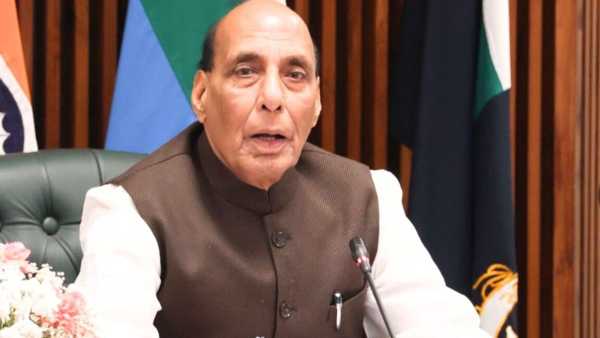
Addressing an event in New Delhi on Saturday, Defense Minister Rajnath Singh said, in the last 12 years, India's journey has moved from shortcomings to self-reliance, from self-reliance to self-confidence and from self-confidence to building a 'developed India'. He said that the government led by Prime Minister Narendra Modi in its first term removed the shortcomings, expanded opportunities and changed the work culture. In the second term, the government transformed expectations into achievements and firmly moved the country forward on the path of self-reliance.
He further said that the government in its third term is laying the strong foundation of 'Developed India' through the policy of 'Reform, Perform, Transform' and he is confident that in the fourth term the world will see the rise of a developed India.
Highlighting the key changes that have taken place in the country in the last 12 years, the Defense Minister said that when 'Make-in-India' was launched in 2014, some people called it a failure, but the scheme set new standards of success and continues to do so even today. He said that there has been a tremendous change in India's status in the world. Earlier the world did not pay much attention to our voice, but today it listens carefully to India's perspective on global issues.
He further said that despite initial skepticism about the 'India Semiconductor Mission' launched in 2021, the country produced its own semiconductor chips last year. This was possible due to the creation of semiconductor parks based on 'plug-and-play' infrastructure model.
Rajnath Singh further said that in the financial year (FY) 2025-26, the annual defense production reached an all-time high of Rs 1.78 lakh crore, which is three times more than the figure of FY 2014-15. He said that defense exports have today reached a record of more than Rs 38,000 crore, which was Rs 686 crore in the financial year 2013-14. This represents an increase of approximately 57 times and underlines the world's confidence in the 'Make-in-India' platform.
The Defense Minister also highlighted India's huge progress in the field of manufacturing and technology, mentioning mobile manufacturing, automobile exports, production of indigenous trains (locomotive) and expansion of digital infrastructure under 'Make-in-India'. Referring specifically to India's digital revolution, he said that in April there were 22.35 billion UPI transactions worth Rs 29 lakh crore and the scope of this facility is also expanding at the international level.
He also talked about the rapid implementation of 5G technology developed under 'Make-in-India' in the country and emphasized that efforts are also being made towards the development of 6G. Rajnath Singh further said that before 2014, corruption and leakages in the delivery of benefits of welfare schemes were generally considered inevitable, leading to benefits not reaching the beneficiaries.
He said that the government addressed this challenge through the 'JAM Trinity' (Direct Benefit Transfer, Jan Dhan, Aadhaar and Mobile Trinity), which made it possible to transfer Rs 51 lakh crore directly to the bank accounts of the beneficiaries and also prevented leakage of about Rs 4.3 lakh crore. He also highlighted the successful implementation of the Goods and Services Tax (GST) and said that despite initial concerns, it has emerged as a model of cooperative federalism by strengthening coordination between the Center and States/UTs.
The Defense Minister said that the removal of Article 370 in Jammu and Kashmir and the continuous efforts to end Naxalism are a great example of the government's resolve to resolve issues that were thought to be unsolvable. He also said that the government sees entrepreneurs as employment creators and wealth creators.
Initiatives such as 'public trust' reforms have improved the ease of doing business and contributed to India's progress towards becoming the world's third largest economy. He said, India has become the third largest start-up ecosystem in the world. In the last 12 years, the number of start-ups has increased from 500 to more than 2 lakh, and the number of unicorns has increased from four to 125.
Rajnath Singh stressed that India's culture is the foundation of its identity, unity and national consciousness, and along with preserving civilization, culture and heritage, attention has also been given to all-round development. He said that efforts are being made to revive India's cultural identity and restore the lost heritage.
For this, initiatives like Kashi Vishwanath Dham Corridor, Mahakal Lok and Maa Kamakhya Divya Lok Project have been taken. Besides, steps like establishment of 'Sengol' in Parliament, restoring the dignity of 'Vande Mataram', return of ancient artefacts and digitization of ancient manuscripts have also been taken.
Describing the role of media as more important than ever in the current era of 'communicative abundance', the Defense Minister said that the challenge today is not lack of information, but its accuracy and credibility. He said that 'Journalism' has also been affected by technological advancements like Artificial Intelligence (AI), but it will not be able to surpass human creativity and intelligence.
He said, the future success of journalism will depend on how well it creates a balance between the capabilities of AI and human sensitivity. While AI will make journalism faster and more accurate, emotional intelligence will ensure it remains human and trustworthy.
Rajnath Singh stressed that the real power of journalism is not just in spreading information, but in showing the right direction to the society, bringing out the truth and strengthening democracy. He said that wrong information has a negative impact on the morale of the society and defense forces. He further said that in journalism it may be important to give the news first, but spreading the right news is even more important.
He said that especially when the matter is related to defense forces, national security or honoring those who have made supreme sacrifice in the service of the country, then every word becomes a matter of national responsibility. Media should always maintain the values of accuracy, impartiality and neutrality.