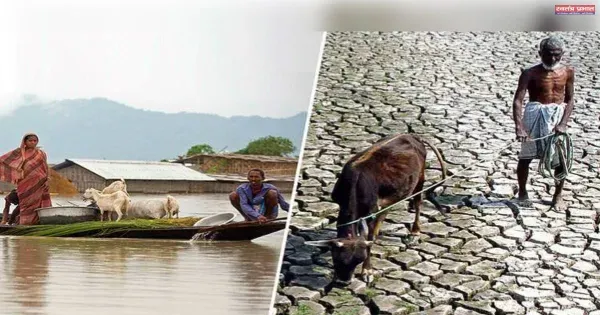
India is a geographically huge country. While on one hand we have world-class scientific institutions, weather forecasting systems, satellite technology, huge administrative machinery and a separate ministry for disaster management, on the other hand, extreme heat, drought, excessive rainfall and floods disrupt the lives of millions of people every year. When there is no shortage of resources, then why is there a lack of preparation and so much loss of life and property?
This problem was not limited to any one city, state or region. Many parts of Rajasthan, Madhya Pradesh, Chhattisgarh, Maharashtra and North India suffer from severe heat wave and drought, while in Assam, Bihar, Himachal Pradesh, Uttarakhand, Kerala and metropolitan cities, even a few hours of rain takes the form of floods. In recent days, cloud bursts and flash floods in Himachal Pradesh have caused massive damage to roads, bridges and villages. At the same time, severe heat and heat waves were also seen in many parts of the country.
This is not only a natural disaster, but is also a test of our development policy, administrative preparedness and long-term planning. When the Meteorological Department keeps issuing warnings of heavy rain, heat wave and cyclone several days in advance, then why is the local administration not able to make adequate preparations in time? Often relief work starts after the disaster occurs. If drainage arrangements, safe shelter, drinking water, medical teams and necessary materials are made available in advance, the loss of life and property can be significantly reduced.
The second big problem is our unplanned urbanization. Buildings were built by filling the ponds, drains and water catchment areas of the cities. There is encroachment on the natural course of rivers, as a result of which even a few hours of heavy rain submerges the cities. On the other hand, the same rain water does not get absorbed into the ground water and after a few months the same area starts facing water crisis. The irony is that the water which we consider a curse during floods, we yearn for every drop of the same water in summer. If large-scale rain water harvesting, small dams, pond rejuvenation, check dams and water conservation works are carried out continuously, then flood water can also become the nectar of the future.
Climate change has made the situation more serious. Scientists believe that now rainfall occurs more intensely in fewer days and the summer period is becoming longer and more intense. This is the reason why sometimes the temperature reaches 48 to 50 degrees Celsius and sometimes months’ worth of rainfall occurs within a few hours. Experts continue to warn that extreme weather events are becoming the new normal. Yet most of our planning is still made with the old weather cycle in mind. The drainage system of cities is decades old, water conservation works in rural areas are not sufficient and construction on river banks continues even today.
Disaster management does not just mean distributing relief material. Real disaster management is one in which risk is reduced before disaster occurs. In developed countries, special emphasis is given to early warning, community training, regular mock drills, modern communication system and quick decision system at the local level. In India too, there is a need to extend these systems to village and ward level. The accountability of governments is as important as that of society. It is also the duty of the citizens to save water sources, plant trees, not fill drains with plastic and garbage, adopt rain water harvesting and conserve local water bodies. Only if society and government work together, a permanent solution is possible.
Experts also repeatedly say that a separate climate adaptation plan should be prepared for every district. Water conservation and drought-resistant farming should be promoted in areas where drought occurs more frequently, while permanent arrangements for river management, scientific maintenance of embankments, drainage and safe rehabilitation should be made in flood-affected areas. In recent years, it has also become clear that merely increasing the relief fund will not solve the problem. There is a need for a development policy in which roads, bridges, buildings, colonies and industrial areas are built keeping in mind the risks of climate change. Hospitals, schools, electricity systems and communication systems should also be disaster tolerant.
Ultimately the question is not of resources, but of vision, will and effective implementation. If we keep only assessing the losses after floods and droughts every year, this crisis will worsen in the years to come. But if we make water conservation, environmental protection, scientific planning, local participation and pre-preparedness a national priority from today, then the magnitude of disasters can be reduced to a great extent. Nature is warning us every year. Now we have to decide whether we want to become a nation that only distributes relief or a visionary nation that prepares before disasters. This is the biggest call of the times.
Sanjeev Thakur