Bentley has officially announced that its first fully electric car will be called the Torcal. Scheduled for its grand unveiling on 23 September in London, the new model will be a luxury SUV focused on everyday usability while introducing a bold new design direction for the brand’s future lineup.
The Torcal, currently in the final phase of testing, will serve as a production-ready evolution of the EXP 15 concept that Bentley showcased last year. This concept was designed to preview the marque’s upcoming design language for its next generation of cars.
In keeping with Bentley’s tradition of naming its vehicles after natural landmarks—such as the Bentayga, Bacalar, and Batur—the new SUV takes its name from El Torcal de Antequera, a striking limestone rock formation in Andalusia, Spain. The name also references the Latin word ‘torquere,’ meaning ‘to twist,’ which is the root of the word ‘torque.’
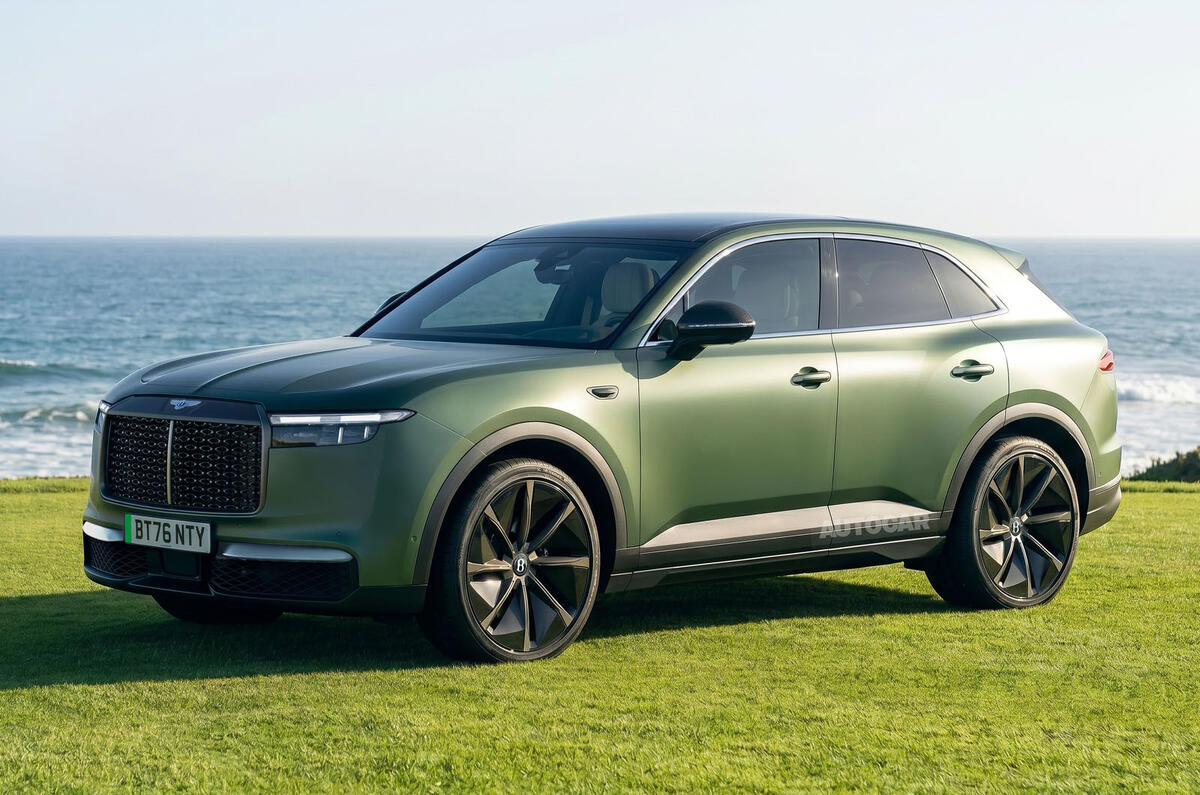
Measuring around 5 metres in length, the Torcal will sit just below the Bentayga in Bentley’s SUV portfolio. Key design elements, inspired by the EXP 15 concept, include a distinctive illuminated grille, vertically stacked LED quad headlamps, and a unique ‘prestigious shield’ rear design reminiscent of the luggage carriers seen on vintage Bentley tourers.
Although its silhouette is similar to that of the Bentayga, the Torcal carries an entirely fresh design identity. It is not a replacement for the V8-powered Bentayga, which will continue in production and receive a new combustion-engine generation in 2028, aligning with Bentley’s multi-powertrain global strategy.
Originally intended to launch last year, the Torcal’s debut was delayed due to slower-than-expected demand for electric luxury vehicles. Bentley has since revised its plans to transition fully to electric mobility by 2030. Instead, the company will now introduce one new plug-in hybrid or pure-electric model each year through 2035.
This approach mirrors that of other luxury carmakers such as Aston Martin, Porsche, Lotus, and Lamborghini, who have also adjusted their EV rollout timelines. Despite this, Bentley will still be among the first in its segment to bring an electric SUV to market at this level.
The Torcal is expected to go on sale from approximately £170,000, positioning it between premium EVs like the BMW iX and Volvo EX90, and ultra-luxury models such as the Rolls-Royce Spectre and Ferrari Luce. Its chief competitor will likely be the upcoming electric Range Rover. Bentley maintains that this is the right time to introduce its first EV, describing the Torcal as “the right car in the right environment more of the time,” with everyday practicality being one of its standout features.
Bentley has confirmed that the Torcal will offer a driving range exceeding 300 miles. Robin Page, Bentley’s Director of Design, previously remarked that the company does not intend to chase record-breaking range figures. “We’re finding that there’s a sweet spot in terms of range. Our customers are basically telling us that 300-350 miles is that sweet spot. Beyond that, they’ll use the private jet,” he explained.
Under the skin, the Torcal will share its platform with the Porsche Cayenne Electric, similar to how the Bentayga is related to the petrol-powered Cayenne. The Torcal will be built on the same PPE (Premium Platform Electric) architecture used by Porsche, drawing power from a 113kWh battery capable of charging at up to 390kW. In the Cayenne, this setup enables a 10-80% charge in under 16 minutes. The Torcal is expected to feature a dual-motor configuration as standard, though Bentley has not confirmed whether it will match the Cayenne Turbo’s 1140bhp and 1106lb ft outputs. A performance level closer to the 657bhp Cayenne S seems more consistent with Bentley’s refined positioning.
Inside, Bentley has yet to fully unveil the cabin design, but spy photos suggest it will incorporate a curved, portrait-oriented central touchscreen similar to the Cayenne’s setup. The 14.25-inch display will be divided into two sections—infotainment at the top and climate controls below—marking the largest screen ever fitted in a Bentley. However, the brand is unlikely to go fully digital in its interior design approach.
The interior philosophy will remain true to Bentley’s emphasis on tactile luxury. The EXP 15 concept demonstrated the company’s renewed focus on high-quality physical controls, catering to customers who prefer a more analogue experience. “What we’re finding, especially at our end of the market, is that people are a bit bored with full-digital screens,” Page noted, adding that Bentley’s appeal lies in “maintaining a high level of mechanical craftsmanship that others can’t replicate.”
Additional details about the Torcal will be released in the weeks leading up to its September premiere. The launch will coincide closely with the debut of the electric Range Rover and precede Jaguar’s long-awaited Type 01 GT reveal—marking a significant milestone for the UK’s automotive industry, which will see its number of series-production EVs increase from two to five.
One of the key questions still surrounding the Torcal is how Bentley will recreate the emotional soundtrack of its renowned V8 and W12 engines in a silent electric powertrain. CEO Frank-Steffan Walliser has hinted that the brand is exploring ways to incorporate a powertrain sound that reflects Bentley’s heritage, describing the marque’s cars as defined by “a soundtrack with soul” and promising that the new EV will set “extraordinary benchmarks in every area that matters.”
While other performance manufacturers such as Hyundai’s N division, Mercedes-AMG, and Porsche have developed synthetic engine sounds for their EVs, Bentley is expected to take a more authentic approach. The company could adopt a method similar to Ferrari’s, whose Luce amplifies natural motor frequencies through speakers to deliver a sound that feels entirely genuine.