First Electricity Supply History: Electricity is a basic necessity today, but there was a time when even the British were astonished by its presence. Let's explore the story of the first electricity supply in India.

Where did electricity first appear in India?
In today's digital age, living without electricity is unimaginable. Conveniences like refrigerators, air conditioners, and washing machines have made our daily tasks much easier. However, there was a time when the whole of India relied on lanterns, torches, and kerosene lamps to fight the darkness after sunset. During British rule, when the electric bulb first shone on our soil, it was nothing short of magical for the common people. The story of electricity's arrival in India is fascinating; let's learn about it.
Where did electricity first come to India?
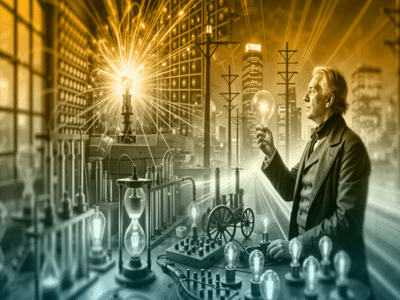
It was the year 1879, when the country's first electric light shone in Calcutta (now Kolkata), the capital of British India. On July 24, 1879, P.W. Fleury & Co. performed the city's first electrical demonstration before the city's citizens. When, without fire, oil, or wick, a glass sphere emitted a sun-like radiant light, even the onlookers were astonished. For the simple Indians of that era, it was a unique magic of the British. The curiosity was so intense that people came from miles around to witness this new technology.
Where was the country's first electric bulb lit?
Just two years after the public demonstration of electricity, in 1881, commercial and industrial use of electricity began in India. Calcutta's famous Mackinnon & Mackenzie Cotton Mill became the first historic building in the country to be fully lit with an electric bulb. With the advent of electricity, the mill's massive machinery began to operate even in the dark of night, relying on artificial light. This single change forever altered the course of India's industrial history, as it now became possible to work night shifts in factories.
Why was Calcutta chosen first for electricity?
Now the question arises: why did the British choose Calcutta over larger cities like Delhi or Bombay? At that time, Calcutta was the largest political, administrative, and commercial hub of the British Empire. To further their economic and commercial interests, the British first invested here. Following the success of this mill, Bombay's Coford Market was also illuminated with electric lights in 1882. Subsequently, in 1889, Calcutta's Harrison Road (now Mahatma Gandhi Road) became the first road in the country to be illuminated with electric poles and streetlights.
Where was the country's first thermal power station built?
As the demand for electricity grew, the British began establishing power generation plants in India. In 1897, the foundation stone of India's first hydroelectric power station was laid at Sidrapong near Darjeeling, illuminating the hilly regions. Just two years later, in 1899, the country's first thermal power station was established in Calcutta, generating electricity on a large scale. The construction of these power stations accelerated the development of India's electricity infrastructure.
Which is the first 100% electrified city in India?
Electricity had opened in offices and mills across the country, but it hadn't yet reached the homes of the general public. Karnataka's Kolar Gold Fields (KGF) won the race. In 1902, the township established within KGF to house workers and officials was the first in the country to provide electricity to every household. This made KGF the first city in India to have 100% electricity. Subsequently, in 1905, Bengaluru became the first city in Asia to illuminate its streets with streetlights, thanks to the Shivanasamudra Hydroelectric Power Station.
Electricity was an expensive luxury for the common people.
In the early days, electricity bills and their costs were so high that they were beyond the reach of the common man. With the exception of KGF, this dazzling light was confined to the mansions of British officers, Viceroys, wealthy industrialists, and the palaces of kings and princes. At that time, paying electricity bills was simply unaffordable for the general public, as even the minimum charge was a few rupees, which was more than the average monthly income of the time. TTherefore, it took a long time for electricity to reach the homes of ordinary villagers and poor families across the country.