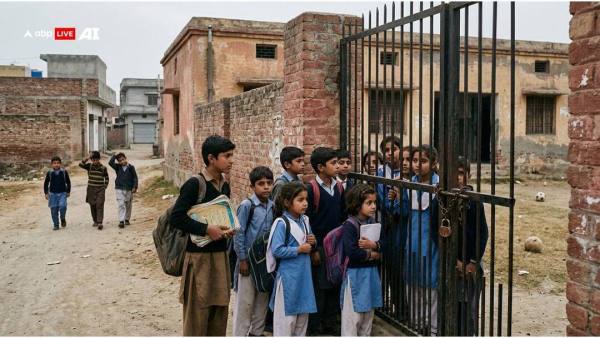
More than 25 million school-age children in Pakistan are still outside the formal education system, even though the government declared a National Education Emergency more than two years ago. A new policy review has highlighted significant shortcomings in the implementation of education reforms, pointing to governance issues, inadequate funding and weak institutional coordination as the main reasons for the continued crisis, according to Geo News.
The review, prepared by the Civil Services Academy (CSA), suggests that Pakistan's education challenges are no longer caused by a lack of planning. Instead, it says poor execution of policies, fragmented administration and ineffective coordination between federal and provincial authorities have slowed progress despite several government initiatives.
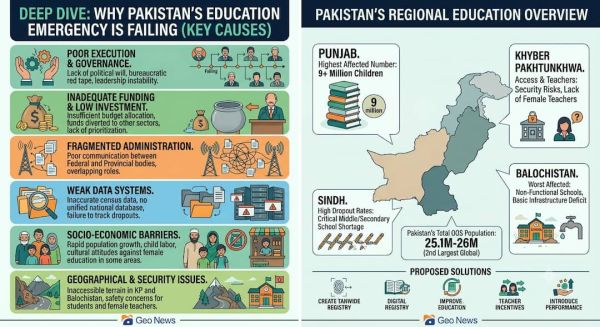
According to the CSA review, an estimated 25.1 million to 26 million children are currently out of school, making Pakistan home to the world's second-largest out-of-school population.
The report notes that provinces have introduced education roadmaps under the National Education Action Plan 2026. However, these plans have not produced the intended results because of governance challenges and widening gaps between policy announcements and implementation.
The findings indicate that while education reforms have been announced over the years, many have failed to bring measurable improvements at the ground level.
The report highlights major regional disparities across Pakistan.
Punjab has the largest number of out-of-school children, with more than nine million affected. In Sindh, a shortage of middle and secondary schools has contributed to high dropout rates among students.
Meanwhile, Khyber Pakhtunkhwa continues to face obstacles including security concerns, difficult terrain and an inadequate number of female teachers, particularly in remote areas.
The situation is described as most severe in Balochistan, where thousands of schools remain non-functional. Many institutions also lack basic facilities such as electricity, sanitation, and essential infrastructure, creating additional barriers to education.
The CSA review attributes the education crisis to a combination of long-term structural issues, including decades of underinvestment, rapid population growth, poverty, and child labour. These factors have gradually pushed millions of children out of the classroom.
The report also points to weaknesses in Pakistan's education data systems. According to the review, the absence of a unified national student database has made it difficult for authorities to accurately monitor enrolment figures and identify students who have dropped out of school.
To address these concerns, the review recommends establishing a nationwide student registry linked to Nadra records, expanding double-shift schooling, strengthening non-formal education programmes, providing greater incentives for female teachers in underserved areas and introducing performance-based funding for education.
According to Geo News, education experts cited in the report argued that successive governments have repeatedly declared education emergencies without providing the financial resources and institutional support needed to bring lasting improvements.