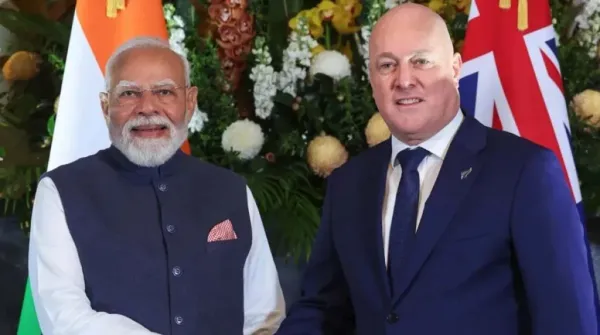
A new chapter in relations between India and New Zealand has started. After the meeting between Prime Minister Narendra Modi and New Zealand Prime Minister Christopher Luxon, both the countries have given the status of ‘Strategic Partnership’ to their bilateral relations. This is the first visit of an Indian Prime Minister to New Zealand in almost 40 years, which is considered very important for the future of both the countries. Both the countries have jointly approved ‘India-New Zealand Strategic Partnership: Roadmap 2030’, under which important sectors like trade, agriculture, security and tourism will be given new heights in the next four years.
Both the countries have prepared to take a big leap on the economic front. India and New Zealand have set a target of increasing their total trade in goods and services to 7 billion New Zealand dollars i.e. about ₹ 35,000 crore by 2030. This agreement will not only open new avenues of investment, but will also give an opportunity to the companies of both the countries to strengthen their hold in each other’s market. Along with this, it has also been agreed to implement a Free Trade Agreement (FTA) as soon as possible, which will make import-export even simpler by eliminating all the barriers to trade.
In this new partnership, special attention has been given to agriculture and dairy sector. New Zealand, known for its advanced agricultural technology, will now provide technical assistance to India in horticulture, forestry and animal husbandry. New Zealand will cooperate to improve the production of kiwi fruit, apples and honey in particular. Not only this, ‘Kiwi Fruit Center of Excellence’ will be established in India. Even in the dairy sector, the new cooperation agreement between the two countries can prove to be a game-changer for Indian farmers and livestock farmers.
Both the countries have signed an important agreement to promote tourism and people-to-people ties. The government will now encourage airlines to start direct non-stop flights between India and New Zealand. If this initiative is successful, travel time will be reduced and this will directly benefit education, tourism and trade relationships. On the other hand, customs and maritime cooperation is also being strengthened. Under the ‘Authorized Economic Operator’ (AEO-MRA) agreement, custom clearance of trusted companies will now be done in a jiffy, and will also open new doors to international careers for Indian seafarers.