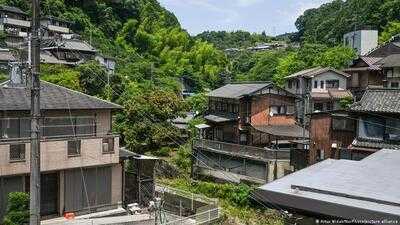
Many Japanese people are reluctant to buy or rent homes where a sudden or violent death has occurred. To reassure prospective buyers and tenants, property owners are calling in "ghost investigators."The two-story house in a southern suburb of Yokohama has seen better days. The metal shutters are permanently drawn over the downstairs windows, the sliding paper window covers upstairs are in tatters, and the garden is overgrown. With a bit of effort and money, however, the property could be renovated into a perfectly habitable home once more. But no Japanese wants this house. It is marked as "jiko bukken," which translates as a "stigmatized property," and it has stood empty for at least five years. Something bad happened here, possibly a suicide, a fire that claimed a life or an elderly person died, what the Japanese refer to as a "lonely death." Murder is another obvious reason for a property to be shunned. Kazutoshi Kodama, president of specialist property Kachimode Co., believes "jiko bukken" are a financial drain on owners and, for him, a business opportunity. Set up in December 2022, Kachimode "assists owners or properties with a history of incidents with the management of their rental properties." Part of this service is a comprehensive "ghost investigation," he said. And far from being dismissed, demand for the service is soaring, he added. 'Japanese see death as impure' "Japanese people sometimes regard death as impure," Kodama told DW. "Death equates to impurity and misfortune. Consequently, they believe that coming into close contact with death will bring them misfortune," he said, adding: "And that means quite a lot of Japanese are reluctant to go near such properties, let alone rent or buy one." Renting or selling a "jiko bukken" is made harder by the legal requirement on any estate agent to reveal a property's history to any interested parties, while a website has been set up that reveals the location of every stigmatized property in the country and the reason they are on the blacklist. Most listings indicate accidental fires, lonely deaths or suicide, but some offer a more ominous note: "Obtain details from real estate agent." In a big city with high rental demand, the owner of a stigmatized property will have to cut the rent by 30%, Kodama said, while elsewhere it will be cut in half. "And there are some properties which, although advertising for tenants, remain vacant as long as 500 days," he said. "I am aware of a property that remained vacant for over 1,000 days. In short, they simply become vacant properties and the concept of a price reduction just does not apply." Some renters, however, are mollified after Kachimode has "cleansed" a property beyond replacing carpets, fittings and wallpaper. "My company carries out what we call 'ghost investigation,'" he said. "We stay in rooms where incidents have occurred from 10 p.m. until 6 a.m. the following morning, conducting video recording, audio recording, electromagnetic wave surveys, measurements of room temperature, humidity and atmospheric pressure, thermography and noise surveys. "The aim is to verify that rooms where people have died have been thoroughly refurbished and are now clean, and to prove that poltergeist phenomena, the presence of ghosts and other mysterious occurrences do not occur," he said. Removing the 'bad spirits' Kachimode's service is unique in Japan, and he works with a university professor who specializes in monitoring the supernatural. An overnight stay costs 88,000 yen (€474, $542), after which a comprehensive report is provided to the owner, which the real estate agent can use to support the assertion that there are no lingering "bad spirits." Kodama said his equipment has, on occasions, picked up anomalies, with video cameras stopping recording and microphones malfunctioning. "That said, in the vast majority of cases, what was perceived as an 'impurity' could not be replicated and was dismissed as a one-off occurrence," he said. "However, there are also properties where various mysterious phenomena occur consistently over a long period of more than a year." Joey Stockerman is one of the founders of Akiya Mart, which promotes the sale of a growing number of empty properties around Japan, particularly in rural parts of the country that are experiencing rapid population decline. "There are a lot of empty properties across Japan and even, surprisingly, in city centers," he told DW. "There are lots of reasons — families disagreeing over how to dispose of a property or they just don't think it is worth selling — but there are a lot of stigmatized properties as well." According to a government survey in late 2024, there were nine million vacant homes across Japan, accounting for 13.8% of all the accommodation in the country. While there are many reasons for this high number of empty homes, superstition also contributes to the problem. "Japanese people are often very superstitious," Stockerman said. "Renting places where someone has died can be really hard, and they do not want properties that are close to graveyards either as there are strong feelings here about death." A challenging investment One of Stockerman's business acquaintances took a chance on buying a stigmatized property in a Tokyo suburb, he said, snapping it up as an investment opportunity for less than $5,000, or about 5% of its true value. The investment did not pan out as he had anticipated, however, as the real estate agent refused to gloss over its history, meaning that it remained empty for two years before he found a tenant. Aware of the sensibilities of property buyers in Japan, Akiya Mart has recently introduced a package whereby a Shinto priest from a nearby temple will visit to carry out a service to "cleanse" a property of any bad spirits. "It's a bit quirky, but there has been interest," Stockerman said. In the real estate business for more than 15 years, Kodama also believes that ridding a home of its unpleasant past will be a growth industry. "Properties where we do find mysterious phenomena are the ones that are typically shunned," he said. "They are difficult to let or sell. But there are still ways to manage even these properties, and we work with owners to do that. "I think this sector has potential," he added. "Because there are people in need." Edited by: Srinivas Mazumdaru