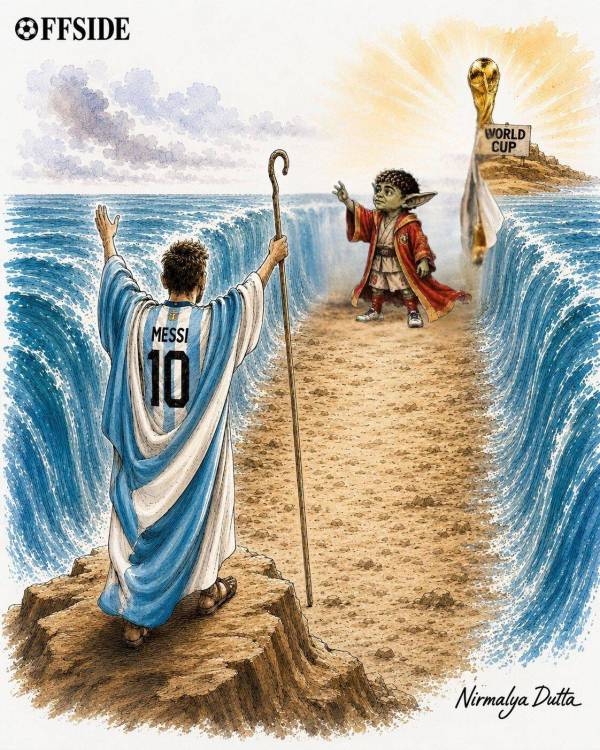
OFFSIDE | The Baptism of Yamal by 'Saint' Messi: The 19-year-old photograph that became World Cup final's origin story
The Times Of India July 18, 2026 02:39 AM
 Comic-book readers are familiar with the concept of origin stories. Iron Man wouldn’t have become Iron Man if he hadn’t been kidnapped in Afghanistan. Peter Parker might have become a wrestler if he hadn’t lost Uncle Ben. Superman might have become a Nietzschean, god-killing Übermensch if he hadn’t been raised by the Kents in Kansas. And yet, all of those origin stories pale in comparison with the real one behind Sunday’s World Cup final, which began in the away dressing room at Barcelona’s Camp Nou.
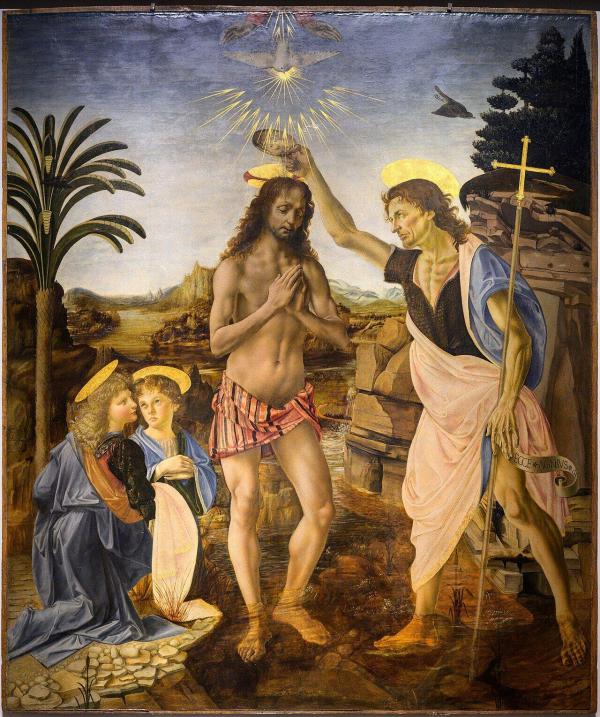
The Baptism of Christ, painted by Italian master Andrea del Verrocchio and his young apprentice Leonardo da Vinci, is considered a benchmark in its genre. Its footballing equivalent is a picture by Joan Monfort that could be titled
The Baptism of Baby Yamal by Saint Messi. Taken in 2007, the photograph has become the unlikely viral image of the two protagonists of Sunday’s World Cup final in New Jersey.
Yamal is 19, Messi is 39, and the 20-year age gap makes Alcaraz and Sinner seem like Novak Djokovic’s peers. But how did that picture come about?
Yamal’s parents entered a raffle run as part of an , through which a child would be paired with a Barcelona first-team player for a professional photoshoot. Yamal was paired with Messi entirely by chance. The rest, as they say, is history.
Monfort, who took the iconic pictures, told BBC Sport he was unaware of the infant’s identity until a friend contacted him after Yamal’s father posted the picture during Euro 2024. That was the tournament in which the 16-year-old Yamal, so young that his presence on the pitch challenged Germany’s strict labour laws for minors, helped Spain become European champions. Monfort remembered Messi as extremely introverted and Yamal as a cheerful, smiling baby. Echoing Messi’s later-career evolution from marauding winger to deep-lying playmaker, the photographer recalled how quickly he adjusted to the unfamiliar situation.
Made in La Masia
The footballing ideas that produced Messi, Yamal and many of the game’s greatest practitioners were conceived in football’s most famous coaching laboratory: La Masia. In English, La Masia means “The Farmhouse”, referring to an old Catalan farmhouse built in 1702 where Barcelona housed young players between 1979 and 2011.
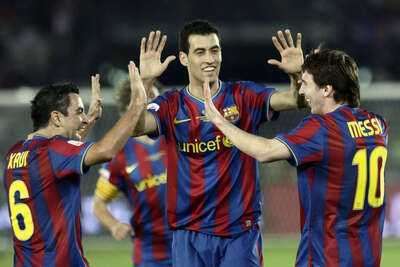
In 2010, : Messi, Xavi and Andrés Iniesta. Spain won their sole World Cup that same year with seven Barcelona players in the starting XI for the final, six of whom were La Masia graduates.
The old farmhouse stopped housing players in 2011, when its residents moved into a considerably swankier academy. By then, however, La Masia had become an idea: the DNA of Barcelona’s identity and shorthand for the club’s tradition of identifying, educating and promoting technically gifted footballers.
Yamal also represents Barcelona’s return to La Masia, accelerated after years of reckless spending left the club : nine academy graduates are in the two World Cup final squads, eight with Spain and Messi with Argentina.
The goal was never to create another Messi, Yamal, Xavi or Iniesta. They were all taught a common footballing tradition: receiving the ball, scanning the field, finding gaps, creating angles, maintaining width and understanding the importance of space.
The Dutch idea
The idea behind La Masia is, surprisingly, a term familiar to anyone who has watched
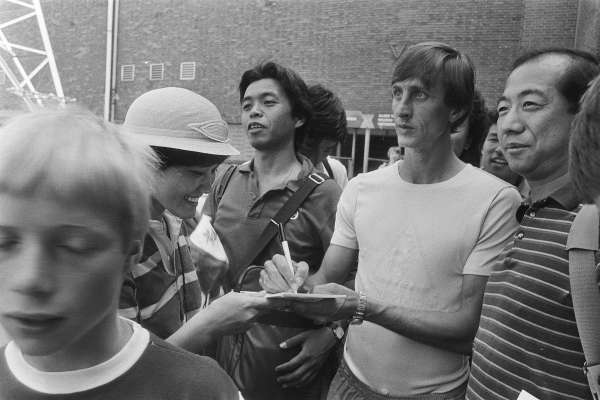
Ted Lasso: . It was brought to Barcelona from Ajax by Rinus Michels, who was followed two years later by its greatest practitioner, Johan Cruyff.
The central principle of Total Football is simple: players interchange positions while the team preserves its structure, requiring every footballer to understand several different functions.
When Cruyff returned as manager in 1988, his Dream Team won four successive league titles and Barcelona’s first European Cup in 1992. The Cruyff philosophy held that technical intelligence could overcome brute force. Under him, the academy increasingly selected players for their understanding of specific functions rather than simply choosing the biggest or fastest children.
One of those who came through was a young midfielder named Pep Guardiola, who famously compared Cruyff’s legacy to a painted chapel that subsequent Barcelona coaches could merely restore or improve. Guardiola would eventually turn those ideas into the perfect sporting USP for sportswashing authoritarian regimes.
‘Coaching’s greatest seminar’
If Cruyff was the dreamer, Van Gaal was the executor, once provoking hilarity by suggesting that Barcelona could win the Champions League with 11 home-grown players. Van Gaal was the bludgeon to Cruyff’s scimitar.
He also believed in Total Football, although his version came with total obedience. Cruyff wanted freedom; Van Gaal demanded discipline. His first Barcelona spell produced two league titles and a Copa del Rey, while also creating what the
Guardian called the “greatest coaching seminar ever”.
Those who attended included Pep Guardiola, Luis Enrique, Phillip Cocu, Frank de Boer, Xavi and Carles Puyol. Years later, Xavi would return as Barcelona manager and elevate Yamal to the first team.
before being retained by his successor, Louis van Gaal.
In his own way, Van Gaal occupied the middle ground between the Cruyff ideal and its later mutations. Guardiola became its purest proponent, eventually turning it into sporting propaganda for authoritarian regimes, while Mourinho became its harshest antithesis.
Going local and global
Football academies usually have a similar task: find players who can eventually be elevated to the first team. La Masia, like France’s Clairefontaine or Manchester United’s Carrington, developed more imperial ambitions and became something much larger.
It formed Barcelona’s first-team spine through a decade of dominance after 2008, supplied Spain with the core of the side that won the 2010 World Cup and became the default lingua franca of world football through its diaspora of players, coaches and executives, with Guardiola its most famous export.
Its influence was most visible between 2008 and 2012, when Guardiola promoted Sergio Busquets and Pedro to the first team, brought Gerard Piqué back from Manchester United and placed Xavi and Iniesta in the middle of the park.
In 2000, Van Gaal was roundly ridiculed for dreaming of winning the Champions League with 11 home-grown players. Almost a decade later, Barcelona dismantled Sir Alex Ferguson’s Manchester United, the reigning European champions, whose ranks included Cristiano Ronaldo, Wayne Rooney, Carlos Tevez, Paul Scholes, Ryan Giggs and Michael Carrick, making them resemble a Sunday league team playing through a hangover.
Spain would then win the World Cup with six La Masia graduates in their starting XI for the final. Guardiola’s travels subsequently took positional play to Bayern Munich and Manchester City. At City, former Barcelona executives helped construct a similar footballing operation that eventually extended beyond the first team and became part of the wider City Football Group.
As Luca Toni would later joke, while telling at least half the truth, Guardiola had changed the game so completely that there was no longer any room for old-fashioned, out-and-out strikers.
La Masia also produced some of the philosophy’s greatest opponents.
There is , although his haram-ball tactics might sometimes feel like La Masia blasphemy. Then there is its greatest apostate: the Special One, cast out from Barcelona heaven before spending his career trying to destroy Total Football.
, when his Inter Milan side eliminated Barcelona. In the second leg, Inter survived for more than an hour with 10 men and just 14 per cent possession, using a rotating defensive cage around Messi and preventing him from receiving freely between the lines.
Finding Messi and Yamal
So how does La Masia find players like that? For Messi and Yamal, the answers were very different.
Messi was playing for Newell’s Old Boys in Rosario when he was diagnosed with growth hormone deficiency at around the age of 10. The condition required regular injections that were too expensive for his parents to sustain.
Messi was brought to Barcelona for a trial at 13, where he gave older defenders the runaround. Even then, the club hesitated over the cost of bringing in a non-European child whose recruitment would involve expensive medical treatment and relocating his family.
Eventually, Barcelona technical secretary Carles Rexach agreed to sign him, . Messi arrived in 2001 as a painfully shy youngster whose treatment Barcelona had agreed to help finance.
Yamal also came from limited means and began playing for a local club. His parents were working-class immigrants from Morocco and Equatorial Guinea, and he grew up between Rocafonda and Granollers.
His full name is Lamine Yamal Nasraoui Ebana, with Lamine Yamal serving as his compound given name. He was during a financially difficult period before his birth. Barcelona scout Isidre Gil spotted him while he was playing for CF La Torreta. Yamal arrived for his Barcelona trial without football boots and .
Years later, manager Xavi invited him to train with the first team. On April 29, 2023, Yamal became Barcelona’s youngest first-team player when he made his debut at the age of 15 years, nine months and 16 days.
Yamal versus Messi at 19
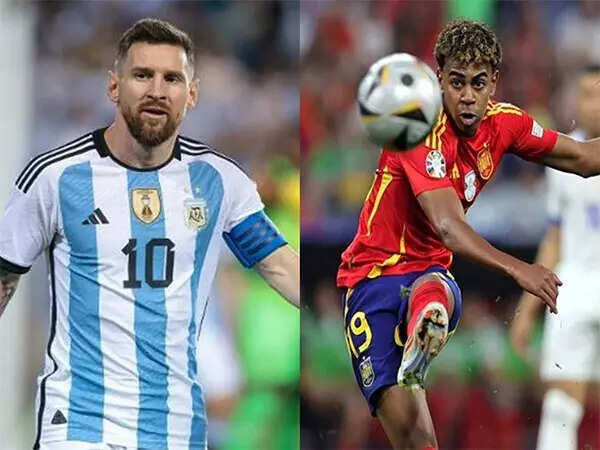
While the obvious analogies have been drawn between them, Messi and Yamal are very different players. There is also a fundamental difference between the Barcelona teams they entered. As , Messi had Ronaldinho to look up to as Barcelona’s main man, whereas Yamal entered Barcelona and Spain as the main man himself.
Ronaldinho was a man who put the beautiful in the Beautiful Game and perhaps could have entered the same historical conversation as Messi with a little less
joie de vivre and considerably more discipline. Alongside him was Samuel Eto’o, one of the most complete and ferocious strikers of his generation.
Messi could develop as the precocious junior member of an established attack. Yamal, by contrast, was asked to become Barcelona’s principal attacking reference within little more than a season.
At 19, Yamal has already played 149 official matches and scored 49 goals. Messi had made only 34 appearances and scored nine times at exactly the same age. The difference in their development had .
Even at 19, it was evident that Messi would become more of a goalscorer than a winger, eventually developing into the false-nine role.
Teenage Messi used the right wing as a runway towards goal, cutting inside with explosive acceleration, close control and the first instinct to score. Defenders knew what he wanted to do and still had no idea how to stop him.
Yamal holds the width for longer, slows defenders down and uses his dribbling to create crosses, through-balls and space for teammates. Messi manipulated defenders through speed and penetration; Yamal manipulates them through hesitation, positioning and the threat of the final pass.
Of course, no longer plays like that. In the , however, he shifted towards the right and assisted both of Argentina’s goals.
Yamal’s contributions at this World Cup have been less dramatic statistically, although he has remained instrumental to Spain’s overall play. In the , it was his run that won the penalty from which La Roja opened the scoring.
The first and last dance
For Lionel Messi , this is almost certainly the last dance, his final opportunity to win back-to-back World Cups. For Yamal, it is the first of what should be several attempts, although Spain have a habit of disappearing into the wilderness after winning.
For Joan Monfort, as for many of us who love football even if we do not wear Barcelona’s or Spain’s colours, it is an almost impossible choice.
“I think we are closing the cycle of their story,” Monfort told BBC Sport. “It is a happy end. My heart is breaking in two pieces.”
Like the man who captured football’s most serendipitous photograph, we now face a heartbreaking choice as we wait to discover who triumphs in this immortal meeting: the happy, smiling baby or the ageless, angelic young man who was holding him.