Many of us only see wind turbines from a distance. They look like massive, graceful pinwheels, slowly sweeping in an arc that’s almost hypnotic. Up close, however, the scale of these giants is revealed. A typical turbine on land stands at about 300 feet, which is the same size as the Statue of Liberty (including its base). When the tip of a blade hits its peak, some of the largest land turbines can be over 600 feet tall, including the blade. And the average diameter of those spinning blades is longer than a football field at more than 430 feet wide! Naturally, something that big does not operate noiselessly.
Wind turbines generate different types of sound, including broadband sound that is similar to white noise; tonal sound from the generators and other mechanical parts; and infrasonic sound. You’ve probably heard the term ultrasound, but you may not be familiar with infrasound. This low-frequency sound wave sits below 20 Hz, which is under the threshold of human hearing. We may not be able to hear sound at this level, but we can sometimes feel it and it may cause structural issues like vibrating windows.
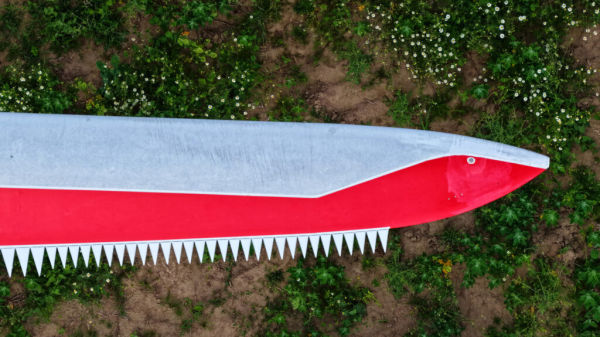
If you’re ever looking at a wind turbine and noticed that the blades have serrated edges, it actually has to do with this noise. These jagged edges help reduce wind turbine noise and allow the turbine to operate at peak efficiency all day, even at night when other turbines are forced to operate in noise-reduction mode. Here’s how it works.
The science behind these jagged-edged blades

In order to make wind turbines more quiet, you first have to understand how that deep whooshing sound is generated. Essentially, the noise happens when air hits the blade’s edges. When that edge is smooth, eddies, or pockets of air, form in a cohesive band across the span of the blade. When those eddies meet the sharp edge of the blade, they scatter and make that whooshing sound we’re all familiar with.
To disrupt that sound, scientists installed serrated edges that disrupt those air pockets. This causes the eddies to hit the trailing edge at different points and at different times, breaking up and weakening the sound. The science has been lab-tested and proven, and we also see this phenomenon happen in nature. Some owl species have wings with serrated edges, for example, and owls are known for their virtually silent flight.
A company called SMART Bladewhich has developed trailing edge serration solutions for wind turbines, says that their serrations reduce the overall sound level by up to 3dB. Researchers are also developing other ways to reduce wind turbine noise, like soundproofing gearboxes and generators with buffer pads. It’s important work, as sound pollution from wind turbines affects humans and may also have a detrimental effect on some animals as well.