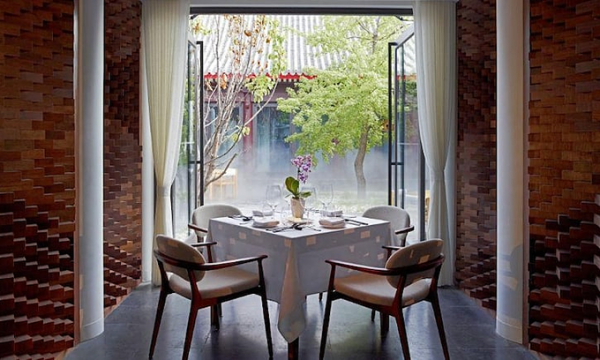
Located across from the Lama Temple, about six kilometers from the Forbidden City, it is the only restaurant in China to have three Michelin stars and a Michelin Green Star for sustainability, according to NDTV Travel.
The World’s 50 Best list has called it “the gold standard of vegetarian dining.”
The restaurant has also become a draw for the ultra-wealthy and famous, attracting guests like Italian President Sergio Mattarella and Spanish Prime Minister Pedro Sanchez during their visits to China.
Inside, the dining room is dressed in marble floors and silk chandeliers. The Michelin Guide notes that the kitchen relies on techniques such as steaming, slow-cooking, and sauteing. Three set menus of 10 or more courses are available, all vegetarian and veganizable on request.
The menu draws on local ingredients prepared with Chinese techniques and a contemporary presentation. Dishes change every two weeks, following the 24 solar terms of the Chinese calendar.
Depending on the season, dishes might include rice with black truffle or purple bamboo shoot soup. The restaurant also features native ingredients like gordon euryale seeds paired with fermented drinks, teas, and wines.
|
Inside King’s Joy restaurant in China. Photo by Michelin Guide |
King’s Joy was founded by David Yin, whose family left Beijing for Taiwan in 1966, spent 15 years in Canada, before returning back to Beijing. The restaurant’s name recalls their former Taipei eatery.
Today, the second generation leads the kitchen: Gary Yin is executive chef and his sister Mia Yin heads pastry.
“We use seasonal produce from local organic farms, cut down on energy and waste, and ban disposable items,” Gary told Michelin.
In China, vegetarian eating is tied to Buddhism and simplicity. About 4% of the population identifies as vegetarian, according to a 2024 state media study, and China’s dietary guidelines have included vegetarian recommendations since 2016.
Despite promoting Chinese culinary culture, King’s Joy was placed on a restricted list for Beijing officials starting in 2025, according to CNN. The restriction has not been publicly announced or explained.
Cost is the likely reason.
With meals starting at $250 per person, dining at King’s Joy conflicts with the government’s anti-corruption campaign and calls for official frugality.
With the average Beijing government salary around $1,600 a month, being seen at a restaurant of this price risks fueling perceptions of waste or bribery.
A similar precedent was set in 2014, when the government closed luxury clubs to crack down on official waste.
Gary notes that placing the restaurant in the capital was a choice to influence influential people toward sustainable eating, Time magazine reported.
As for the reported ban on officials, he maintains that business has yet to see any change.