UEFA Declares No Confidence in Infantino After Failed World Cup Equity Plan/ TezzBuzz/ WASHINGTON/ J. Mansour/ UEFA declared that it had lost confidence in FIFA President Gianni Infantino after helping defeat his plan to sell private investors a stake in World Cup commercial operations. CONCACAF joined calls for accountability and a leadership review, while officials in Europe and Asia criticized FIFA’s decision-making and governance. Infantino can seek another term, but opponents have until Nov. 18 to enter the presidential election scheduled for March in Rabat, Morocco.
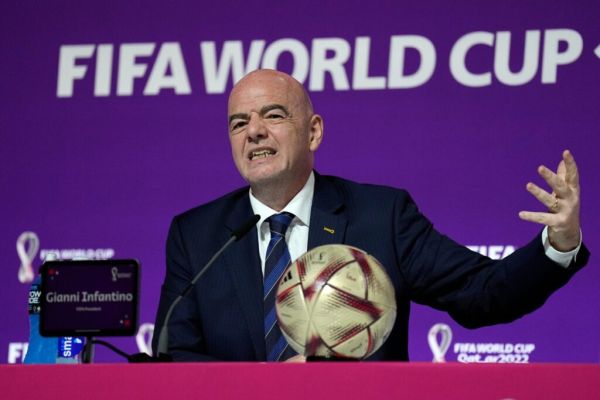
GENEVA — UEFA has declared that it no longer has confidence in FIFA President Gianni Infantino and has signaled that it could support efforts to end his decade-long leadership of global soccer.
The European governing body issued its warning Saturday, only hours after Infantino abandoned a plan to sell private investors a stake in FIFA’s World Cup commercial operations.
UEFA, led by President Aleksander Čeferin, had organized the strongest opposition to the proposal and helped create a threat by European federations to boycott FIFA competitions.
After defeating the proposed deal, UEFA shifted its focus toward determining who developed it and whether Infantino should remain president.
CONCACAF, the governing body for soccer in North America, Central America and the Caribbean, later joined the call for accountability.
The confederation said the controversial proposal indicated broader problems with FIFA’s governance and could not be treated as an isolated mistake.
The statement raised the possibility that opposition to Infantino could extend across multiple continental confederations before FIFA’s next presidential election.
Infantino had proposed transferring FIFA’s commercial businesses into a subsidiary valued at approximately $20 billion.
The new company would have managed commercial operations connected to the men’s and women’s World Cups and Club World Cups.
Private investors would have acquired a 20% stake in the subsidiary.
Opposition intensified each day after FIFA announced the proposal Tuesday.
Infantino ultimately withdrew it early Saturday after resistance from Europe, Asia and North America and a revolt among senior FIFA officials.
UEFA said stopping the private equity proposal was not enough. It called for an investigation into how the project advanced without adequate consultation.
The language suggested that UEFA intends to coordinate with other regional governing bodies on governance reforms and potentially on the future of FIFA’s presidency.
Norwegian soccer federation President Lise Klaveness, an elected member of UEFA’s executive committee, said the proposal placed international soccer cooperation at risk.
She argued that existing oversight systems had failed to prevent FIFA’s leadership from advancing a plan driven by individual rather than collective interests.
Her comments expanded the debate beyond the abandoned proposal to the effectiveness of FIFA’s internal checks and balances.
Asian Football Confederation President Sheikh Salman bin Ibrahim Al Khalifa also criticized the way the investment proposal was developed.
The AFC had joined UEFA and CONCACAF in opposing Infantino’s plan.
The combined membership of the three confederations could become important if Infantino faces a challenger in FIFA’s next presidential election.
Infantino’s plan began collapsing after all 55 UEFA member associations agreed Thursday to boycott the World Cup and other FIFA competitions if the proposal moved forward.
CONCACAF and the AFC subsequently confirmed their opposition.
The boycott threat created immediate uncertainty for international soccer because the next FIFA competition, the Women’s Under-20 World Cup, is scheduled to begin Sept. 5 in Poland.
FIFA withdrew the plan before the boycott could be implemented, but the rapid reversal did not stop demands for leadership accountability.
FIFA’s internal opposition became public Friday when senior Infantino adviser Carlos Cordeiro resigned.
Cordeiro, a former Goldman Sachs banker and former president of the U.S. Soccer Federation, represented FIFA on the White House Task Force for the World Cup.
He urged other senior FIFA employees to speak publicly about the proposal and its potential consequences.
His resignation placed additional pressure on Infantino by showing that opposition existed within the president’s immediate circle.
FIFA Chief Operating Officer Kevin Lamour issued his own statement hours after Cordeiro’s resignation.
Lamour told The Associated Press that FIFA employees had been deceived by Infantino’s lack of transparency while the private investment project was being planned.
The criticism from FIFA’s chief operating officer strengthened claims that the project had not gone through a sufficiently open or collective approval process.
The World Cup equity plan was at least the third ambitious Infantino initiative to divide international soccer before ultimately being abandoned.
In 2018, Infantino promoted a secretive $25 billion offer from Japan’s SoftBank to establish new competitions.
Critics warned that the proposal could threaten existing continental tournaments involving clubs and national teams. FIFA eventually abandoned the initiative.
In 2021, Infantino supported holding the World Cup every two years instead of once every four years.
That proposal angered national federations and the International Olympic Committee, where Infantino serves as an elected member. FIFA also dropped that plan.
Despite those controversies, Infantino was reelected without opposition in 2019 and 2023.
The reaction to the World Cup private equity proposal could be more politically damaging because UEFA is now openly questioning whether he should remain in office.
Potential candidates have until Nov. 18 to enter FIFA’s next presidential race.
The election is scheduled exactly four months later in Rabat, Morocco, where FIFA has its African headquarters.
FIFA’s statutes allow Infantino to seek one additional four-year term.
Winning a contested election requires 106 votes to secure a majority of FIFA’s 211 member associations.
Although regional confederations do not always vote as unified blocs, most of UEFA’s 55 members, the AFC’s 46 members and CONCACAF’s 35 members would create a substantial base for a challenger.
Together, those confederations account for 136 FIFA votes, although it remains unclear how many national associations would support an effort to remove Infantino.
The proposed commercial spinoff appeared capable of creating a commissioner-like position that Infantino might have occupied after his potential final presidential term ended in 2031.
Such a role could have paid considerably more than his current FIFA compensation, which includes an annual salary and bonus package worth more than $6 million.
The project’s collapse eliminates that potential structure while intensifying scrutiny of Infantino’s leadership and motivations.
Not every FIFA member has turned against Infantino.
The Qatar Football Association issued a statement Saturday supporting him and welcoming his decision to abandon the proposal.
Qatar’s response shows that Infantino retains support among some influential national federations.
The central question is whether that support will be sufficient if UEFA and other confederations recruit a credible challenger before the November deadline.
More on Sports