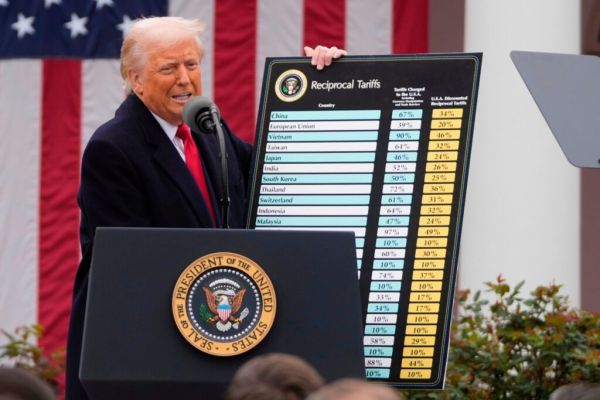
25 States Sue over Trump’s New Tariffs, Calling them ‘Pretext’ to Replace his Old Ones/ TezzBuzz/ WASHINGTON/ J. Mansour/ 25 States Sue over Trump’s New Tariffs, Calling them ‘Pretext’ to Replace his Old Ones/ TezzBuzz/ WASHINGTON/ J. Mansour/ Twenty-five states sued the Trump administration, arguing that its new forced-labor tariffs are an unlawful replacement for import taxes struck down by the Supreme Court. The tariffs, ranging from 10% to 12.5%, apply to 59 countries and the European Union and affect countries supplying 99% of U.S. imports. The White House says Section 301 of the Trade Act gives the administration legally durable authority to impose the new tariffs.
WASHINGTON — Twenty-five states sued the Trump administration Monday over tariffs imposed on 59 countries and the European Union, arguing that the new import taxes are a pretext for replacing tariffs struck down by the Supreme Court in February.
The United States introduced the double-digit tariffs in July, accusing the targeted countries of failing to prevent imports produced through forced labor.
The tariffs took effect as temporary worldwide duties imposed by President Donald Trump after the Supreme Court ruling expired.
New York was joined by Arizona, California, Colorado, Connecticut, Delaware, Hawaii, Illinois, Kentucky, Massachusetts, Maryland, Maine, Michigan, Minnesota, Nevada, New Jersey, New Mexico, North Carolina, Oregon, Pennsylvania, Rhode Island, Virginia, Vermont, Washington and Wisconsin.
The lawsuit argues that the administration’s forced-labor justification does not provide a lawful basis for tariffs covering nearly all U.S. imports.
Trump has argued that higher tariffs will help restore American manufacturing. During his second term, he reversed decades of U.S. policy favoring lower trade barriers and increasingly open international commerce.
The president initially relied on the 1977 International Emergency Economic Powers Act, known as IEEPA, to impose double-digit tariffs on imports from nearly every country.
Trump declared the longstanding U.S. trade deficit a national emergency, but the Supreme Court ruled that IEEPA did not authorize the president to impose tariffs.
The ruling required the administration to refund importers that had already paid the duties.
Following the Supreme Court defeat, Trump imposed temporary tariffs of 10% on imports worldwide to replace some of the lost revenue.
Those tariffs expired at midnight on July 24, prompting the administration to adopt a different legal strategy.
The White House is now relying on Section 301 of the Trade Act of 1974, which allows the president to impose import taxes and sanctions against countries determined to be engaging in unfair trade practices.
Trump previously used Section 301 to impose significant tariffs on Chinese imports during his first term. Those tariffs survived legal challenges.
The administration’s new tariffs range from 10% to 12.5% and target countries supplying 99% of American imports.
The White House argues that foreign governments’ failure to block goods produced through forced labor harms American businesses and workers.
The states’ case follows two lawsuits filed by small businesses in the U.S. Court of International Trade in July.
Those lawsuits also challenge the administration’s use of Section 301. They argue that the government failed to establish an adequate case against each individual country or explain how the tariffs would eliminate the trade practices they were imposed to address.
Section 301 requires the government to identify unfair trade conduct and follow specific procedures before imposing penalties.
Barry Appleton, a law professor and co-director of New York Law School’s Center for International Law, said the latest litigation reflects the administration’s repeated attempts to impose broadly similar worldwide tariffs through different laws.
Appleton said the “nearly copy-pasted” nature of the three tariff plans could make the latest measures more difficult to defend.
However, Section 301 may provide the administration with a stronger legal foundation because presidents have used it for decades.
More on US News