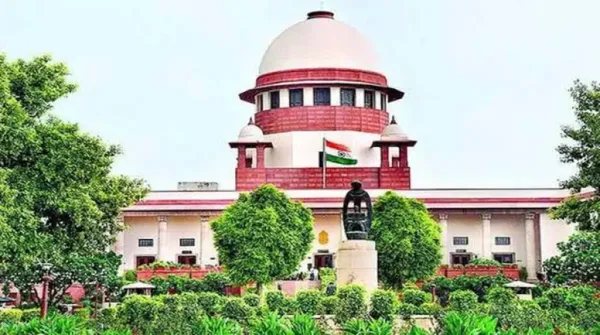
Supreme Court Verdict on Hanging vs Lethal Injection: The decades-old system of hanging death row prisoners in India will continue for now. The Supreme Court has rejected the PIL demanding the adoption of less painful lethal injection or other alternatives in place of the noose.
The court clarified that under the present legal and constitutional framework, the practice of imposing death penalty by hanging cannot be held unconstitutional or illegal.
While giving this historic decision, the bench of Justice Vikram Nath and Justice Sandeep Mehta also refused to send the case to a larger bench. However, the court made it clear that its decision is not a final stop for the future, if the central government wishes, it can form a committee of experts to review other options on scientific and medical grounds.
In this public interest litigation (PIL) filed by advocate Rishi Malhotra, the constitutional validity of Section 354(5) of the Code of Criminal Procedure (CrPC), under which the convict is hanged by the neck until he dies, was challenged. Citing Article 21 of the Constitution (right to life and a life with dignity), the petitioner had argued:
During the hearing, 'Project 39A' and various parties presented global experiences before the court. The court found that lethal injection or other proposed alternatives also face numerous practical, medical and legal challenges. Cases of injection failure and extreme pain have also been reported in several countries. Apart from this, the bench also considered human aspects to the execution process such as the mental health of the executioner.
The Supreme Court said in its order that rejecting this petition does not at all mean that the doors of constitutional inquiry have been closed for the future. If solid scientific, medical or empirical evidence emerges in the future that changes the scientific basis of earlier decisions, the issue may be reconsidered.
Attorney General R, appearing for the Central Government. Venkataramani told the court that the government was ready to consider at an expert level to review the possibilities of alternative methods of death penalty.
During earlier hearings, a suggestion had also come before the court whether the culprits could be given the option to choose between hanging or injection? However, the Center in its affidavit had termed it as practically impossible. The Centre's argument was that deciding the method of punishment is purely a policy matter.
This decision of the Supreme Court has made it clear that unless the Parliament changes the law or the Central Government notifies a new scientific method based on the report of an expert committee, in the rarest of rare cases, the death row convicts in India will be hanged.