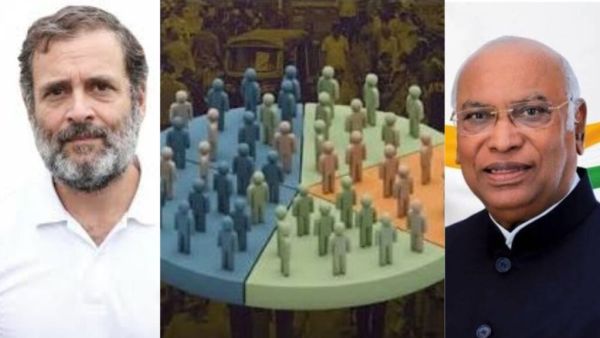
New Delhi: A fresh political battle erupted over India's caste census on Tuesday after Congress leaders Mallikarjun Kharge and Rahul Gandhi urged Prime Minister Narendra Modi to replace the existing questionnaire with a new format.
The opposition leaders claimed that the current method of collecting caste details could result in inaccurate and fragmented data, raising concerns over its impact on reservation policies, welfare schemes, education opportunities and social justice programs.
The demand has brought the methodology of caste enumeration back into the national spotlight, with political parties now debating how India's caste data should be collected, classified and used for policy decisions.
In a letter to Prime Minister Narendra Modi, Congress president Mallikarjun Kharge and Lok Sabha Leader of Opposition Rahul Gandhi said they did not support the caste census being conducted under the current format.
They demanded that the existing questionnaire be withdrawn and a fresh framework be prepared after discussions with political parties, researchers, experts and the general public. The Congress leaders suggested that the government should study the caste survey models adopted in Bihar and Telangana while preparing a revised system.
According to them, accurate caste data is necessary to understand the population strength and socio-economic conditions of different communities and ensure that government policies reach the intended beneficiaries.
The biggest objection raised by Congress leaders is to the open-ended caste identification format. Under the current approach, individuals can provide their caste name, which is then recorded accordingly. Kharge and Rahul Gandhi argued that this could create serious classification problems because many communities have different names, regional identities, sub-castes and language-based variations across India.
They claimed that if these variations are recorded separately, a single caste group could appear as multiple different categories in official data. According to the Congress leaders, such fragmentation could make the final database extremely complicated and may affect the accuracy of population estimates.
The Congress has also raised concerns over the measurement of the Other Backward Classes (OBC) population through the caste census. The party argued that without reliable caste-based data, governments may face difficulties while designing policies to reservation, employment, education and welfare schemes.
The issue has become politically important as caste data has often been linked with debates around representation, social equality and distribution of government resources.
As a solution, Kharge and Rahul Gandhi have proposed introducing a standardized caste list through a drop-down system. They suggested that the database could be prepared using existing official records, including lists of Socially and Educationally Backward Classes and information available from government institutions.
The leaders said a similar approach was followed in caste surveys conducted in Bihar and Telangana. Copies of caste lists used in the Bihar caste survey of 2022 and Telangana caste survey of 2024 were also shared along with their communication to the Prime Minister.
The caste census issue has emerged as a major political topic ahead of the larger debate on social justice and representation. Congress leaders have argued that accurate caste data is essential for evidence-based policymaking, while the Centre's approach to the exercise is under political scrutiny.
Congress general secretary Jairam Ramesh also criticized the current process, alleging that it would not provide a complete picture of India's caste demographics. The debate reflects a larger political divide over whether caste enumeration should focus only on collecting information or also ensure detailed classification for future policy decisions.
Caste census data can play an important role in understanding demographic patterns, economic conditions and social inequalities among different communities. Supporters of detailed caste enumeration believe that reliable data can help governments create targeted welfare programs and improve policy implementation.
However, experts have also highlighted challenges such as classification of thousands of caste identities, avoiding duplication and ensuring uniform data collection across states. The Congress has asked the Central government to reconsider the existing questionnaire and begin wider consultations before moving ahead with the caste census process.