Central government employees are eagerly awaiting the recommendations of the 8th Pay Commission. Amidst this anticipation, there is much speculation regarding the fitment factor. Let us find out what the salary would be with a 2.1 fitment factor.
Central government employees are keenly awaiting the 8th Pay Commission's recommendations and have high expectations regarding them. Amidst these expectations, there is constant speculation about the fitment factor, as it determines the salary hike. While employee unions are demanding a fitment factor ranging from 2.57 to 2.86, even if the government settles for a 2.1 fitment factor, employees would still see a significant salary increase. Let us explain how.
How much will the salary increase with a 2.1 fitment factor?
The 7th Pay Commission set the minimum basic pay for employees at ₹18,000. If the 8th Pay Commission recommends a 2.1 fitment factor, the salary hike will be calculated based on this figure. Here is the calculation:
₹18,000 x 2.1 = ₹37,800
To put it simply:
Current Basic Pay = ₹18,000
Estimated Basic Pay under 8th Pay Commission = ₹37,800
Difference in Basic Pay = ₹19,800
Looking solely at the basic pay, the increase is 110%; in other words, the new basic pay will be 2.1 times the current basic pay.
What will the actual salary hike be?
However, it is important to note that this does not represent the *actual* salary hike. Employees do not receive only the ₹18,000 basic pay; they also receive Dearness Allowance (DA) on top of it. Therefore, the new salary should be compared not just against the ₹18,000 figure, but against the current basic pay *plus* the DA. For this reason, it would be incorrect to assume that a 2.1 fitment factor translates directly into a 110% salary hike.
A Small Figure, A Big Benefit
Manjit Singh Patel, President of the All India NPS Employees Federation, also believes that employees stand to gain significantly from the 2.1 fitment factor. He has sought to explain this point through social media posts. Although the figure itself may appear small, it is set to deliver substantial benefits.
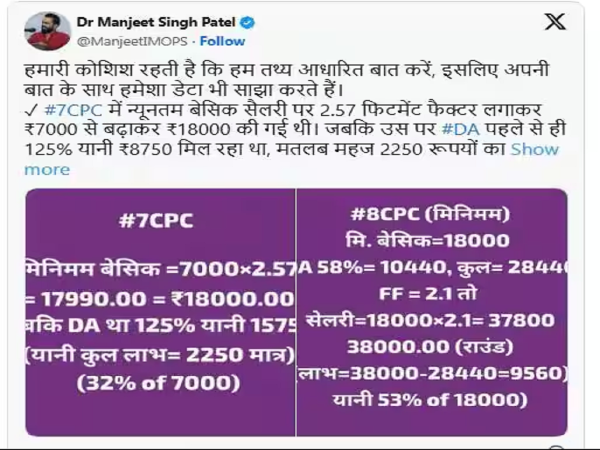
He pointed out that under the 7th Pay Commission, the basic pay was raised from ₹7,000 to ₹18,000—effectively an increase of ₹7,000 achieved by applying a 2.57 fitment factor. However, since employees were already receiving a 1.25% Dearness Allowance (DA) at the time, the actual increase in their salary amounted to approximately ₹15,000.