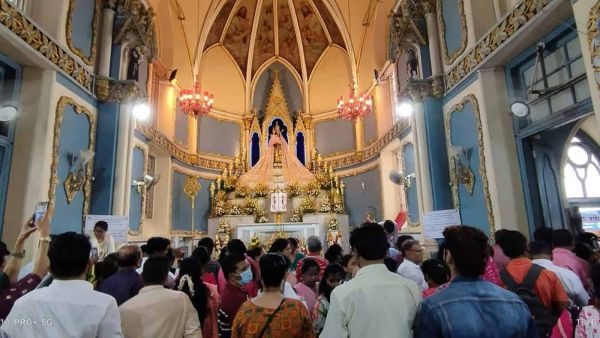
Mumbai: As the Maharashtra anti-conversion law comes into force on August 28, local pastors in the Mumbai Metropolitan Region are asking worshippers to fill out “self-declaration” forms clarifying that they are attending prayers willingly.
According to a report by The Indian Express, the forms clearly state that individuals face “no pressure, inducement, temptation, lure, or threat of any kind” to attend a prayer meeting and that they are going to churches of their own choice.
The form asks worshippers to mention their PAN or Aadhaar number and submit a passport-size photograph. These forms were reportedly being circulated in English, Marathi, and Hindi to gatherings in Mumbai, Thane, Vasai-Virar, Palghar, and Mira-Bhayandar. The self-declaration forms also have a blank space left for witness details to further confirm that the person has signed the form with “free will.”

“I hereby confirm that attending the church, participating in prayers, religious meetings, and other gatherings is part of my religious freedom and right, guaranteed under Articles 25 to 28 of the Constitution of India,” the form reads.
“If anyone makes false allegations against me or the church in this regard, this self-declaration should be treated as evidence and used accordingly.”
The development comes amid a rise in disruptions to Sunday prayers over the past five months. According to the TIE report, nine first information reports (FIRs) were registered in connection with such incidents between April and July. The recent attacks have a distinct pattern, right from the start of a congregation that is generally held on Sundays in a school, rented hall, banquet hall or a person’s own house.
These meetings are interrupted by people claiming to be from Hindutva groups, Vishwa Hindu Parishad or Bajrang Dal, who then object to the gatherings, alleging that Hindus are being forcibly converted. They call the police; both sides reach the station, and in some cases, an FIR is lodged.
Of the nine FIRs recorded, seven are against the organisers of prayers and worshippers, while two are against Bajrang Dal workers.
Pastor Steven Rozario of New Hope Church in Virar handed out the forms and explained their importance. “This is a self-declaration form. I want all of you to fill it out, attach a passport-size photograph, and bring it with you next Sunday when we meet for prayer. Considering the continuous disruptions and attacks during prayer meetings, we are keeping these forms with us so that if someone questions us in the future and claims that we forced or compelled you to attend the prayer meeting, we can show this as proof.”
The church has recently built a wrought-iron gate that remains locked during the service in view of the continuous attacks. “In most cases, police do not even register FIRs against those who cause the violence,” Rozario told The Indian Express. “This is why we all came up with these forms, hoping they will help us if such a situation arises in our church. The new law has given a free pass to those who break the law.”
A churchgoer said in the sixteen years of her practising Christianity, it was the first time she was asked to prove in writing that she was attending a church voluntarily.
“Earlier, there was a freedom to choose and believe what we wanted to follow, and nobody questioned us about why we were following a particular faith,” 55-year-old Anita Patel said. She expressed unfamiliarity with the ordeal and called it strange, saying, “It feels as though I no longer have the freedom to follow what I want to.”
“But it is okay; considering the current situation and the attacks on prayer meetings, this is perhaps the only way to live,” Patel said.
Others shared that the form serves as a precautionary measure and can help protect them while attending a prayer meeting. “It is purely for security purposes,” said Devdan Tribhuvan, state president of the Maharashtra Christian Development Association. “The forms are not government documents; they are signed by the person and kept with the pastor.”
He said the choice to come to a prayer meeting rests solely with the person. “There is no allure or compulsion. If I am a Christian, I can choose to go to any church in Mumbai,” Tribhuvan said.
The Bajrang Dal, on the other hand, said that it operates within the framework of the law. “If our workers are attacked, they will defend themselves. We are not going there either to get beaten or to beat anyone, but self-defence is everyone’s right,” said Gautam Ravariya, the group’s regional co-convenor, who monitors prayer meetings on the internet.
According to Ravariya, some prayer organisations first assist vulnerable families or individuals, then encourage them to convert.
Meanwhile, the Vasai Virar Police Commissioner denied that there was a “trend” of such incidents, despite five of the nine attacks taking place under his jurisdiction. He was unaware of the self-declaration forms being distributed by churches and pastors.
Church leaders fear disruptions could escalate now that the state’s anti-conversion law, notified on July 31, is soon to take effect. The legislation penalises religious conversions achieved through coercion, fraud, force, threats, misrepresentation, undue influence, or promises of marriage. Under the law, the burden of proof falls on the facilitator to demonstrate the conversion was voluntary, with harsher penalties applied if the case involves minors, women, Scheduled Castes, Scheduled Tribes, or individuals of unsound mind.