Following US mediation, Syrian and Israeli representatives met in Jordan last weekend for the first time in months. The talks aimed to defuse tensions following the recent Israeli attacks on Syrian territory and prevent hostilities between Israel and Turkey from spilling over into Syria.
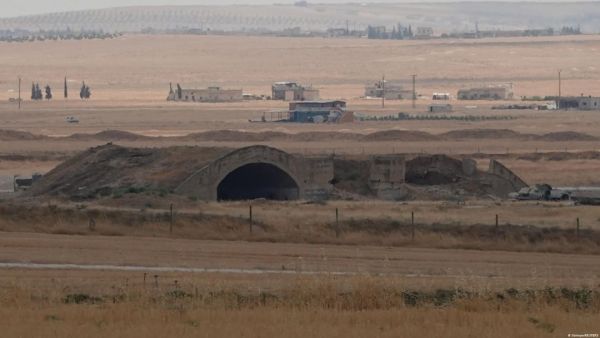
The escalation was sparked by an Israeli attack on the Abu Duhur military airfield in Idlib Province on August 18. According to Syrian sources, the attack struck the runway and storage facilities without causing any fatalities. Israel stated that Syria had violated — or threatened to violate — a previous security agreement by allowing Turkish troops to use the airfield. Damascus and Ankara rejected these allegations.
The US criticized the attack by its Israeli ally as an "unnecessary escalation." In diplomatic terms, this amounts to a fairly clear show of rhetorical support for Ankara and Damascus.
Israel views a potential Turkish military presence in Syria as a red line. Yet, it remains unclear whether such a deployment is planned in the long term or whether it was even imminent at the time of the attack. Evidence on this matter is not publicly available.
However, as early as April 2025, Reuters news agency cited anonymous sources saying Turkey had inspected at least three air bases in Syria where it might want to station troops as part of a planned joint defense pact. Israeli airstrikes were already taking place at that time as well.
The Washington-based think tank Foundation for Defense of Democracies (FDD), which is considered pro-Israel, justifies the attack as follows: "Israel worries that Ankara could eventually use its military presence in Syria as a platform to pressure or threaten Israel, and remains wary of the close relationship between Syrian President Ahmad al-Sharaa and the Turkish leadership."
For Bente Scheller, Syria expert at the German Green Party-affiliated Heinrich Böll Foundation, this explanation falls short.
"There is no evidence so far that Turkish troops are actually supposed to be stationed there," she told DW. While Israel may indeed have its own intelligence, the recent attack must be viewed against the backdrop of Israel's overall policy toward Syria as well as Turkey's growing regional role, she noted.
Marcus Schneider, a Middle East analyst at Germany's Friedrich Ebert Foundation — which is affiliated with the German Social Democratic Party (SPD) — in Beirut, also points out that a struggle for power and influence is unfolding in Syria and beyond.
"The attack primarily raises the question of what kind of military order will emerge in Syria in the future," he told DW. In his view, Israel wants to keep Syria weak, as a sovereign state that controls its own airspace would restrict Israel's military freedom of action. "The corridor for attacks against Iran runs through Syria," explained Schneider. A sovereign Syria could therefore pose a strategic obstacle to Israel.
Following the Hamas terror attacks on Israel on October 7, Israel's heightened security concerns are understandable, adds Scheller. In addition, Israel is certainly viewing with concern another development that extends beyond Syria.
"Israel is undoubtedly aware of how Turkey is currently attempting to position itself as a regional hegemon," Scheller said. The attack on Abu al-Duhur is therefore "clearly also a message to Turkey."
Turkey supports Syrian President al-Sharaa and is committed to a unified Syria which includes the territory in the country's northeast, where the majority of Syria's Kurdish population is located. For years, Turkey has been attacking the former Kurdish-led autonomous zone along its southern border. On Tuesday, the commander of the Kurdish-led Syrian Democratic Forces announced the official dissolution of the group.
An analysis by the US think tank Carnegie Foundation describes the situation as a strategic rivalry between Israel and Turkey: "The northeast is also the main arena where two externally-driven strategic visions for Syria collide." The International Crisis Group also views Syria as a fault line between Turkey, a rising regional power, and Israel.
Syria's improved relations with the US — which amount to US support — offer new prospects for the country, despite the Islamist past of its new leader, President Ahmad al-Sharaa. In summer 2025, the US began gradually easing sanctions, and in November of that year, al-Sharaa was received by US President Trump at the White House. The two met again on the sidelines of the NATO summit in Ankara in July 2026. In early 2026, the US withdrew its military forces from Syria, and on Monday (August 24), it officially removed the country from its list of state sponsors of terrorism.
However, under the current circumstances, Syria appears to be relying primarily on itself, including in its relations with Turkey. For analyst Marcus Schneider, however, a potential Turkish presence is not comparable to the former Iranian presence during the Assad regime.
Contrary to the view held in Israel, he argues that Ankara is primarily interested in a stable Syria and in securing its southern border. "The idea that Turkey, a NATO member, would attack Israel, a nuclear power, is preposterous," he said. The real problem, he argues, is that Israel increasingly views Turkey as a strategic adversary and interprets Turkey's capabilities as evidence of hostile intentions.
Al-Sharaa is seeking foreign policy support wherever he can find it, observes Scheller. "In recent months, Turkey has increasingly become one of the countries from which Damascus expects concrete assistance." This is not just a matter of security: Ankara wants to expand its regional influence and, at the same time, has an interest in maintaining stability along the shared border, she said.
Following the overthrow of Syria's longtime ruler Bashar Assad in December 2024, Israel established a security zone north of the Golan Heights and has repeatedly attacked Syrian targets. According to an analysis by the Carnegie Foundation, the calls for such a buffer zone is deeply rooted in Israeli security thinking; less clear, however, is the intention — sometimes attributed to Israel by analysts — of permanently fragmenting Syria to keep it weak.
The US think tank FDD takes a different view, pointing to Israel's skepticism toward the new Syrian military and Turkish support. However, Schneider notes that the new regime in Syria has extended a hand to Israel from the outset, despite its ideological origins. "Damascus does not want a war with Israel," he said, adding that it wants to regain its national sovereignty. It is precisely this aspiration that clashes with Israel's military presence and its red lines.
"Syria is caught between two militarily powerful neighbors that respect neither its sovereignty nor its territorial integrity," said Scheller.
In her view, the outcome will now depend on al-Sharaa's negotiating skills. "How can he defend Syrian sovereignty against these two neighbors and actually chart a distinct Syrian path?" However, Syria's weakness does not lie solely in its military inferiority. The country must first develop a viable political order, she notes.
This is also the starting point for political scientist Haid Haid in an analysisfor the British think tank Chatham House: "Syria's foreign policy success has been significant, but it cannot, on its own, secure stability. In this sense, Syria's greatest vulnerability lies not at its borders, but within."
Disclaimer: This report first appeared on Deutsche Welle, and has been republished on ABP Live as part of a special arrangement. Apart from the headline, no changes have been made in the report by ABP Live.