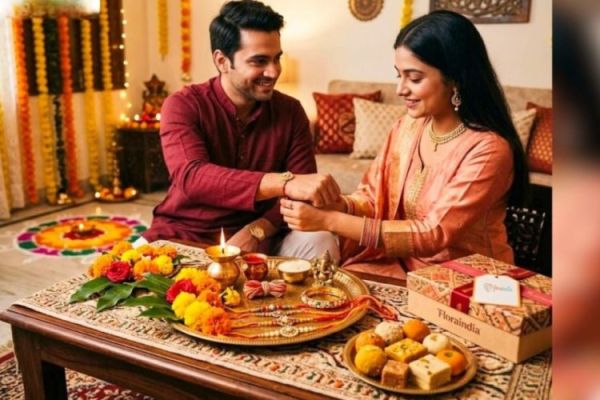
Raksha Bandhan 2026: This time there is no hindrance from Bhadra to tie Rakhi. The tradition of celebrating Rakshabandhan between sunrise and sunset has been mentioned in the scriptures.
Raksha Bandhan 2026: Today is the full moon of the month of Sawan and the festival of Rakshabandhan is being celebrated across the country. This time there is no hindrance from Bhadra to tie Rakhi. The tradition of celebrating Rakshabandhan between sunrise and sunset has been mentioned in the scriptures. On this basis, three auspicious times for tying Rakhi have been suggested today from 6:15 am to 7 pm. During this time, brothers and sisters can tie Rakshasutra as per their convenience and auspicious time.
This time due to absence of Bhadra, three auspicious times have been suggested for tying Rakhi throughout the day on the day of Rakshabandhan. The first Muhurta will be from 6:15 am to 11 am. The second auspicious time is from 12:30 pm to 2 pm. After this, the third Muhurta will be from 5:30 pm to 7 pm. According to religious tradition, Rakshabandhan is celebrated from sunrise to sunset. Therefore, brothers and sisters can celebrate the festival by tying Rakhi at these auspicious times.
Today Rakshabandhan is mainly considered a festival of love and resolve to protect brothers and sisters. Although thousands of years ago its form was different. In Atharvaveda, there is mention of tying gold and gems for the purpose of protection. The context of Raksha Sutra is also found in Ramayana.
Before going on exile, Mother Kaushalya had prepared a medicine-based defense formula for Lord Rama. This shows that in ancient times, Raksha Sutra was associated with the wish for protection and auspiciousness.
The tradition of Rakshabandhan is also mentioned in the Bhavishya Purana. It is told that Shri Krishna had told Yudhishthir the complete method of performing Rakshabandhan on the full moon day of the month of Sawan. With time, this tradition of tying Raksha Sutra started taking the form of a systematic religious ritual.
By the 13th century, certain rules and mantras for Rakshabandhan had also come into vogue. In this period, it was no longer just a common tradition of tying a thread, but its religious importance had also been established.
The tradition of Rakshabandhan later reached the royal families and the Mughal court also. Rakhi is said to have reached the Mughal court during the reign of Akbar. After this, Jahangir mentioned in his autobiography that this thread was named Rakhi.
The clearest historical mention of this tradition is found in Jahangir’s autobiography Tuzuk-e-Jahangiri in the 17th century. Jahangir writes that in Saavan, Brahmins used to go to the banks of rivers and ponds, recite mantras and conjure colored threads.
In the 18th century, Rajput women used to bring kings to tie Rakhis. At that time Rakhi was not limited to family relationships only, but also became a symbol of security and social relations.
The tradition of Rakshabandhan took another form in the 19th century. During this period, there is mention of the beginning of the tradition of making any man a brother by giving Rakhi. In this way, the relationship of Rakhi was not limited only to brothers and sisters by birth.
It also became a medium for creating social and emotional connections. With time, Raksha Bandhan took a broader form as a festival of brother-sister affection, trust and resolve to protect each other.