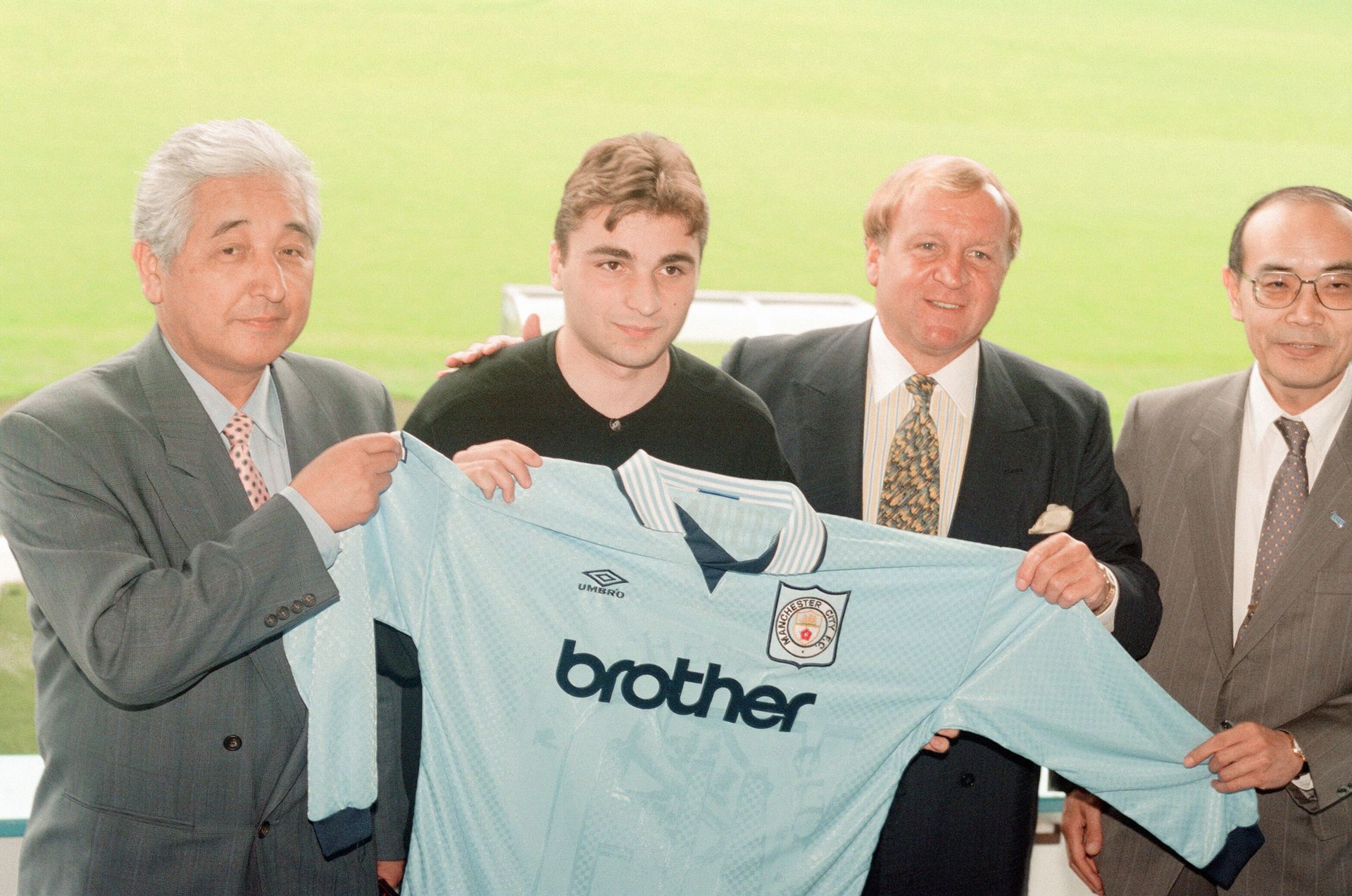
When Georgi Kinkladze joined Manchester City in the summer of 1995, the Georgian playmaker was regarded as one of Europe’s brightest young attacking talents.
It did not take the former Dinamo Tbilisi midfielder long to establish himself as a cult figure at Maine Road, with his arrival coming at a time when the still-young Premier League was beginning to prove itself as a genuine destination for some of the best players on the continent.
That was underlined by the fact that City managed to beat AC Milan, one of the outstanding teams of that era, to Kinkladze’s signature.
“There was interest from Italy, but [City chairman] Francis Lee was very determined,” Kinkladze told FourFourTwo while reflecting on his 1995 move to England.
“He flew to see me and convinced me that City was a place where I could be the main man. I didn't know much about Manchester, but I liked the idea of a challenge in England.”
It soon became obvious to the young Kinkladze that English football was unlike anything he had encountered before.
“When I arrived, the football was very different. It was much faster and more direct. The weather and the food were hard to get used to, but the fans made it easy. From the first day at Maine Road, they treated me like one of their own. That connection was instant.”
Alan Ball was Manchester City manager at the time after having spent the previous season in charge of Southampton, where he had famously built his side around Matt Le Tissier and told the team to ‘Just the ball to Le Tissier.’ So was it a similar situation with Kinkladze at City?
“Alan Ball was very important in my development as a player,” he continued. “He loved technical players and wanted the team to play with flair, even if we were struggling in the table.
“The 90s were a different time and sometimes I was targeted by foul play. If you tried to dribble, someone would try to kick you. Vinnie Jones and the Wimbledon Crazy Gang were famous for it.
“But I had played in the streets of Tbilisi so I knew how to jump over a tackle. I always thought that if they couldn't catch me, they couldn't hit me.”
During those early Premier League years, several high-profile foreign players arrived in the division, and Kinkladze admitted it was an exciting period to be part of.
“It was the start of something new,” he added. “Seeing Gianfranco Zola, Dennis Bergkamp and Juninho arrive in the Premier League was exciting and it felt like the league was opening up to creative players.
“The long-ball reputation of English football was changing.”