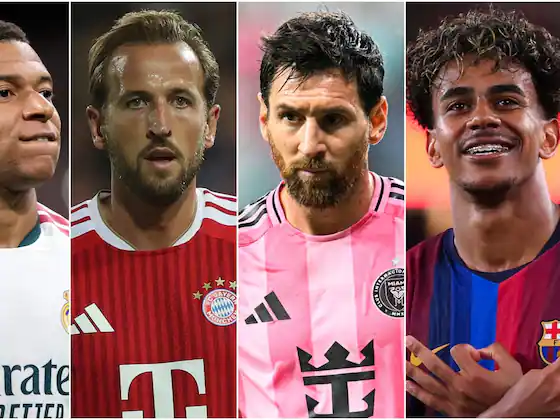
England captain Harry Kane is among the leading contenders to win the 2026 Ballon d'Or when the annual ceremony to honour the world's best footballer is held in London next month.
Kane is one of three English nominees for the prize, along with Jude Bellingham and Declan Rice, while 39-year-old Lionel Messi is aiming to claim the ninth Ballon d'Or of his extraordinary career.
If Kane were to win the Ballon d'Or, he would become the first English player to do so since Michael Owen in 2001 and only the fifth Englishman ever to lift the famous award.
More than in any previous year, this feels like Kane's strongest chance to receive individual recognition in a career that has so often been defined by his selflessness.
After scoring a huge 61 goals in all competitions for Bayern Munich and helping England reach the World Cup semi-final, very few nominees can match Kane's influence for both club and country last season.
In previous years, Kane's numbers might have been overshadowed by the almost unbelievable output of Cristiano Ronaldo and Lionel Messi. But that era of goalscoring is difficult to define and even harder to reproduce.
What Kane produced last season was exceptional. He is not only a striker with relentless accuracy and total concentration, but also a creator, a leader and a role model.
Stretching the idea of what a modern striker can be, Kane was just as comfortable dropping deep and directing a thrilling first-leg comeback against Paris Saint-Germain last season as he was using sharp instincts in the box and sheer courage to drive England past DR Congo.
Kane played with clear purpose last season, and the fact that Bayern and England did not fully achieve their targets should not count against him. Even if the selfless Kane himself would probably disagree, given his natural tendency to move attention away from himself and back on to the team.
Ironically, and perhaps a little tragically, the very quality that makes Kane such a compelling candidate may also be the factor that costs him. In a very British way, Kane carries the traits of someone too modest for the spotlight.
Never one for self-promotion, Kane is unlikely to engage in the kind of uncomfortable campaigning that often surrounds the Ballon d'Or build-up, instead allowing others to make the case for themselves.
Others before him, including World Cup winner and fellow 2026 nominee Rodri, have triumphed in years when public relations and politics did not dominate the conversation.
But with this year's 30-man shortlist so open, nominees are likely to rely as much on emotion as on hard facts. The key question is whether Kane's quality can rise above the noise.
Among the other nominees, Kylian Mbappe, Lamine Yamal, Rodri and Messi appear the most likely to stay alongside Kane in the race.
Mbappe, who has never previously finished in the top three of the Ballon d'Or voting, managed to rise above a turbulent year at Real Madrid and ended the season with 42 goals in all competitions, including 15 in 11 Champions League appearances.
The 27-year-old has admitted that this would be a good year for him to win the Ballon d'Or and is clearly aware of the historical significance involved, with Real Madrid jointly holding the record for the most Ballon d'Or winners of all time with 12.
"I think when you play for Real Madrid, the best club in the world, people associate you with this award," he said.
Yamal is widely regarded as the finest young player in the world right now and, in almost any year, would be expected to feature among the Ballon d'Or favourites.
However, an injury-hit campaign meant he found it difficult to contribute as much as he would have wanted to Barcelona's La Liga title triumph and Spain's first World Cup victory since 2010.
Whenever Yamal did play, he delivered moments of the highest class with the ease and energy of youth, finishing with 16 goals and 12 assists in 28 league appearances.
The Ballon d'Or, though, is as much about consistency as pure brilliance, especially when measured against the production of Kane and Mbappe.
Messi and Rodri have both won the Ballon d'Or before, and both were central figures in helping Argentina and Spain respectively reach the World Cup final.
Rodri was named man of the match in the final, which was won in extra time by fellow nominee Ferran Torres, completing an impressive period in which he rebuilt his reputation after an injury-hit spell before securing a move to Barcelona.
Defending champion Ousmane Dembele is also in contention after helping Paris Saint-Germain win back-to-back Champions League titles, while also enjoying a prolific World Cup.
Premier League champions Arsenal unsurprisingly provide a major share of the nominees from England's top division, with Rice, Gabriel and William Saliba all included.
Beyond the Arsenal trio, Premier League representation is limited, with Manchester City striker Erling Haaland and Manchester United's Bruno Fernandes the only other nominees.
David Raya has been nominated for men's goalkeeper of the year, while Mikel Arteta and Unai Emery are both shortlisted for coach of the year.
On the 70th anniversary of the award's creation, the Ballon d'Or will return to the place where the first winner, Sir Stanley Matthews, was honoured in 1956.
The Theatre du Chatelet in Paris has staged the Ballon d'Or since 2019, but it will temporarily hand over hosting duties to the London Palladium Theatre on Monday, October 26.
A world away from the modest ceremony at Blackpool Town Hall where Sir Stanley Matthews collected the first Ballon d'Or, the award is returning to its spiritual home to mark the anniversary.