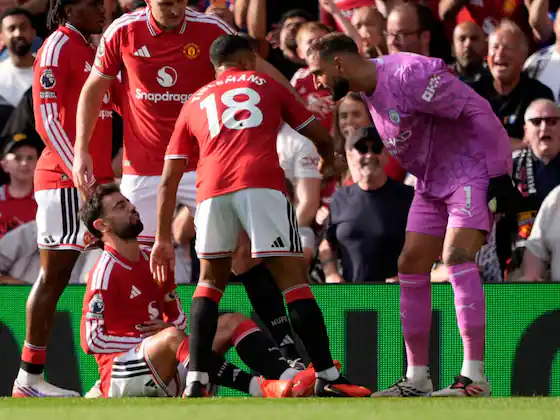
The Manchester derby had plenty of kicking, plenty of shouting and complete bewilderment over some dreadful refereeing calls, with a bit of football taking place in between.
It is that football which matters here, with United showing precisely why there is still a major question mark hanging over Michael Carrick.
Can he finally be the manager who builds on a strong season and delivers consistency? Can he turn Manchester United into a calmer side capable of patiently wearing opponents down?
Even though the season is only four matches old, there may already be doubts about that second point.
The problems United encountered trying to break down a stubborn opponent were remarkably similar to the ones they had on the opening day against Hull, but this time they were up against 10 men for 67 minutes.
You can read 16 Conclusions on the match here, but this piece is about a deeper look at where it went wrong for United from a tactical point of view.
The Bottlenecked Centre Manchester United were effective in attack last season when they moved the ball quickly with one-touch passing and several players operating close together, mainly through the middle of the pitch. But what happens when there are simply too many players in that area?
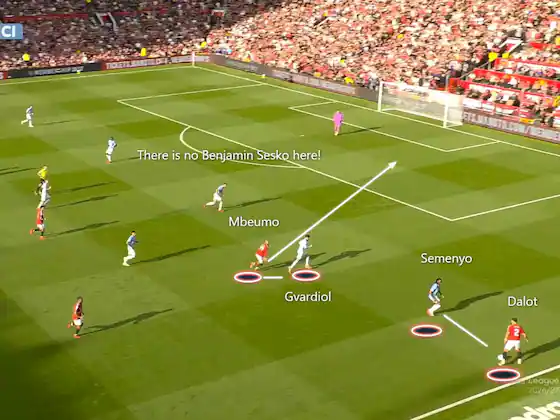
Credit must go to City, who produced something close to Thomas Frank’s Brentford-style low block and shut down central spaces, forcing United towards the flanks. They even used Antoine Semenyo as a wing-back at times.
Operating in a 4-4-1/5-3-1 after going down to 10 men meant the responsibility was on Manchester United’s players to create something themselves, rather than wait for transitions as they have successfully done in this fixture before.
Because most of United’s attackers prefer to drift inside with their backs to goal and receive fizzed passes into their feet - Bryan Mbeumo, Matheus Cunha and Bruno Fernandes among them - City were able to condense the middle of the pitch and squeeze the available room.
Enzo Fernandez and Elliot Anderson offered outstanding protection in midfield, stepping in quickly to stop passes being fed into those players from defence.
Manchester City squeezed the midfield against Manchester United.
As Fernandes tried to drop in to offer an option, he was immediately tracked by Ruben Dias because the space was so crowded that the Red Devils could not move the ball sharply between themselves.
A mass of City midfielders, forwards and defenders denied Manchester United’s central attackers any room in the middle of the pitch, which left most of United’s attackers bunched together centrally and unavailable as passing options.
It becomes far more difficult to play quick combinations when so many players are packed into one area.
Bruno Fernandes could find no room against Manchester City.
Wide issues for Manchester United So why, you might ask, could they not simply go wide and try to score from there?
Well, their opening match against Hull City had already shown that this is an area where they struggle.
Whenever Manchester United worked the ball out wide, a wide full-back would step out to confront Marcus Rashford or Bryan Mbeumo, and if a full-back or attacker attempted an underlapping run into the gap between a City full-back and centre-back, the centre-back was quick to stay tight to the runner going beyond.
Manchester United struggled out wide against Manchester City.
On top of that, it brought little reward because Manchester United took far too long to introduce a player to aim for in the penalty area in Benjamin Sesko. Their severe deficiencies at full-back were exposed.
Manchester United had no focal point in attack.
They do not have a dangerous attacking full-back who can consistently deliver crosses or overlap effectively unless Luke Shaw is playing alongside Rashford, and it is no secret that the Englishman’s minutes have had to be managed for a long time.
Even when Sesko was introduced - too late - City were still quick to send a centre-back out towards the player attempting the cross, disrupting the delivery aimed at the Slovenian. The Red Devils never succeeded in creating a chance for the tall striker.
With limited room through the middle and poor quality delivery from wide areas, United were short of ideas for large spells of the match, even with the extra man.
Manchester United fluffing their lines in attack Manchester United have become used to winning this fixture by playing in transition. City are usually the team that dominate the ball, so United - with Bruno Fernandes as the conductor - have had something of a cheat code, helped by an Old Trafford crowd driving them on.
When that script was reversed, United discovered just how hard it was. Many of their attackers are so used to exploiting large spaces in attack that, when they did finally get some room in City’s half, they often rushed the moment.
They hurried into mishit shots when a pass was the better option, sliced passes carelessly out of play or took poor first touches - in short, they forced things. Poor decision-making led to fewer chances being created.
Manchester United rushed their decisions.
United looked like a side unfamiliar with scoring from calmer, more controlled attacking moves. And, truthfully, even if they are trying to become that team, they do not currently look capable of it.
Manchester United spent heavily on their attack last summer, and it paid off. Their goalscoring improved and so did their results.
Although they were on the wrong end of a debatable VAR decision, the concern for Michael Carrick is that, already twice in four matches this season, an opponent has quickly worked out that United become blunt when pushed wide and when their effective central players are stifled.
The pattern for United over the years has been one promising season followed by a disastrous one.
There is still plenty of time for Carrick to put things right, but he must solve these issues before the downward spiral reaches the point of no return.