Bournemouth will play the first European match in their history on Thursday, and FFT spoke to key figures at the club to understand how they have risen to greater heights than ever before.
With heads down, the Bournemouth players were clearly devastated. As they made their way back to the dressing room at Goodison Park, they knew that their 3-1 win over Everton would still not be enough to save them.
Aston Villa’s draw with West Ham had confirmed the Cherries’ relegation after five seasons of outperforming expectations in the top flight. Six days later, Eddie Howe resigned, bringing to an end a 26-year connection with the club as both player and manager. From the technical area, he had masterminded an extraordinary escape from relegation out of the Football League, three promotions and a highest-ever Premier League finish of ninth. It felt as though the fairy tale was collapsing, with the final chapter of Bournemouth’s golden era about to be written.
Six years later, those painful memories from July 2020 now look like only the end of the opening act. Promotion back to the Premier League, an admired recruitment model, a sixth-place finish and qualification for the Europa League have done far more than ease the pain of relegation.
There was never any certainty that the story would reach this point. In their first season back in the Championship, defeat to Brentford in the play-off semi-finals left the club at a major crossroads – had they failed to go up the following year, the narrative could easily have been about decline rather than the upward momentum they have enjoyed since.
“The second season was really big for us as a club,” vice-captain Lewis Cook says, having joined the Cherries in 2016. “The pressure behind the scenes was significant. The players probably didn’t realise at the time, but if we hadn’t gone up that year, it would have been tough.”
That summer, after Jason Tindall and Jonathan Woodgate had both taken charge at different points during the previous campaign, Scott Parker arrived to inherit a squad that still featured several players with top-flight experience, including Jefferson Lerma, Dominic Solanke and Philip Billing. The new manager made them far more difficult to beat – Parker did not lose a league game until November and, driven by Solanke’s 29 league goals, his side finished runners-up behind champions Fulham.
Winning promotion back to the Premier League not only delivered a major financial lift, but also made Bournemouth a far more attractive investment. Owner Maxim Demin had been considering a sale, and talks over a takeover with long-time admirer Bill Foley continued throughout the summer after promotion. Demin had been involved since 2011 and had overseen the rise from League One to the top division, but felt it was the right moment to move on.
A difficult start to life back in the top flight could easily have derailed those talks. A 2-0 opening-day win over Aston Villa was an ideal beginning, but heavy defeats to Manchester City and Arsenal followed, before a 9-0 hammering by Liverpool at Anfield. That was followed by an ill-judged post-match interview from Parker, who said the team were “underequipped at this level” and admitted there had been a “fear of where we are as a squad” throughout pre-season without “help” from above.
“That season was hard,” Cook admits. “We just needed to settle the ship after a few big defeats. It goes back to the lads not having any fear and being able to bounce back from bad situations. Ever since I came to Bournemouth, everyone has always written us off as a small club, but we showed fight.”
Parker was dismissed and replaced by first-team coach Gary O’Neil, who was tasked with rescuing a side that many pundits had already written off for immediate relegation. His impact was exactly what was needed, and an unbeaten run of six matches – including a 2-1 home victory over Leicester with Foley in the stands – brought renewed belief. By the time the Premier League paused for the World Cup in mid-season, the Cherries were out of the relegation zone.
As attention shifted to Qatar, Demin and Foley completed their deal, with the American’s investment group, Black Knight Football Club, finalising a takeover worth more than £100m. With it came Foley’s mission statement: to “move forward with an ‘always advance, never retreat’ approach”. The initial plan under the new ownership was to invest in a state-of-the-art training centre, improve player development and strengthen the first team, while also committing additional funds to the Cherries’ women’s team. Black Knight also embraced the strong family atmosphere that had served the club so well in the past.
“The club has to be run properly from top to bottom,” says record appearance holder Steve Fletcher, who scored the vital goal that kept Bournemouth in the Football League in 2009. He now works as a club ambassador. “Everyone has to buy into what we’re all about. It doesn’t matter how big or small your department is, or how significant or insignificant you think your role might be, everyone is made to feel like they have a big part to play.
“Whether you’re a chef, groundsman, accountant, in media or marketing, part of the first team or a masseur, everybody is pulling in the same direction – for the club to do well and for the players to be at their best. The players performing on the grass is the most important thing, but the feeling of unity right across the club is incredible.”
Even so, one thing that has unquestionably changed since the takeover is the ambition to move beyond simply surviving in the Premier League. “Different owners have tried to elevate the club in certain areas that you can see – the hospitality, the stadium and the training ground,” says Cook. “But the club has kept its identity of buying really good people and really good players. That’s helped us climb the table and grow. Previously, me and the older lads who’ve been here for quite a while would say it was always about staying in the league. There were a few times we finished higher, but staying in the league was always the ambition.”
Remaining in the division was still the main target in the closing months of Black Knight’s first season – something achieved with relative comfort as O’Neil’s side won six of their final nine matches in the spring.
There were already signs too of a vital recruitment strategy, with Dango Ouattara, Antoine Semenyo and Illia Zabarnyi all arriving in the January transfer window. The three would later generate a combined profit of more than £105m when they were sold last season.
That model has become central to Bournemouth’s recent progress – signing raw, gifted players from across the world and later selling them for substantial fees. It was not a complete reset in transfer policy, but the takeover gave an already established scouting network greater reach and stronger financial backing to secure its targets.
Unlike Brighton and Brentford, with whom Bournemouth are often grouped as examples of smart recruitment, their system is not built around the same heavily data-driven model. They are part of Foley’s multi-club network, which includes French club Lorient, Portugal’s Moreirense and New Zealand’s Auckland FC, with intelligence and analytics shared across the group to identify players capable of stepping straight into the first team.
That meant former chief executive Neill Blake and technical director Richard Hughes remained influential after the takeover, only leaving later on – Blake taking up a role overseeing Black Knight’s wider portfolio, while Hughes departed for Liverpool in 2024. Tiago Pinto, previously of Roma and Benfica, joined Bournemouth that same summer as president of football operations.
Since the takeover, players such as Milos Kerkez and Dean Huijsen have arrived and then moved on from the Vitality Stadium after short spells, while Solanke joined Spurs in 2024 in a £65m transfer. All of that has strengthened Bournemouth’s standing and made the club an appealing destination for players.
“When I first came to the club and even now, I can see how it’s constantly progressing,” defender James Hill tells FFT. “It’s an incredible place for players to come and develop their game – look at the players who’ve come and gone, how they’ve developed and pushed on to greater heights.
“For some players, this might not be the end point, it could be the beginning of their journey towards bigger things. The talent that has come through the door has been frightening.”
Hill joined Bournemouth from Fleetwood in 2022 as a 19-year-old. He enjoyed a breakthrough season in 2025-26, becoming a regular in the side after loan spells at Hearts and Blackburn, and after spending recent years around the first-team group.
His path is a clear illustration of how the club’s production line of talent keeps delivering replacements for players who depart. When Zabarnyi, Huijsen and Kerkez all moved on, it created the opening for Hill to establish himself in a reshaped defence.
“There was no-one saying, ‘Yes, it’s your spot now, go and play’, but there were opportunities for me to play during the season – I was at right-back at the start, before slowly building my way up,” Hill explains, having later made himself a regular in central defence.
“We’re such a good group. Whoever has the shirt and starts is supported by everyone else. Even if you’re left at home and not in the squad – and I’ve been there plenty of times – it’s about being ready to support the team and take your opportunity, because it may come. When players leave, there’s an opportunity for others to step in.”
The constantly evolving nature of the Bournemouth squad has also extended to the dugout. When O’Neil was replaced by Andoni Iraola in the summer of 2023, only weeks after keeping them up, many were surprised – even more so when the Spaniard failed to win any of his first nine league matches in charge.
But after a 2-1 victory over Burnley in his 10th game, the new head coach never looked back, leading the club to 12th place with a record Premier League points total. That figure was bettered again when they finished ninth the following season, playing a modern, high-pressing style that impressed many observers and changed the squad’s internal expectations.
“Europe was what we were pushing for last season, that was the main goal at the start of the year,” says Hill. “We’d missed out the season before, so we knew what the target was and where we could get to.”
A 4-2 defeat to champions Liverpool on the opening night of last season showed glimpses of their quality, before an eight-game unbeaten run lifted Bournemouth into the upper part of the table. But just as supporters started to dream, a stretch of 11 matches without a win gave critics renewed ammunition.
“I can remember us drawing a lot of games and everyone having opinions about us not winning,” Cook recalls. “But if you draw five or six games in the Premier League, it’s not the worst thing at all. I felt we were in a great spot.”
For all the positivity inside the camp, that run also coincided with the looming exit of Semenyo, who had scored nine goals by early January and had been the team’s main attacking threat. Even though the Ghana international’s move to Manchester City was in its final stages, he kept playing and featured for the Cherries in a crucial home game against Tottenham that would become his farewell on the south coast.
What happened next felt like something from Roy of the Rovers. With the match drifting towards a 2-2 draw and another game without victory, the forward collected the ball on the left with a crowded penalty area ahead of him. With only seconds remaining, Semenyo shifted the ball onto his right foot and drilled a low shot from 25 yards across goal and into the far corner. It proved to be his final touch in Bournemouth’s red and black, and gave his team-mates the perfect parting gift.
“It was an incredible night,” says Hill. “You couldn’t write it for him to score that goal as well. It was such a relief to win, because we hadn’t won a game for a while. But even before that, despite not winning, our performances had been improving.
“The boys were incredible when that moment came and Antoine left us. We were so happy because he deserved his big move – the lads understood that we needed to step up and you could already see it happening in the performances.”
Semenyo’s goal carried significance beyond the personal. As well as ending the winless sequence, it triggered another unbeaten run. Bournemouth did not lose again for the rest of the season – 18 matches in all – while recording notable wins at home to Liverpool, and away to Arsenal and Newcastle along the way.
As the season moved towards its conclusion, the possibility of qualifying for Europe became increasingly real – with Champions League football still a genuine prospect until the final week.
Crossing the line is often harder than forcing your way into contention, but there was little sign of nerves. “We went into every game thinking that we could get three points because we were full of confidence,” Hill adds. “We did very well at keeping the noise out of the camp and just concentrating on our performances. Over the last three games, we knew what we needed to do. We actually performed better under pressure.”
Victory at Fulham all but secured European qualification, but it was not officially confirmed until the penultimate game, against Manchester City. Pep Guardiola’s team needed to win to keep their title hopes alive, but another inspired Bournemouth display frustrated them. Eli Junior Kroupi’s goal looked set to earn all three points, only for Erling Haaland to snatch a 95th-minute equaliser for the visitors.
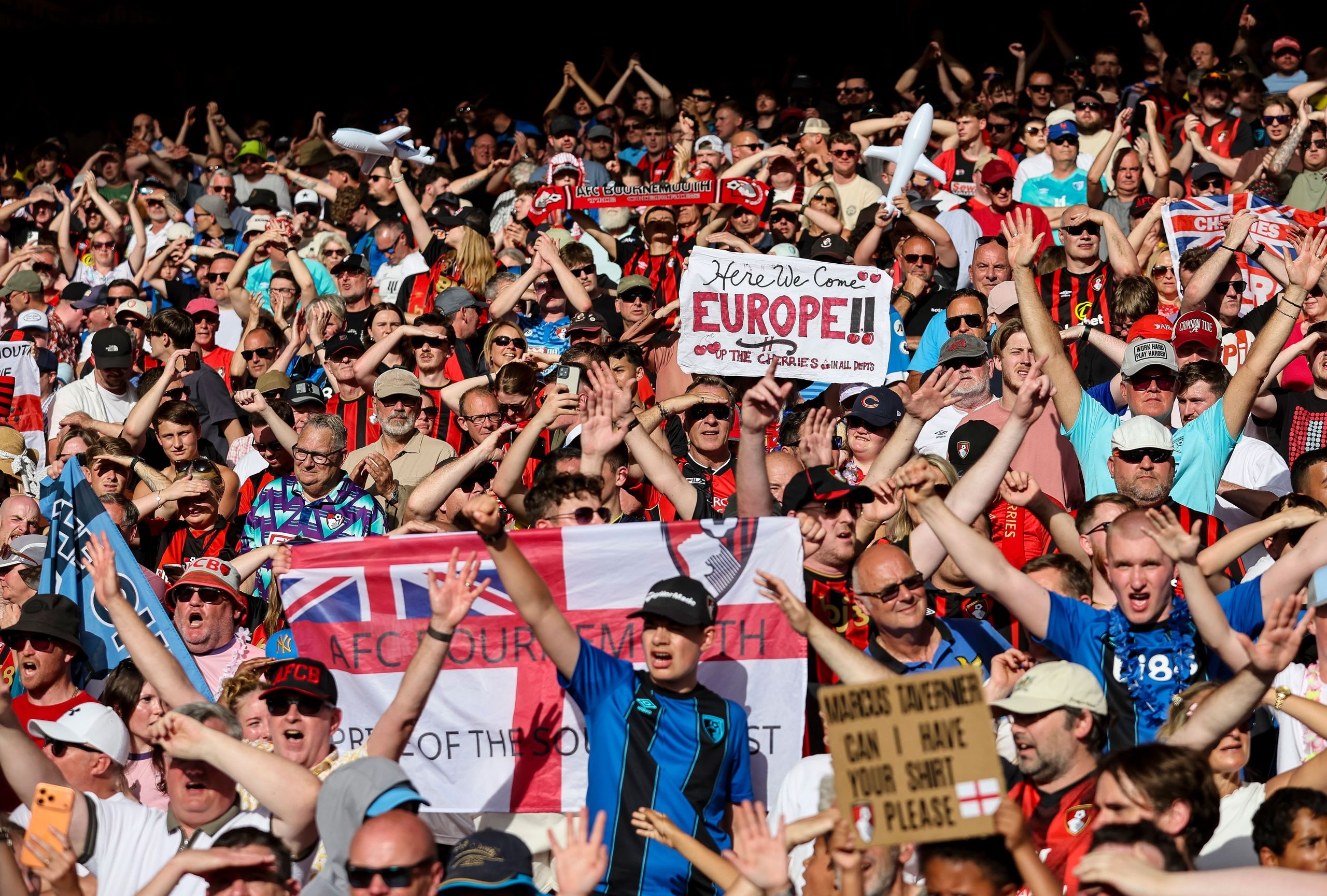
Although the draw meant a top-five finish was extremely unlikely going into the final day, there was no feeling of disappointment at the final whistle as players, supporters and staff celebrated reaching Europe for the first time in the club’s history.
“To finish in a Europa League place and celebrate on the pitch with the staff, players, everyone associated with the club and all the fans was incredible,” says Cherries legend Fletcher, after whom the North Stand at the Vitality Stadium was named in 2010. “I don’t think it properly sank in until a couple of days later when I started going out on the streets, and into supermarkets and restaurants, and people came to talk to me about it. The magnitude of what the club and that team achieved will live on forever.”
The scale of that achievement will be there for all to see when Bournemouth begin their first-ever Europa League campaign on Thursday alongside fellow Premier League clubs Sunderland and Crystal Palace, with the opening match of an eight-game league phase that runs until late January. Four of the Cherries’ European fixtures will be staged at their 12,000-capacity ground, believed to be the smallest home stadium ever used by an English club in a major European competition.
That is part of the charm of the story and a powerful reminder of where they have come from, even if change continues at speed. Iraola has since departed to become Liverpool’s new manager and has been succeeded by former Borussia Dortmund boss Marco Rose, while centre-back Marcos Senesi joined Spurs this summer.
The demands of playing twice a week on a regular basis will bring a fresh test for the squad, but by now the players are well used to adapting. “It’s similar to what happened last season – players have left, others come in, and you have to adapt and be ready to go,” Hill says. “With the new gaffer as well, the rate we’re learning has been really good.
“We don’t need to worry about the challenge of playing more games, either. We need to enjoy every moment – the excitement of playing in Europe and having those fixtures is an incredible problem to have, because the success of last season brought us to this point.”
Those with an even longer connection to the club will see these European nights as more than simply a reward for last season. For Fletcher, whose association with Bournemouth goes back to 1992, it is the continuation of a fairy tale that still refuses to end. “There will be a lot of emotion when we play that first European game,” he says. “Personally, I’ll probably shed a tear and try to capture the moment as much as I can.”
On Thursday, in Sociedad, everyone connected with Bournemouth will be able to watch with their heads held high.