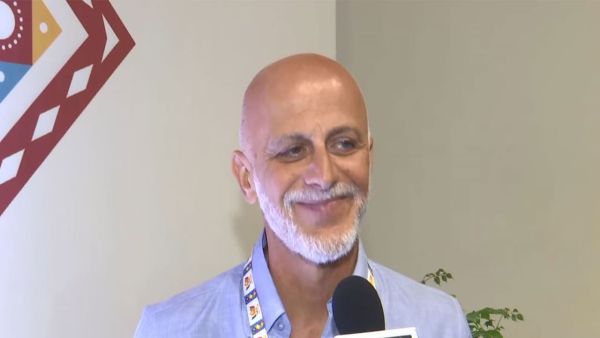
Underscoring India’s growing prominence on the global stage as a hub for cultural pluralism and strategic diplomacy, European Press Federation journalist Marco Alpeggiani highlighted the nation's remarkable trajectory. Sharing his perspective during an interaction with ANI at the BRICS Summit 2026 in New Delhi, Alpeggiani said, “I think it’s a massive opportunity for India. We are talking about multiculturalism; we are talking about multipolarity, and India has been developing greatly over the last 10–15 years. I think this is a great opportunity to show, to itself first, that these goals are really at the core of Indian society, following India’s traditions...”
Expanding on bilateral economic engagement and industrial synergy, he highlighted prospective avenues for collaboration between European enterprises and the Indian market, pointing towards emerging commercial partnerships. Detailing upcoming industrial collaborations, Alpeggiani added, “The next goal for the Italian fashion industry is going to be India. PM Modi and PM Meloni have been discussing this extensively... After many years of collaboration with China, the Milan Fashion industry has now set its sights on Indian society, especially Delhi, to develop a very close partnership. I think in the next couple of weeks, we will have the first Italian-Indian fashion industry meetings in Delhi, and it will be an opportunity. We need new markets in Europe, and we need collaboration...”
As these international perspectives highlight India's rising stature, the nation is hosting the summit on September 12–13 under the theme “Building for Resilience, Innovation, Cooperation and Sustainability”, with development, sustainability and innovation forming key areas of focus. These discussions align smoothly as BRICS leaders and partner countries gather in the national capital for deliberations aimed at strengthening cooperation across development, finance, technology, trade and people-to-people exchanges.
Building directly on these diplomatic talks, BRICS leaders earlier unanimously adopted the New Delhi Declaration 2026, with Prime Minister Narendra Modi describing the outcome as a reflection of a BRICS that is “wider in reach and stronger in purpose”. In a series of posts on X, PM Modi said the declaration focuses on innovation, sustainability and people-to-people ties, with the aim of making cooperation “more practical, development-oriented and responsive to the aspirations of the BRICS nations”. “I thank all the fellow BRICS nations and their leaders for its adoption,” the Prime Minister said.
Highlighting the roadmap ahead from these goals, PM Modi said the declaration also looks firmly towards the future, with BRICS set to deepen cooperation in artificial intelligence, Digital Public Infrastructure, quantum technologies, startups, MSMEs, science and research. “The Declaration also looks firmly to the future. BRICS will deepen cooperation in AI, Digital Public Infrastructure, quantum technologies, StartUps, MSMEs, science and research,” he added.
Complementing these strategic objectives, he noted that the grouping would strengthen the New Development Bank and work together on food, health, energy security, strong supply chains and sustainable infrastructure.
Marking two decades of its evolution alongside these milestones, India also released two commemorative postage stamps during the summit, celebrating the evolution of BRICS as a platform for dialogue and cooperation while capturing the priorities of India's BRICS Chairship 2026 under the same guiding theme.
Reflecting India's emphasis on environmental sustainability within this framework, the summit additionally witnessed Prime Minister Modi and BRICS leaders jointly planting saplings of the Banyan tree at the venue. The Banyan tree has deep-rooted significance in Indian civilisation, thought and culture and symbolised the collective resolve of BRICS nations to advance environmental sustainability and leave a greener legacy for generations to come.
The summit has brought together BRICS members and partner countries as India seeks to advance its priorities under its 2026 chairship and strengthen the grouping's role as a platform for cooperation among major emerging economies. BRICS currently comprises 11 countries—Brazil, China, Egypt, Ethiopia, India, Indonesia, Iran, Russia, Saudi Arabia, South Africa and the UAE. In 2025, Belarus, Bolivia, Kazakhstan, Cuba, Malaysia, Nigeria, Thailand, Uganda, Uzbekistan and Vietnam joined BRICS as Partner Countries, rounding out the framework of the 18th BRICS Summit being held in New Delhi on September 12–13, with India's chairship centred on resilience, innovation, cooperation and sustainability. (ANI)
(Except for the headline, this story has not been edited by Asianetnews Editorial staff and is published from a syndicated feed.)