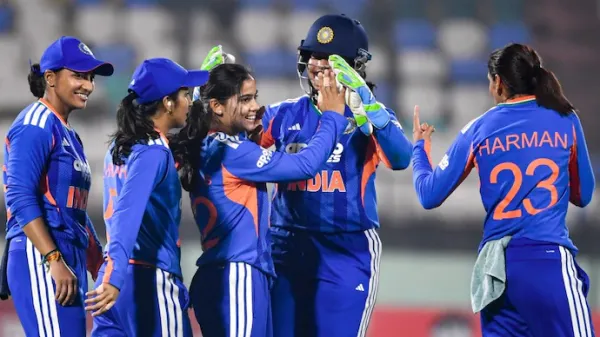
India vs Sri Lanka: The journey of Indian women’s cricket has been shaped by defining moments, resilient leadership, and historic breakthroughs. At the center of the current chapter stands Harmanpreet Kaur, a leader who is now just one win away from achieving an unprecedented milestone in T20 International cricket. As India prepares for another crucial contest, Harmanpreet’s captaincy record places her on the verge of becoming the most successful skipper in the history of the T20I format.
Harmanpreet Kaur currently occupies second place on the list of most successful captains in women’s T20 Internationals. With 75 victories from 129 matches as skipper, her record reflects consistency, longevity, and the ability to guide her side through different phases of international cricket. One more win would allow her to equal the record held by the legendary Meg Lanning, a name synonymous with dominance in women’s cricket.
The third T20I against Sri Lanka women’s cricket team at the Greenfield International Stadium offers Harmanpreet a golden opportunity to reach the summit. India already lead the five-match series 2–0, and confidence is visibly high within the squad. The match is not only important in terms of the series outcome but also carries historical significance for Indian cricket leadership.
Meg Lanning currently sits at the top with 76 wins from just 100 matches as captain, an extraordinary success rate that underlines her era of control over the format. Her tenure with Australia women’s cricket team was defined by tactical clarity and relentless winning momentum. Under her leadership, Australia lifted the T20 World Cup four times, in 2014, 2018, 2020, and 2023, establishing a benchmark that has inspired teams across the globe.
In comparison, Harmanpreet Kaur’s India came agonizingly close to World Cup glory in 2020, finishing as runners-up after a tough final against Australia. That defeat, while painful, became a turning point. It strengthened the team’s resolve and highlighted the need for composure in high-pressure matches. The lessons learned during that campaign played a crucial role in shaping future successes.
India’s maiden World Cup victory in 2025 on home soil marked a defining milestone for the Women in Blue. That triumph was not just about lifting a trophy; it symbolized the evolution of Indian women’s cricket into a confident, title-winning unit. Harmanpreet’s leadership during the tournament earned praise for balancing aggression with calm decision-making, further cementing her reputation as a modern cricket leader.
With momentum on their side, India have already set their sights on the next big challenge: the T20 World Cup in England scheduled for June and July 2026. The tournament represents another chance to add silverware to the cabinet and reinforce India’s status as a global powerhouse. Preparation, squad depth, and leadership stability will be key factors in their campaign.
For the upcoming ICC T20 World Cup, India have been placed in Group A alongside Pakistan, South Africa, and Australia. Each fixture promises high intensity, but the clash against arch-rivals Pakistan on June 14 in Birmingham is expected to draw global attention. Performances in the group stage will set the tone for India’s title ambitions and test the team’s ability to handle pressure.
While statistics highlight Harmanpreet Kaur’s achievements, her true impact extends beyond wins and losses. She has nurtured young talent, fostered belief within the squad, and led by example with both bat and temperament. As she stands on the brink of history, her journey reflects the broader rise of Indian women’s cricket on the world stage.