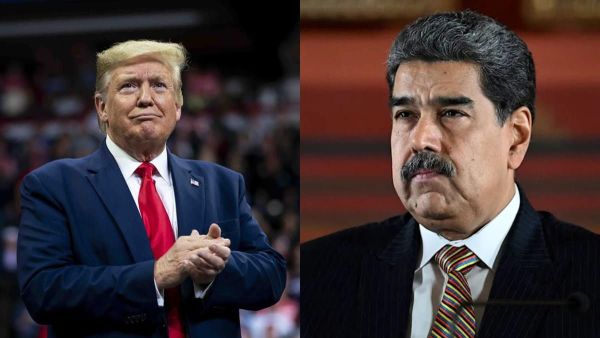
Caracas (Venezuela): The United States carried out a lightning military strike on Venezuela early Saturday, capturing President Nicolas Maduro and his wife, Cilia Flores, and spiriting them out of the country. American officials say the pair will face narco-terrorism charges in US courts.
The overnight operation left Venezuela reeling, with its leadership uncertain and details of casualties and the impact on its military still to emerge. Countries across the region and the wider world were absorbing the destabilising implications of the apparently unilateral US action.
Here’s what we know — and what we don’t:

Explosions rang out, and low-flying aircraft swept through Venezuela’s capital, Caracas, early Saturday. At least seven blasts were heard in an attack that lasted less than 30 minutes. The targets appeared to include military infrastructure. Smoke was seen rising from the hangar of a military base in Caracas, and another military installation in the capital was without power.
Venezuelan officials said people had been killed, but the scale of casualties was unclear.
Trump said in a social media post that Maduro “has been, along with his wife, captured and flown out of the Country.”
The attack followed months of escalating pressure by the Trump administration, which has built up naval forces in the waters off South America and, since early September, has carried out deadly strikes on alleged drug-smuggling boats in the eastern Pacific and Caribbean. Last week, the US struck Venezuelan soil with a CIA drone strike at a docking area alleged to have been used by drug cartels.
US Attorney General Pam Bondi said on social network X that Maduro and Flores had both been indicted in the Southern District of New York and “will soon face the full wrath of American justice on American soil in American courts.”
She said Maduro faced charges of “Narco-Terrorism Conspiracy, Cocaine Importation Conspiracy, Possession of Machineguns and Destructive Devices, and Conspiracy to Possess Machineguns and Destructive Devices against the United States.”
Maduro was indicted in March 2020, during Trump’s first term, but the indictment against Flores was not previously made public.
The US does not recognise the jurisdiction of the International Criminal Court, and the legal implications of the strike under US law were not immediately clear.
The Trump administration maintains that Maduro is not the legitimate leader of Venezuela and claims he has effectively turned Venezuela into a criminal enterprise at the service of drug traffickers and terrorist groups.
Mike Lee, a US senator from Utah, said on X that the action “likely falls within the president’s inherent authority under Article II of the Constitution to protect US personnel from an actual or imminent attack.”
Maduro’s government accused the United States of an “imperialist attack” on civilian and military installations and urged citizens to take to the streets.
Armed individuals and uniformed members of a civilian militia took to the streets of a Caracas neighbourhood long considered a stronghold of the ruling party. But in other areas of the city, the streets remained empty hours after the attack. Parts of the city remained without power, but vehicles moved freely.
By law, Vice President Delcy Rodriguez should take power, but there was no confirmation that this had happened.
There was no immediate comment from Venezuela opposition leader Maria Corina Machado. She was in hiding for almost a year before travelling to Norway last month to receive the Nobel Peace Prize.
Venezuela’s neighbour, Colombia, sent troops to the border and anticipated an influx of refugees from Venezuela.
Cuba, a supporter of the Maduro government and a longtime adversary of the United States, urged the international community to respond to what President Miguel Diaz-Canel Bermudez called “the criminal attack.”
Russia’s Foreign Ministry said the attack and capture of Maduro would be “an unacceptable infringement on the sovereignty of an independent state.”
US allies in Europe — critical of Maduro but mindful of international law — offered muted responses as they scrambled to understand the scale and implications of the attack.
European Union foreign policy chief Kaja Kallas said the bloc “has repeatedly stated that Mr Maduro lacks legitimacy and has defended a peaceful transition. Under all circumstances, the principles of international law and the UN Charter must be respected. We call for restraint.”
British Prime Minister Keir Starmer said he had not spoken to Trump about the attack and stressed that “the UK was not involved in any way.” Spanish Prime Minister Pedro Sanchez said Spain was “conducting a thorough monitoring of the events in Venezuela” and called for “de-escalation and responsibility.”
In an interview on Saturday morning, President Donald Trump said that the United States will be making decisions on what is next for Venezuela.
“We’ll be involved in it very much” as to who will govern the country, Trump said.
“We can’t take a chance in letting somebody else run and just take over what he left, or left off,” Trump said in an interview with Fox News hours after the capture.
He also added President Maduro and his wife were aboard US warship Iwo Jima and were headed to New York, where they will face prosecution.
Meanwhile, Venezuelan ruling party leader Nahum Fernandez told The Associated Press that Nicolas Maduro and his wife were at their home within the Ft. Tiuna military installation when they were captured.
“That’s where they bombed,” he said. “And, there, they carried out what we could call a kidnapping of the president and the first lady of the country.”
(With inputs from Associated Press.)