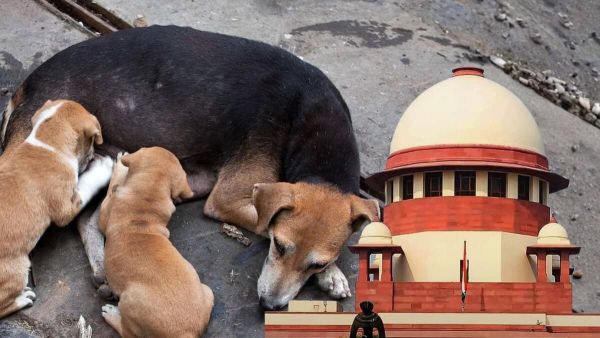
New Delhi: While hearing the removal of stray dogs from public spaces, the Supreme Court, on Wednesday, January 7, questioned the petitioners, “How do you know which dog is in the mood to bite?”
A bench of Justices Vikram Nath, Sandeep Mehta and NV Anjaria, hearing pleas for modification of its earlier orders filed by dog lovers and those seeking stringent compliance, observed that people were dying not only due to stray dog bites alone but also because of accidents caused by stray animals on roads.
“It’s not just biting,” Justice Nath said. “It’s also the threat caused by dogs. Of accidents. How can you identify? Which dog is in what mood in the morning, you don’t know.”

“The roads should be clear of dogs and stray animals. Civic bodies have to implement the rules, modules and directions strictly,” the bench said.
Justice Mehta pointed out that two Rajasthan High Court judges have suffered accidents in the last 20 days and one of the judges was still suffering from spinal injuries.
“It’s a serious issue,” he told lawyers appearing in the matter.
In his arguments, senior advocate Kapil Sibal, appearing for the petitioners, submitted that the response against this issue should be reflective of a mature and responsible society.
“First of all, this is not an adversarial issue and we are here as dog lovers. If one tiger is a man-eater, we don’t kill all tigers. We must make sure that sterilisation takes place and the population must come down. There is a process for that,” Sibal submitted, saying that the court can adopt the formula of capture, sterilise, vaccinate and release (CSVR) for managing and controlling the population of stray dogs, which will gradually reduce dog bite incidents.
He added that if dogs that have rabies and those that do not have rabies are put in the same shelter, all of them will get rabies.
Responding sarcastically, Justice Mehta said, “Only thing left is then to also provide counselling to the dog to not bite someone.”
“Prevention is always better than cure,” Justice Nath observed and pointed out that there was nothing much to argue in the matter. The court is only directed to remove the stray dogs from institutional areas and has not interfered with any rules and regulations, he said.
The bench said that what it is trying in the matter is the strict enforcement of rules, regulations, modules and standard operating procedures (SOPs) by states and civic bodies.
“Some states have not responded to compliance with our orders and implementation of the arguments. We will be very harsh with those states. All the rules, regulations and SOPs need to be followed,” the top court said.
At the outset, senior advocate Gaurav Agarwal, who has been appointed as amicus curiae in the matter, said that the National Highways Authority of India (NHAI) has prepared an SOP to implement the court order.
“They have identified 1,400 km of road as a vulnerable stretch. However, after detection, the NHAI says that the state governments have to take care of it,” Agarwal said.
The bench suggested fencing the roads and expressways to prevent stray animals from coming onto the roads.
Agarwal submitted that states like Madhya Pradesh, Uttar Pradesh, Karnataka and Punjab are yet to file compliance affidavits, while some states have filed very “disappointing” affidavits.
Justice Nath said that the court will deal with those states.
The arguments remained inconclusive and would continue on Thursday, January 8.
(With PTI inputs)