New Delhi [India], January 10 (ANI): India's economy is expected to remain one of the fastest-growing major economies globally, with growth projected at 7.4 per cent in 2025, according to the United Nations' World Economic Situation and Prospects 2026 report.
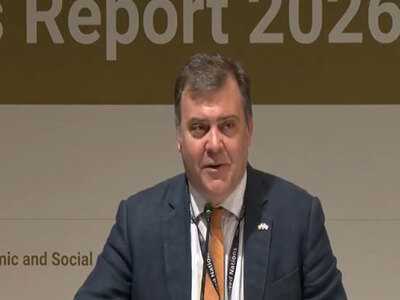
Speaking after the report's release, UN Country Economist for India Chris Garroway said the growth projection aligns with India's strong recent performance, noting that the figure coincides with the advance estimates released this week by the Ministry of Statistics and Programme Implementation (MoSPI) for fiscal year 2025-26.
The UN expects India's growth momentum to moderate slightly in the coming years, with economic expansion projected at 6.6 per cent in 2026, followed by a marginal uptick to 6.7 per cent in 2027.
According to the UN report, India's robust growth outlook is underpinned by strong private consumption and the front-loading of exports in the previous year. However, the UN anticipates some softening in export performance next year as new tariffs take effect.
The report also highlights domestic policy measures as key contributors to sustained growth. Tax reforms and monetary easing have supported economic activity, while continued government spending on infrastructure, defence, digitalisation, and renewable energy has boosted fixed capital formation across the economy.
"These numbers are supported by assumptions of strong private consumption, as well as the front loading of exports last year, and an expected dip in the coming year as tariffs come into place. The report also cites tax reforms and monetary easing in India as one of the reasons for the continued strong growth. The report also refers to important government spending on infrastructure, defence, digital and renewable energy projects, all of which boosted fixed capital formation in the country," Garroway said.
According to the World Economic Situation and Prospects (WESP) 2026, released by the United Nations earlier this week, the economic growth in India is projected to moderate from an estimated 7.4 per cent in 2025 to 6.6 per cent in 2026. Resilient household spending, strong public investment, and lower interest rates are expected to underpin economic activity.
While higher US tariffs may weigh on select product categories, key export segments are likely to remain largely unaffected. Moreover, strong demand from other major markets is expected to partially offset the impact, the UN report had asserted.
Trade policy uncertainty is a key near-term risk, even though recent US tariff increases on Asian economies were smaller than initially anticipated and some trade agreements have been reached.
Against that backdrop, the report underscored that navigating an era of trade realignments, persistent price pressures, and climate-related shocks will demand deeper global coordination and decisive collective action at a time when geopolitical tensions are rising, policies are becoming more inward-looking, and impetus towards multilateral solutions is weakening. (ANI)