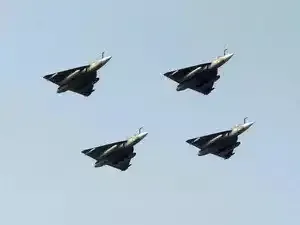
As fighter jets prepare to roar across the national capital’s skies for the Republic Day celebrations, the Delhi Forest Department has adopted an unusual strategy—using 1,275 kg of boneless chicken to control the movement of black kites and keep them away from aircraft flight paths, reported PTI.
A senior official said the meat-throwing exercise, conducted annually ahead of the air show in coordination with the Indian Air Force (IAF), is meant to reduce the risk of bird strikes, which pose a significant threat to low-flying aircraft during aerial displays.
"This is an annual preventive exercise undertaken before the Republic Day air show. Birds such as black kites are naturally drawn to open areas and food sources, and if they enter the flying corridor, they can pose a serious hazard to aircraft performing low-level manoeuvres," an official told PTI.
Highlighting the difference this year, the official said the department has decided to switch to chicken meat.
"Earlier, buffalo meat was used for this purpose. This year, chicken meat will be used for the first time. Our effort is to strike a balance between wildlife management and the smooth conduct of the Republic Day celebrations," the official added.
The exercise will be carried out between January 15 and January 26 at 20 locations across the city, including sensitive zones such as the Red Fort and Jama Masjid, where a high concentration of kites is usually observed, he added.
The other locations include areas near Mandi House, Delhi Gate and Maulana Azad Institute of Dental Sciences among others.
"These locations are identified every year based on bird movement patterns. Areas such as the Red Fort and Jama Masjid see a higher influx of kites, increasing the risk of birds straying into the flight path. By feeding them at designated points, we ensure they stay away from the air show route and also remain adequately fed," the official said.
Explaining the process, the officer said it involves throwing small pieces of chicken meat into the air at the designated locations so that the birds remain engaged at lower altitudes and do not fly towards the air routes.
"This exercise is carried out repeatedly over a period of around 15 days before the event, allowing the birds to get accustomed to the feeding pattern. The objective is to ensure that on the Republic Day air show, the birds do not stray into the flight paths and pose any risk to aircraft," the official added.
To carry out the exercise, the Delhi government’s Department of Forests and Wildlife issued a short-term notice on Wednesday seeking quotations for the supply of 1,275 kg of boneless chicken, as per the tender document.
The meat will be supplied over seven days between January 15 and January 25. Of this, 170 kg will be delivered on January 15, 18, 19, 20, 23 and 25, while a larger quantity of 255 kg is scheduled for January 22. All consignments are to be delivered to the Wildlife Rescue Centre in Wazirabad.
Around 20 kg of meat will be used at each location, taking the total daily requirement across all sites to nearly 400 kg.
According to the tender, the chicken must be supplied in 20–30 gram pieces, packed in five-kg packets, with daily consignments ranging from 34 to 51 packets depending on the quantity required.
While the document does not specify the cost, a trader at the Ghazipur Chicken and Fish Market said boneless chicken is currently priced at about Rs 350 per kg.
A senior official said the meat-throwing exercise, conducted annually ahead of the air show in coordination with the Indian Air Force (IAF), is meant to reduce the risk of bird strikes, which pose a significant threat to low-flying aircraft during aerial displays.
"This is an annual preventive exercise undertaken before the Republic Day air show. Birds such as black kites are naturally drawn to open areas and food sources, and if they enter the flying corridor, they can pose a serious hazard to aircraft performing low-level manoeuvres," an official told PTI.
Highlighting the difference this year, the official said the department has decided to switch to chicken meat.
"Earlier, buffalo meat was used for this purpose. This year, chicken meat will be used for the first time. Our effort is to strike a balance between wildlife management and the smooth conduct of the Republic Day celebrations," the official added.
The exercise will be carried out between January 15 and January 26 at 20 locations across the city, including sensitive zones such as the Red Fort and Jama Masjid, where a high concentration of kites is usually observed, he added.
The other locations include areas near Mandi House, Delhi Gate and Maulana Azad Institute of Dental Sciences among others.
"These locations are identified every year based on bird movement patterns. Areas such as the Red Fort and Jama Masjid see a higher influx of kites, increasing the risk of birds straying into the flight path. By feeding them at designated points, we ensure they stay away from the air show route and also remain adequately fed," the official said.
Explaining the process, the officer said it involves throwing small pieces of chicken meat into the air at the designated locations so that the birds remain engaged at lower altitudes and do not fly towards the air routes.
"This exercise is carried out repeatedly over a period of around 15 days before the event, allowing the birds to get accustomed to the feeding pattern. The objective is to ensure that on the Republic Day air show, the birds do not stray into the flight paths and pose any risk to aircraft," the official added.
To carry out the exercise, the Delhi government’s Department of Forests and Wildlife issued a short-term notice on Wednesday seeking quotations for the supply of 1,275 kg of boneless chicken, as per the tender document.
The meat will be supplied over seven days between January 15 and January 25. Of this, 170 kg will be delivered on January 15, 18, 19, 20, 23 and 25, while a larger quantity of 255 kg is scheduled for January 22. All consignments are to be delivered to the Wildlife Rescue Centre in Wazirabad.
Around 20 kg of meat will be used at each location, taking the total daily requirement across all sites to nearly 400 kg.
According to the tender, the chicken must be supplied in 20–30 gram pieces, packed in five-kg packets, with daily consignments ranging from 34 to 51 packets depending on the quantity required.
While the document does not specify the cost, a trader at the Ghazipur Chicken and Fish Market said boneless chicken is currently priced at about Rs 350 per kg.