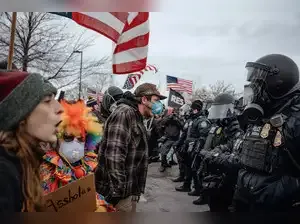
President Donald Trump on Thursday threatened to invoke an 1807 law and deploy troops to quell persistent protests against the federal officers sent to Minneapolis to enforce his administration's massive immigration crackdown. Presidents have invoked the law more than two dozen times, most recently in 1992 by President George H.W. Bush to end unrest in Los Angeles. In that instance, local authorities had asked for the assistance. Minnesota Attorney General Keith Ellison responded that he would challenge any such action in court. He's already suing to try to stop the surge by the Department of Homeland Security, which says it has made more than 2,000 arrests in the state since early December. ICE is a DHS agency.
The threat comes a day after a man was shot and wounded by an immigration officer who had been attacked with a shovel and broom handle. That shooting further heightened the fear and anger that has radiated across the city since an Immigration and Customs Enforcement agent fatally shot Renee Good in the head.
Trump has repeatedly threatened to invoke the Insurrection Act, a rarely used federal law, to deploy the U.S. military or federalize the National Guard for domestic law enforcement, over the objections of state governors.
The Insurrection Act of 1807 is a law allowing the president to deploy the military or federalize soldiers in a state's National Guard to quell rebellion, an exception to laws that prohibit soldiers being used in civil or criminal law enforcement.
It has been used 30 times in U.S. history, according to New York University's Brennan Center for Justice. The Supreme Court has ruled that the president alone can determine if the act's conditions have been met.
Trump has already taken the unusual step of federalizing National Guard soldiers to help with immigration law enforcement in Democrat-run cities over the objections of state governors, including in Los Angeles last year, which a judge ruled in December was unconstitutional.
Trump's aggressive moves in Minnesota have divided his supporters: 59 per cent of Republicans favored a policy prioritizing arrests by immigration officers even if people get hurt, while 39 per cent said officers should focus on not harming people even if it means fewer arrests, according to a Reuters/Ipsos survey released on Thursday.
The threat comes a day after a man was shot and wounded by an immigration officer who had been attacked with a shovel and broom handle. That shooting further heightened the fear and anger that has radiated across the city since an Immigration and Customs Enforcement agent fatally shot Renee Good in the head.
ET Budget Survey: Tell us your wishlist
Trump has repeatedly threatened to invoke the Insurrection Act, a rarely used federal law, to deploy the U.S. military or federalize the National Guard for domestic law enforcement, over the objections of state governors.
What is the Insurrection Act in USA?
The Insurrection Act of 1807 is a law allowing the president to deploy the military or federalize soldiers in a state's National Guard to quell rebellion, an exception to laws that prohibit soldiers being used in civil or criminal law enforcement.
It has been used 30 times in U.S. history, according to New York University's Brennan Center for Justice. The Supreme Court has ruled that the president alone can determine if the act's conditions have been met.
Trump has already taken the unusual step of federalizing National Guard soldiers to help with immigration law enforcement in Democrat-run cities over the objections of state governors, including in Los Angeles last year, which a judge ruled in December was unconstitutional.
Trump's aggressive moves in Minnesota have divided his supporters: 59 per cent of Republicans favored a policy prioritizing arrests by immigration officers even if people get hurt, while 39 per cent said officers should focus on not harming people even if it means fewer arrests, according to a Reuters/Ipsos survey released on Thursday.