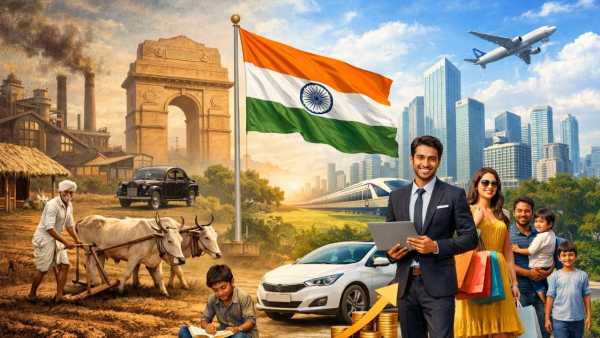
It has been 77 years since our Constitution came into force in the country. India is celebrating its 77th Republic Day today. This is not just a constitutional milestone, but also a symbol of the country's social and economic journey. In the 1950s, India was a newly independent country, where resources were limited and the common man's priority was only to meet his daily needs. Today the same India stands as a strong economic power on the global stage.
India's economy was very fragile in the initial years after independence. The country's GDP was considered to be around 30 billion dollars. Agriculture was the mainstay and industry and service sectors were still in their nascent stages. Employment opportunities were limited and technological development was almost non-existent. With time, development of policies, institutions and human resources began to change the picture.
Today India's total GDP has reached the level of about 4 trillion dollars. That means, compared to 1950, the size of the economy has increased more than a hundred times. Information technology, pharmaceuticals, manufacturing, startup ecosystem and service sector have played an important role in this growth. India is now counted among the top economies of the world.
Around 1950, the average annual income of an Indian was only around 60-70 dollars. Permanent houses, electricity, education and health facilities were a dream for most people. Today the situation is different. Per capita income has reached above 2000 dollars. Access to banking, mobile, internet and government schemes in villages has improved the standard of living. Although challenges still exist, the opportunities are greater than ever.
The falling value of rupee is often discussed. In 1950, one dollar was worth around Rs 4.7, whereas today it is around Rs 90. But seeing this only as a weakness would be an incomplete analysis. Many factors like inflation, global trade, money market and open economy have influenced this change. In the initial decades, India had to depend on foreign aid for imports. Today the country has foreign exchange reserves of about 700 billion dollars. This reflects economic stability, investor confidence and ability to deal with global crises.
In the 1950s, India's share in global trade was limited. Today both India's exports and imports have increased manifold. India now trades actively with big markets like America, Europe, Asia and Africa. India, which struggled with hunger and poverty, has today become a center of space missions, digital payments, nuclear power and startup innovation. From UPI to Chandrayaan, India has proved that development and self-reliance can go together. This journey of 77 years is full of achievements, but challenges are also no less. Issues like employment, inequality and sustainable development still demand attention. Nevertheless, India's story so far shows that with the right direction and sustained effort, big changes are possible.