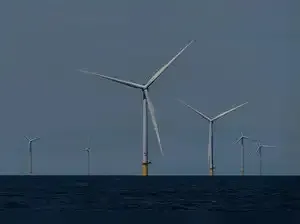
HAMBURG: Britain, Germany, Denmark and other European countries signed a clean energy pact at a summit in Hamburg on Monday, pledging to deliver 100 gigawatts (GW) of offshore wind power capacity through large-scale joint projects. The agreement clashes with U.S. President Donald Trump's opposition to green energy, and signals that Western and Northern European governments remain committed to wind power as a way to boost the region's energy security.
Speaking at the World Economic Forum in Davos last week, Trump amplified his criticism of European countries' efforts to shift to low-carbon energy, saying countries that rely on wind turbines lose money.
"We are standing up for our national interest by driving for clean energy, which can get the UK off the fossil fuel rollercoaster and give us energy sovereignty and abundance," British Energy Minister Ed Miliband said in a statement. The commitment to boost cross-border collaboration is part of a goal agreed by North Sea countries in 2023 to have 300 GW of offshore wind capacity by 2050. That followed Russia's invasion of Ukraine, which sharpened fears about Europe's dependency on Russian gas.
Industry lobby group WindEurope said that under the agreement its member companies pledged to cut costs, to create 91,000 jobs and to generate "1 trillion euros of economic activity".
Adding 100 GW at sea would transform Europe's power market because the region currently has 258 GW installed wind capacity, both on- and offshore, providing 19% of the electricity consumed in Europe, according to WindEurope data. Monday's deal, a draft of which was reported by Reuters last week, was signed at the North Sea Summit by Britain, Belgium, Denmark, France, Germany, Iceland, Ireland, Luxembourg, the Netherlands and Norway.
"By planning expansion, grids and industry together and implementing them across borders, we are creating clean and affordable energy, strengthening our industrial base and increasing Europe's strategic sovereignty," said German Economy Minister Katherina Reiche.
Separately, Reiche on Monday unveiled plans to revive Germany's languishing offshore wind tenders by a package of measures including granting investors more reliable power revenues.
By introducing Contracts for Difference, investors stand to receive compensation when market prices for electricity fall under an agreed reference price or they will pay back some of their revenues when prices exceed that benchmark.
The minister said Germany needed to step up its efforts after two recent tenders to develop wind projects off its coast did not attract any bids, whereas Britain and Ireland ran successful projects.
Britain said it would also sign other agreements with smaller groups of attending nations to promote more efficient development of cross-border projects, and infrastructure to create wind farms at sea that are directly connected to more than one country. Earlier in January, Britain secured a record amount of offshore wind capacity in its latest power auction, when projects with a total capacity of 8.4 GW were awarded contracts. (Reporting by Andreas Rinke in Hamburg, Holger Hansen in Berlin and William James in London; Writing by Ludwig Burger, Editing by Helen Popper and Hugh Lawson)
Speaking at the World Economic Forum in Davos last week, Trump amplified his criticism of European countries' efforts to shift to low-carbon energy, saying countries that rely on wind turbines lose money.
"We are standing up for our national interest by driving for clean energy, which can get the UK off the fossil fuel rollercoaster and give us energy sovereignty and abundance," British Energy Minister Ed Miliband said in a statement. The commitment to boost cross-border collaboration is part of a goal agreed by North Sea countries in 2023 to have 300 GW of offshore wind capacity by 2050. That followed Russia's invasion of Ukraine, which sharpened fears about Europe's dependency on Russian gas.
Industry lobby group WindEurope said that under the agreement its member companies pledged to cut costs, to create 91,000 jobs and to generate "1 trillion euros of economic activity".
Adding 100 GW at sea would transform Europe's power market because the region currently has 258 GW installed wind capacity, both on- and offshore, providing 19% of the electricity consumed in Europe, according to WindEurope data. Monday's deal, a draft of which was reported by Reuters last week, was signed at the North Sea Summit by Britain, Belgium, Denmark, France, Germany, Iceland, Ireland, Luxembourg, the Netherlands and Norway.
"By planning expansion, grids and industry together and implementing them across borders, we are creating clean and affordable energy, strengthening our industrial base and increasing Europe's strategic sovereignty," said German Economy Minister Katherina Reiche.
Separately, Reiche on Monday unveiled plans to revive Germany's languishing offshore wind tenders by a package of measures including granting investors more reliable power revenues.
By introducing Contracts for Difference, investors stand to receive compensation when market prices for electricity fall under an agreed reference price or they will pay back some of their revenues when prices exceed that benchmark.
The minister said Germany needed to step up its efforts after two recent tenders to develop wind projects off its coast did not attract any bids, whereas Britain and Ireland ran successful projects.
Britain said it would also sign other agreements with smaller groups of attending nations to promote more efficient development of cross-border projects, and infrastructure to create wind farms at sea that are directly connected to more than one country. Earlier in January, Britain secured a record amount of offshore wind capacity in its latest power auction, when projects with a total capacity of 8.4 GW were awarded contracts. (Reporting by Andreas Rinke in Hamburg, Holger Hansen in Berlin and William James in London; Writing by Ludwig Burger, Editing by Helen Popper and Hugh Lawson)