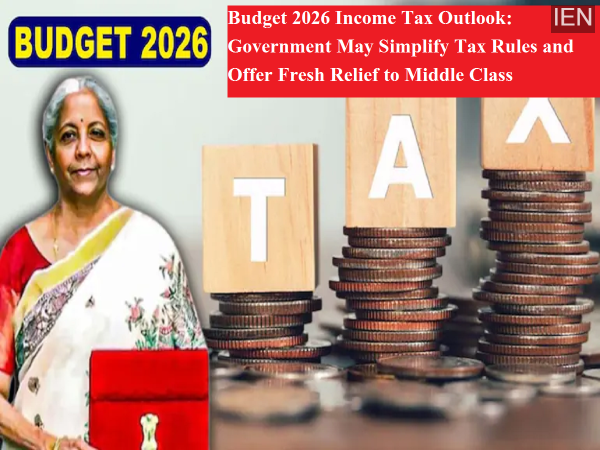
As India prepares for Union Budget 2026, expectations are running high among taxpayers, especially the middle class. Finance Minister Nirmala Sitharaman is widely expected to focus on simplifying income tax rules while announcing targeted relief measures to ease the financial burden on salaried individuals and investors. With the new Income Tax Act set to come into effect from April 1, experts believe the upcoming budget speech on February 1 could include several meaningful changes.
In recent years, the government has consistently worked towards making India’s tax system more transparent and easier to understand. The introduction of the new tax regime, followed by the announcement of a revised Income Tax Act, signals a continued effort to reduce complexity. According to tax experts, Budget 2026 may focus on smaller yet impactful reforms that benefit taxpayers without significantly straining government finances.
One of the most anticipated announcements in Budget 2026 is a possible increase in the standard deduction under the new tax regime. At present, salaried taxpayers can claim a deduction of ₹75,000. Reports suggest that the finance minister may raise this limit to ₹1,00,000, which would directly increase take-home income for millions of employees.
Such a move would align with rising living costs and inflation, offering meaningful relief to salaried individuals who rely heavily on fixed incomes.
Homebuyers may also have reasons to stay optimistic. Currently, under Section 24(b) of the Income Tax Act, taxpayers can claim a deduction of up to ₹2 lakh on home loan interest payments. However, this benefit is available only under the old tax regime.
Experts believe Budget 2026 could increase this deduction limit to ₹3 lakh. While it remains uncertain whether this benefit will be extended to the new tax regime, any enhancement would significantly help homeowners dealing with higher EMIs amid elevated interest rates.
With medical costs rising sharply, health insurance has become a necessity rather than a choice. At present, tax deductions on health insurance premiums are available only under the old tax regime.
There is growing speculation that the government may allow health insurance deductions under the new tax regime as well. If announced, this step would make the new regime more attractive and provide much-needed relief to families struggling with healthcare expenses.
Equity investors are also closely watching Budget 2026 for potential changes in capital gains taxation. In the Union Budget 2024, the government revised capital gains rules, increasing the short-term capital gains (STCG) tax to 20% on equities sold within one year.
Currently, long-term capital gains (LTCG) are taxed at 12.5% if gains exceed ₹1.25 lakh in a financial year. Market participants are now demanding a reduction in STCG rates, arguing that high short-term taxes discourage retail participation and market liquidity.
While no official confirmation exists, experts believe the finance minister may consider fine-tuning capital gains rules to balance revenue collection with investor sentiment.
The expectations from Budget 2026 are high largely because of the relief announced last year. In Union Budget 2025, the government made annual income up to ₹12 lakh tax-free under the new tax regime. For salaried individuals, this threshold effectively rose to ₹12.75 lakh, providing significant relief to the middle class.
This move boosted disposable income and was widely welcomed. Taxpayers now hope that Budget 2026 will build on this momentum by offering further simplification and targeted benefits.
Budget 2026 is shaping up to be crucial for taxpayers across income groups. From a possible increase in standard deduction and home loan benefits to relief in health insurance and capital gains taxation, the government appears poised to continue its reform-driven approach. If implemented, these measures could strengthen household finances and make the tax system more taxpayer-friendly.
All eyes are now on February 1, when the finance minister unveils her budget roadmap for the coming year.