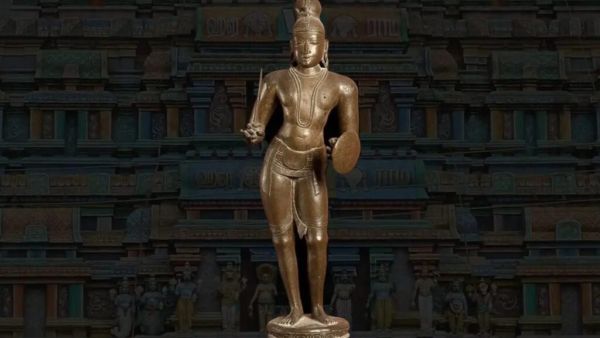
A sacred bronze statue nearly five centuries old is now being returned to its original religious context. The Ashmolean Museum of Oxford University, UK officially handed over the Thirumangai Alvar statue to India, and it will be further restored at the Sri Soundararaja Perumal Temple in Thadikombu, Tamil Nadu.
The transfer took place at a ceremony held at India House in London on Tuesday, March 4. According to the Indian side, after the idol reaches India, the Archaeological Survey of India (ASI) will conduct technical and epigraphic verification as per the prescribed procedure, after which the installation process in the temple will proceed.
According to museum records, this statue was purchased through Sotheby’s in 1967. At that time it was considered part of the legitimate collection. But in 2019, a researcher indicated that the idol was from a temple in Tamil Nadu and matched old photographs.
From here the matter came to a decisive turn. After the identification was revealed, the Ashmolean Museum contacted the Indian High Commission and sought documentary information from the Government of India regarding the statue and the original temple. The subsequent investigation involved the participation of ASI, Tamil Nadu government and the temple administration, and the conclusion was that the statue belonged to India.
Dr. Sturgis also said that the Museum had purchased it in 1967 with good intentions and now it is being returned to India with the same good intentions.
In British public discourse this transfer was seen in the context of faith and living heritage, beyond the return of cultural property. Baroness Thangam Debonnaire, a member of the House of Lords, said during the program that this is not just a piece of art, but a sacred statue of a living temple.
Four other Indian antiquities were also handed over to India at the ceremony. It also indicated that the process of withdrawal at the institutional level following investigation and statutory conclusion of source-country claims could now proceed in a more clear-cut framework.
There have been claims on the Ashmolean Museum’s collection from different parts of the world before, but according to available information, this is the first case of an object being returned after a claim. For this reason, this decision is being considered an example in the history of the museum.
Its significance for India is twofold: first, the return of the religious icon that had gone out of the temple; Second, an example of evidence-based recovery through coordination of multiple agencies. Now the next phase is statutory testing and restoration in India, after which the statue will be reinstalled in its original temple complex.