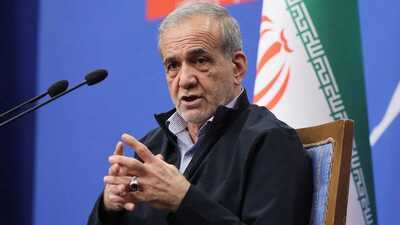
Iranian President Masoud Pezeshkian has issued an open letter addressing the American public, in which he clearly said that Iran does not hold any hostility towards Americans. He said that the people of Iran have no enmity towards ordinary Americans. This statement of Pezeshkian has come at a time when tension continues between Iran and America.
He urged American citizens to look beyond political rhetoric and reconsider their perception of Iran. In his letter, Pezheshkian stressed the need to draw a clear distinction between governments and ordinary citizens. He wrote in the letter that Iranian people do not have enmity towards the people of any country, which includes America. He called it not just a political statement but a deep cultural thought.
In the letter, Pezheshkian said that relations between Iran and the United States are widely misunderstood, and he stressed that Iran has never in its modern history chosen the path of aggression, expansionism, colonialism or domination, and has never initiated any war. He said that instead the country has firmly and bravely driven out those who attacked it.
He stressed that Iran has no hostility toward other countries, including the United States, Europe and neighboring countries. He emphasized that Iranians differentiate between the government and the people. Along with this, he described the recent actions taken by America as aggression targeting civilians and infrastructure and warned that such steps create instability and sow the seeds of discontent that will last for years.
Pezeshkian defended Iran's actions as a balanced response based on legitimate self-defense and said the decision to withdraw from the nuclear deal and escalate tensions were disastrous choices made by the US government. The Iranian President criticized Western countries for presenting Iran as a threat. He says that this belief neither matches the historical facts nor the current circumstances. He also questioned US military actions, asking whether there was really any threat from Iran that justified these steps.
Pointing to civilian suffering and damage to critical infrastructure, he asked, 'Does massacring innocent children or claiming to have sent a country 'back to the Stone Age' by bombing a country serve any purpose other than further damaging the global reputation of the United States?' Pezeshkian expressed deep concern over the civilian losses caused by the war. Referring to the death of innocent children and destruction of infrastructure, he said that such actions only harm America's global image.
The Iranian President also questioned Israel's role and accused America of acting as Israel's representative. He said Washington is acting under outside influence, and asked whether the US "has become involved in the conflict as a proxy for Israel. He described it as a proxy role, which could further escalate regional tensions."
The letter cites several historical events as the reasons behind Iran's distrust of the United States, including the 1953 coup, decades of sanctions, and past military conflicts. Pezeshkian cited the 1953 coup, economic sanctions, and past military conflicts, saying that these events created Iran's distrust of the United States. He said these policies further complicated the relationship between the two countries.
'The turning point for change was the intervention aimed at preventing Iran's nationalization of its resources,' he wrote in the letter. He further said that subsequent policies deepened mistrust among Iranians. Despite this, Pezeshkian stressed that Iran has not adopted the path of aggression. He said, 'Iran has never chosen the path of aggression in its modern history, the country has defended itself only when attacked.'
Pezeshkian presented the current moment as a turning point and warned about the long-term consequences of continued confrontation. 'Today the world stands at a crossroads,' he wrote. It is more costly and futile than ever to continue on the path of confrontation. He urged Americans to question prevailing beliefs and adopt the path of dialogue instead of increasing tension.
He also highlighted Iran's development despite sanctions, citing advances in education, technology and healthcare as measurable, observable realities that refute negative portrayals. At the end of his message Pezeshkian urged Americans to look beyond what he described as misinformation and engage in developing a broader understanding of Iran and its people. He asked the Americans whether the information they were being given matched the reality of Iran.
This letter has come at a time when tension between the two countries is at its peak, both sides are making sharp statements and the diplomatic solution still remains uncertain. This letter has come before the possible address of US President Donald Trump, who is going to speak on the current situation related to Iran.