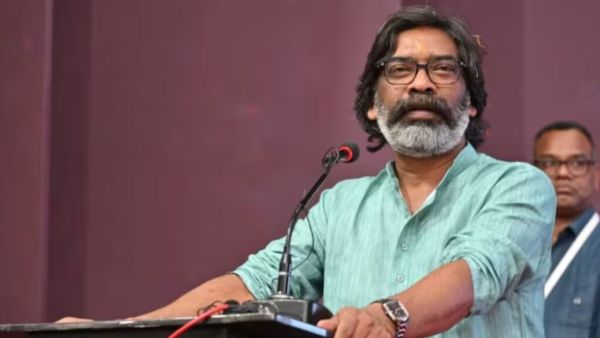
Jharkhand Chief Minister Hemant Soren and his wife, MLA Kalpana Soren, recently visited important tea plantation areas of the state ahead of the Assam elections. During this time, he directly met the tribal laborers working in the tea gardens, deeply understood their problems and established direct communication with them. Referring to various public welfare schemes running in his state Jharkhand, he took a sharp dig at the policies of the Bharatiya Janata Party (BJP) government in Assam.
Chief Minister Hemant Soren, in an emotional post on his official In his post, he clarified the contradiction between the contribution of this society and the current situation. Soren wrote,
This was not just a tweet, but the voice of a community that has been ignored for too long.
In his talks and social media posts, Soren emphasized that the tribal society is still deprived of their fundamental rights. He said that they neither get ownership rights on their land, nor are they given equal opportunities in the field of education, nor do they get proper respect in the society. What is even more humiliating is that they have been confined to a limited identity by calling them ‘Tea Tribe’, their rights are denied and even today they are demeaned by addressing them with terms like ‘coolie’. The Chief Minister clarified that these words are not mere titles, but they symbolize centuries of exploitation, neglect and deeply rooted discriminatory mentality.
Giving historical context, Soren said that during the colonial rule of the British, people of tribal community from different parts of India were forcibly brought away from their original homes and lifestyle to work in these tea gardens of Assam. They were forced to work and live in inhumane conditions, where their generations spent their entire lives. It is extremely sad that even so many decades after the country gained independence, there has been no fundamental or meaningful change in the social and economic condition of these working communities. Even today their basic needs are not met. This situation raises a serious question mark on our democracy and justice system.
The Chief Minister raised the question whether it is acceptable that the people who built the economy of this earth with their hard work and dedication still have to struggle for their existence, their identity and basic human rights? This shows that a large section is still deprived of social and economic justice even though they have been important participants in the development of the country.
Taking his point further, Hemant Soren said that this struggle is not only political. More than that, it is a fight for the dignity of the tribal society, a fight to get back their lost identity, and a fight to provide them historical justice. He stressed that the time has come when the tribal society gets their full rights. This includes protection of their cultural identity, restoration of social respect and assurance of all constitutional rights provided by the Indian Constitution.
Concluding his speech, Soren gave a powerful message, ‘Silence will no longer suffice. We all have to together correct this injustice of history. His statement shows that the issue of tribal rights can no longer be ignored. This is a clarion call to all political parties, society and government to solve this serious problem.
With the upcoming elections in Assam and the BJP government at the Centre, this visit of Chief Minister Soren and his vocal statement directly challenges the BJP to hold accountable the issues of the tribal community. Given the large number of tribal voters in the tea garden areas, their issues will definitely play an important role in the electoral equations. This move of Hemant Soren is also being considered as part of Jharkhand Mukti Morcha’s (JMM) strategy to strengthen its position as a champion of tribal interests at the national level. This struggle is an important step towards ensuring justice and equality for a large and important community of India, beyond mere electoral gains.