
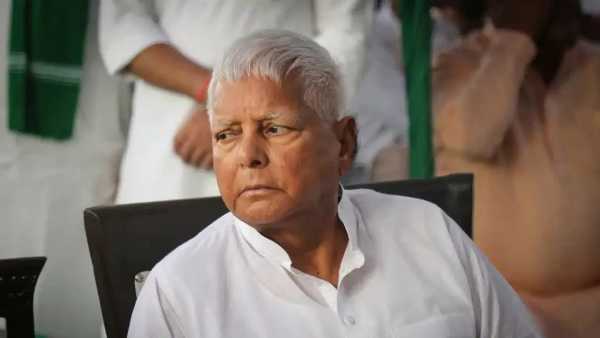
Former Chief Minister of Bihar and RJD leader Lalu Prasad Yadav has received a setback from the Supreme Court. On Monday (April 13), the court rejected Lalu's petition in which he had sought quashing of the Central Bureau of Investigation (CBI) investigation against him and his family in the Land for Jobs case. This decision was given by Justice M.M. Sundaresh and Justice N. Kotiswar Singh's bench pronounced.
The Supreme Court allowed Lalu Prasad Yadav to raise the issue of Section 17A of the Prevention of Corruption Act during the hearing in the alleged Land for Jobs case being investigated by the CBI. The court asked the lower court to hear his case on merit basis. However, the court has exempted him from his personal presence during the hearing. While giving relief to Lalu, the court said that keeping in mind the facts and circumstances, the petitioner is given liberty to raise legal issues at the time of trial.
The court clarified that it is not appropriate to interfere at this stage and the petitioners can raise their legal objections before the trial court. Justice M.M. Sundaresh and Justice N. Kotiswar Singh's bench said in its order that the petitioner is given the freedom to raise issues related to prior sanction (sanction) during the trial. The court also made it clear that pending such legal questions cannot stop the trial process.
This case is mainly related to the scope and applicability of Section 17A of the Prevention of Corruption Act. Under this section, prior permission is required before initiating an investigation into decisions taken by a public servant in the course of his official duties. The Supreme Court identified the questions of the scope of this section and its retrospective applicability, but refrained from considering them for the time being.
During the hearing, senior lawyer Kapil Sibal, appearing on behalf of Lalu Yadav, argued that the investigation conducted without prior approval is illegal. He claimed that the allegations of influencing appointments in the Railways are directly linked to Yadav's official functions as Railway Minister, which attract protection under Section 17A.
Opposing the petition, Additional Solicitor General SV Raju argued that sanction was not required in Yadav's case as he was neither the decision-making officer nor the recommending officer in the alleged transaction. He further said that the petition has been filed long after the investigation was completed.
However, the bench remarked that questions related to formal or informal influence peddling may arise during the trial. Can be checked better during trial. The court indicated that it would be appropriate to resolve such factual and legal issues in the trial court only.
Monday's order comes a few weeks after the Delhi High Court rejected Yadav's petition. The High Court had said that Section 17A, implemented in 2018, does not apply retrospectively to crimes alleged to have been committed between 2004 and 2009. The court had also said that protection under Section 17A would not apply as the alleged acts were not related to any official recommendation or decision made by Yadav in the discharge of his duties.
This case is related to fraud in railway recruitments between 2004 and 2009. During this period Lalu Yadav was the Railway Minister at the Centre. While being the Railway Minister, several Group D appointments were made in the West Central Zone of the Indian Railways in Jabalpur, Madhya Pradesh. It is alleged that Lalu Prasad Yadav and his associates had acquired land from people for jobs in the Railways. After this matter was revealed, the central agencies started investigation and in January this year, they framed charges against 41 people including Lalu Prasad Yadav, Rabri Devi, Tejashwi Yadav, Misa Bharti.