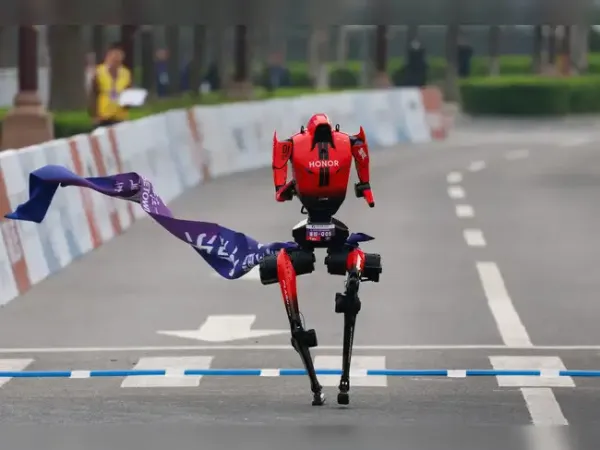
A humanoid robot won a half marathon race for robots in Beijing on Sunday, completing the 21 kilometre course faster than the human world record in a demonstration of China’s advancing technology. The winning robot, developed by Honor, finished the race in 50 minutes and 26 seconds, according to the Beijing Economic Technological Development Area, where the event began.
This timing surpassed the human world record set by Uganda’s Jacob Kiplimo, who completed the same distance in about 57 minutes at the Lisbon road race in March.
The performance marked a major improvement from last year’s inaugural race, when the winning robot completed the course in 2 hours, 40 minutes and 42 seconds. The latest event, held alongside a race for human participants, also saw minor disruptions, with one robot falling at the start line and another colliding with a barrier.
He added that technologies used in the robot, including structural reliability and liquid cooling, could be applied in future industrial settings.
China’s state broadcaster CCTV reported that the runners up, also from Honor and using autonomous navigation, completed the race in approximately 51 minutes and 53 minutes. CCTV also noted that a robot acted as a traffic officer, directing participants using arm gestures and voice commands.
Another attendee, Wang Wen, said robots attracted more attention than human runners and described their speed as exceeding that of humans, suggesting the beginning of a new phase in technological development.
A recent report by London based research firm Omdia ranked Chinese companies AGIBOT, Unitree Robotics and UBTech Robotics Corp among the top global vendors for general purpose embodied intelligent robots. Each of these companies shipped more than 1,000 units last year, with AGIBOT and Unitree Robotics exceeding 5,000 units, according to the report.
(With inputs from AP)
This timing surpassed the human world record set by Uganda’s Jacob Kiplimo, who completed the same distance in about 57 minutes at the Lisbon road race in March.
The performance marked a major improvement from last year’s inaugural race, when the winning robot completed the course in 2 hours, 40 minutes and 42 seconds. The latest event, held alongside a race for human participants, also saw minor disruptions, with one robot falling at the start line and another colliding with a barrier.
Design and technology behind the winning robot
Du Xiaodi, a test development engineer at Honor, said the team was satisfied with the outcome. He explained that the robot’s design was inspired by elite human athletes, featuring long legs measuring about 95 centimetres and equipped with a liquid cooling system developed largely in house.He added that technologies used in the robot, including structural reliability and liquid cooling, could be applied in future industrial settings.
Mixed autonomy and competition results
According to Beijing E Town, around 40 percent of the robots navigated the course autonomously, while the rest were remotely operated. State media outlet Global Times reported that a separate remotely controlled robot from Honor crossed the finish line first in 48 minutes and 19 seconds. However, the autonomous robot secured the official title based on the event’s scoring rules.China’s state broadcaster CCTV reported that the runners up, also from Honor and using autonomous navigation, completed the race in approximately 51 minutes and 53 minutes. CCTV also noted that a robot acted as a traffic officer, directing participants using arm gestures and voice commands.
Public reaction and growing interest
Spectators expressed surprise at the rapid progress in robot performance. Sun Zhigang, who attended both last year’s and this year’s events, said the improvement was significant and noted that robots surpassing humans was something he had not expected.Another attendee, Wang Wen, said robots attracted more attention than human runners and described their speed as exceeding that of humans, suggesting the beginning of a new phase in technological development.
Broader technological and strategic context
The development of humanoid robots forms part of China’s broader push in advanced technology, an area of strategic competition with the US. The country’s latest five year plan emphasises advancing scientific and technological frontiers, including accelerating the development and application of humanoid robots between 2026 and 2030.A recent report by London based research firm Omdia ranked Chinese companies AGIBOT, Unitree Robotics and UBTech Robotics Corp among the top global vendors for general purpose embodied intelligent robots. Each of these companies shipped more than 1,000 units last year, with AGIBOT and Unitree Robotics exceeding 5,000 units, according to the report.
(With inputs from AP)