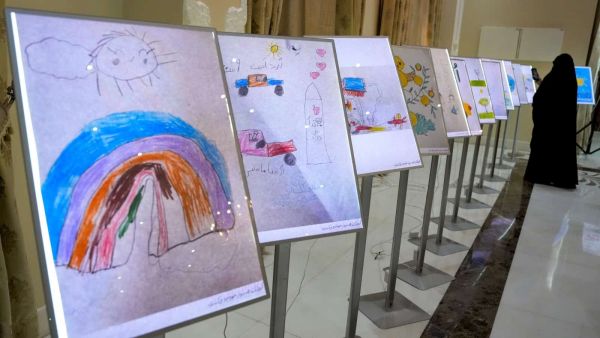
New Delhi: Everything is as it should be in the drawings… a globe in green and blue, a yellow school bus in motion, multi-hued birds perched on a branch beneath blue clouds and a shining sun.
What is missing? The children who brought that fragile order into being and gave visual form to a world they saw as full of colour.
Framed in innocence and hope, the drawings on display at the Iranian Embassy belonged to children killed when a school in Minab, Iran, was bombed into rubble on February 28 – the day the Iran-US-Israel war broke out. Around 160 children, aged five to seven, were killed.

The exhibition, titled “Minab Children Still Draw the Sun,” ended earlier this week. It was an art show unlike any other, less a celebration of the creations and more a mourning of their creators.
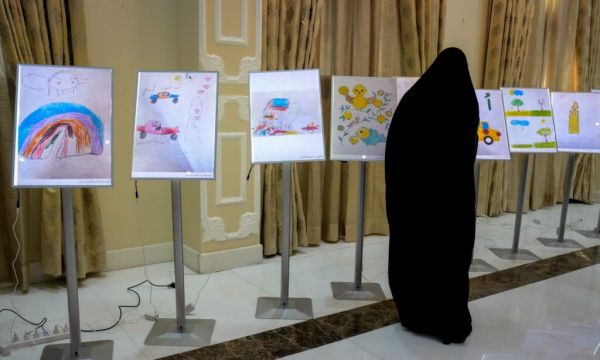
The artworks were found in school bags buried under the Shajareh Tayyebeh girls’ elementary school by Red Crescent teams, then scanned and sent to the Iranian Embassy in New Delhi as well as many others across the world.
The recurring Persian line at the bottom of most of these drawings read: “May our children find happiness.”
A preliminary glance at the artworks induced deep sadness with even some of the most stoic finding it hard to hold back their tears. The hall, filled with visitors of all ages, also echoed with sounds of loud sobs.
“A school that was destroyed following a millitary attack by the USA and the zionist regime. Pages that were recovered through the efforts of Red Crescent rescue teams, and have been restored only to the extent that they can be seen.
“The world depicted in them is still simple, bright and trustworthy. But the world outside did not remain so. Children, in no war, should be victims; yet in every war, many worlds collapse with their extinguishing,” read the description of the exhibition.
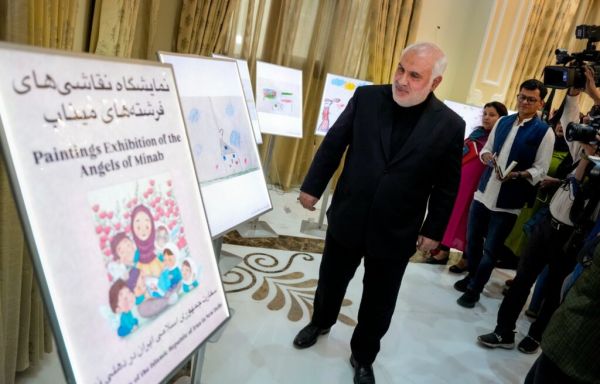
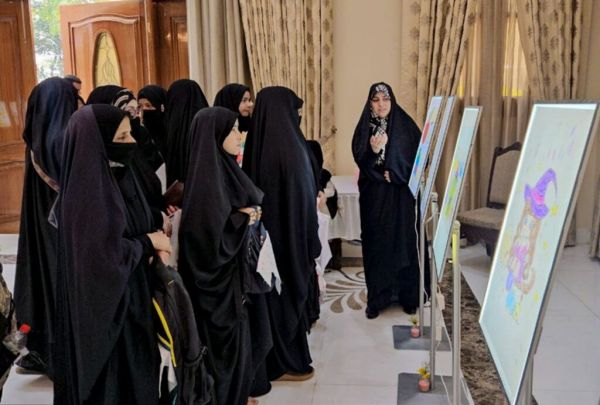
Displayed under soft gallery lights, the 28 drawings carried a quiet weight: a candle burning steadily, the fluttering of an Iranian flag, a nearly perfect glimpse of four seasons, and even a playful little witch. All seen through the lens of a childhood abruptly cut short.
It was more than just about the drawings. In another section of the hall were photographs of rows of graves dug for children. A video showing the school reduced to rubble, voices breaking as bodies are pulled from the debris, played on at the centre.
There was a picture of Makan Nisiri, whose shoes were found hanging from a tree at the school. His body was never recovered.
“Killing innocent children is an act of terror. Humanity is bigger than anything else in this world. And I am here to show my solidarity to Iran and my Muslim brothers in these troubled times,” said Pandit Vijay Kumar Sharma, one of those catching the exhibition on its last day.
“Those who call themselves superpowers will bow their heads – and these children and their sacrifice will make that happen,” he said.
Placed beside the drawings, multiple whiteboards were covered in handwritten messages of tribute. Some voices expressed anger toward those blamed for the attack, others offered solidarity with Iran, while many focused on grief and prayers for peace for the children lost.
“Love can only win – yes, in the end love will win. Long live Iran. You will be remembered in history as heroes,” wrote Tara Goswami from Assam.
“Love and duas for lives snuffed out – you shall live as long as the sun shines and remain forever in our hearts,” said another.