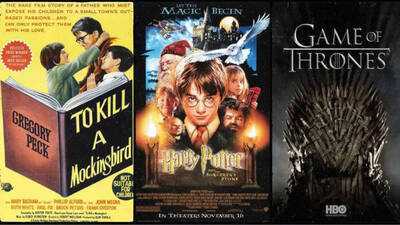
My journey with JK Rowling’s Harry Potter began long before the movies hit the screens. While the films were entertaining and drew in large audiences, I often felt a sense of incompleteness, as if something vital was missing. This feeling resurfaced on World Book Day as I searched for popular literary works that have made their way to the big screen, prompting a familiar debate: why do beloved books often lose their essence in film adaptations? From Harry Potter (with ongoing efforts to improve this) to George RR Martin’s Game of Thrones (a particularly striking example) to classics like To Kill a Mockingbird, this trend is evident. Even the most celebrated adaptations—whether critically acclaimed (The Shining, 1980), commercially successful (I Am Legend, 2007), or culturally significant (The Great Gatsby, 2013)—often fail to encapsulate the full emotional depth of their source material. The issue is complex; it’s not simply that books are better, but rather that each medium conveys human experiences in fundamentally different ways.
Books excel at delving into the inner thoughts of characters. Through prose, authors grant readers direct access to the emotions, fears, and evolving perceptions of their characters. This is akin to a point-of-view medium where readers experience the protagonist's journey through their own mental lens, often leading to profound emotional connections.
Take Harry Potter, for example. Across seven novels, readers are immersed in Harry’s internal struggles—his feelings of isolation, moral dilemmas, and gradual confrontations with loss and identity. While the films convey the overarching story, they inevitably sacrifice much of his inner complexity. Subtle reflections, such as Harry’s thoughts on Cedric Diggory’s death, his complicated feelings towards Snape, or his simmering frustrations in Order of the Phoenix, are largely condensed or omitted in the films. What remains is a streamlined narrative that prioritizes plot progression over psychological depth.
Another crucial factor is the concept of time. Novels unfold at a pace determined by the reader. A single paragraph can be savored, reread, and absorbed, allowing emotions to develop gradually and subtly. In contrast, films and television are bound by a specific runtime. Even lengthy series face challenges with pacing and audience engagement, often necessitating the compression of subplots, merging or eliminating characters, and accelerating slow emotional arcs.
A prime example is Game of Thrones. In its early seasons, when it closely followed George RR Martin’s books, the show maintained a careful balance between plot and character development. However, as it progressed, it began to outpace the source material, leading to a hurried narrative. Complex character motivations—such as Daenerys Targaryen’s evolution and Jaime Lannister’s moral journey—were condensed into abrupt changes that left many viewers feeling disconnected. In contrast, the books dedicate extensive pages to these transitions, allowing readers to inhabit the characters’ lives and perspectives and understand their choices, no matter how troubling they may be within the narrative.
One of the most significant strengths of literature is its interpretative nature. While a book provides a framework, the reader completes the experience. The appearance of characters, their voices, and even the tone of a scene are partially shaped by the reader’s imagination, fostering a deep personal connection. In contrast, cinematic adaptations replace this multiplicity with a singular, fixed interpretation. From the actors to the sets and performance tone, everything becomes definitive, which, while impactful, also limits the range of emotional engagement.
Harper Lee’s To Kill a Mockingbird is a prime example of a novel filtered through Scout Finch’s perspective, whose childlike understanding adds a unique emotional layer to the text. Readers experience events as Scout interprets them. The film adaptation, while highly regarded, cannot fully replicate this narrative, shifting the tone from a subjective experience to an observational one.
The rhythm of a sentence, word choice, and metaphor usage all contribute to how a scene is experienced. While cinema is rich in visual and auditory elements, it cannot replicate the precise emotional nuances of language. Dialogue must be concise; excessive exposition risks feeling forced. Consequently, much of the emotional weight carried by prose is either translated into visual cues or lost entirely.
This is particularly evident in adaptations of literary works known for their stylistic depth. In F. Scott Fitzgerald’s The Great Gatsby, the prose conveys a sense of longing and disillusionment that is inseparable from the language itself. While film adaptations can recreate the setting and plot, the elusive quality of the author’s voice remains difficult to capture.
The ambiguity offered by books, which allows for interpretation, is often absent in cinema. While literature thrives on emotional uncertainty, visual storytelling frequently demands clarity—what is shown must be understood in the moment. Although some films embrace ambiguity, mainstream adaptations often lean towards explicitness to ensure accessibility, which can dilute emotional impact. In literature, what is left unsaid can be as powerful as what is articulated. Pauses, silences, or unresolved tension can resonate deeply precisely because they are not fully explained.
Finally, perhaps the most compelling aspect lies in how each medium is consumed. Reading is typically a solitary act that requires focus, imagination, and emotional investment. This intimacy fosters a bond between the reader and the text. In contrast, watching a film or series is often a more passive and sometimes communal experience. While it can be emotionally engaging, it does not demand the same level of participation.