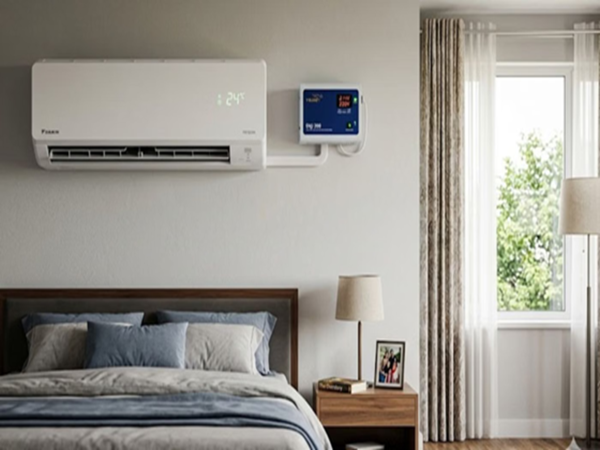
As the summer season arrives, the demand for air conditioners (ACs) surges rapidly. If you, too, head to the market to buy a new AC to escape the scorching heat, you are bound to come across the term 'Convertible AC.' Nowadays—from TV commercials to showrooms—this type of AC is the talk of the town everywhere. But do you actually know what a Convertible AC is? How does it differ from a standard AC, and is it a wise investment? In this report, let's break down the entire concept of Convertible ACs in simple, easy-to-understand language.
**What is a Convertible AC?**
A Convertible AC can operate at varying capacities—that is, at different cooling levels. Standard or "normal" ACs, on the other hand, operate at a fixed capacity. This means that if you purchase a standard 1.5-ton AC, it will *always* run at its full 1.5-ton capacity. You cannot alter the operational capacity of a standard AC.
This is precisely where the Convertible AC gains the upper hand. It utilizes smart technology that allows you to increase or decrease the AC's cooling capacity (measured in tons) according to your specific needs. For instance, a 1.5-ton Convertible AC can be adjusted—with the simple press of a button on the remote control—to operate at capacities of 1 ton, 1.2 tons, or even 0.8 tons. The market now offers 4-in-1, 5-in-1, and 6-in-1 Convertible AC models that, when necessary, can even deliver cooling beyond their nominal capacity (e.g., boosting a 1.5-ton unit to 1.6 or 1.7 tons).
**Major Benefits of a Convertible AC**
**Significant Reduction in Electricity Bills:** The greatest benefit of this technology is the positive impact it has on your wallet. When there are only one or two people in the room, you can set the AC to operate at a lower capacity—such as 1 ton or less. By operating at a lower capacity, the AC consumes significantly less electricity, thereby substantially reducing your monthly utility bill.
Cooling on Demand: If you have a large number of guests at home, you can run the unit at full capacity (100% or 110%); conversely, when you are alone, you can set it to operate at 40% or 60% capacity.
Extended Compressor Lifespan: While the compressor in a standard AC cycles on and off repeatedly, the compressor in a convertible (inverter) AC operates at a consistent speed. This places less mechanical stress on the machine, resulting in a longer operational life.
Is it Cheaper or More Expensive Compared to a Standard AC?
In terms of upfront cost, convertible ACs (which typically feature inverter technology) are more expensive than standard, non-inverter ACs. The price difference between a standard AC and a convertible AC can range from approximately ₹3,000 to ₹5,000.
However, when considering long-term expenses, a convertible AC proves to be more economical. A standard AC consumes a significant amount of electricity because it operates at a fixed speed. In contrast, a convertible AC conserves energy. Within just one or two years, the savings on your electricity bills will be sufficient to recoup the initial additional cost (the extra ₹3,000 to ₹4,000) of the AC unit.
Which One Should You Buy?
If the AC in your home is used for 4–5 hours or more per day, purchasing a convertible AC is the most prudent decision. By spending a little extra upfront, you can realize substantial long-term savings on your electricity bills. On the other hand, if you only run the AC for 1–2 hours a day, you might consider opting for a more affordable standard AC. Nevertheless, given the technological advantages and potential for cost savings, a convertible AC remains the superior choice in today's market.
Disclaimer: This content has been sourced and edited from Amar Ujala. While we have made modifications for clarity and presentation, the original content belongs to its respective authors and website. We do not claim ownership of the content.