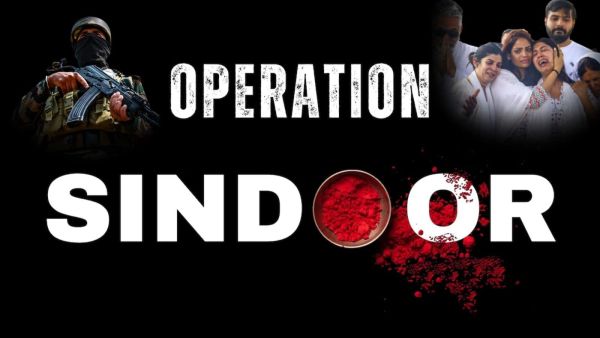
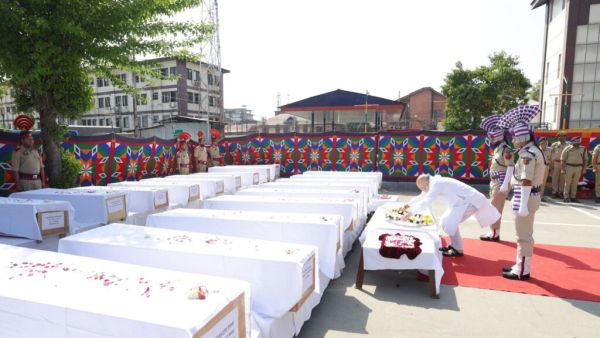
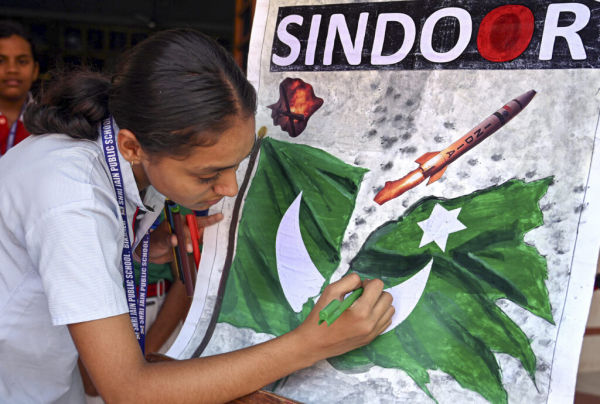
Hyderabad: India on Thursday, May 7, marked the first anniversary of Operation Sindoor, the landmark tri-services military action launched in the early hours of May 7 last year that targeted terror infrastructure across Pakistan and Pakistan-occupied Kashmir (PoK). The day was marked by tributes from the country’s top political and military leadership, heightened security in Jammu and Kashmir and a high-level defence review in Jaipur.
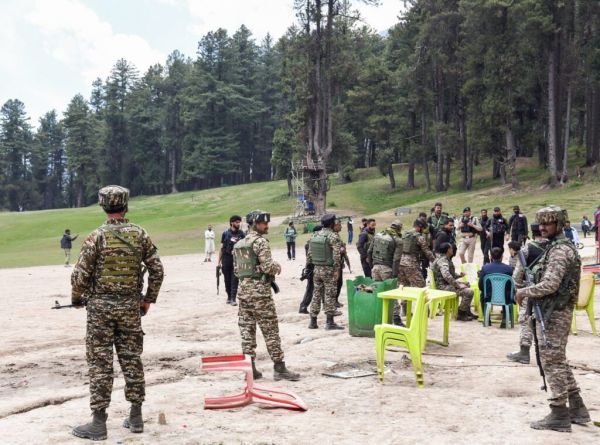
Operation Sindoor was launched in direct response to the April 22, 2025, terror attack in Pahalgam, in which 26 people – mostly tourists – were killed by Pakistan-backed militants belonging to The Resistance Front, an offshoot of Lashkar-e-Taiba. The attackers singled out victims by religion, forcing them to recite the Islamic “kalma” to identify non-Muslims.
Several of the victims were newly married and many were shot at close range in front of their families. A local pony ride operator who tried to save tourists was also killed.


In response, Indian forces launched a series of precision strikes on nine terror camps in Pakistan and PoK in 22 minutes, eliminating at least 100 terrorists. A BrahMos cruise missile, fired from a Su-30 MKI, struck the Jaish-e-Mohammad (JeM) headquarters in Bahawalpur, while the Lashkar-e-Taiba’s main training facility at Muridke – used to plan multiple attacks, including the 2008 Mumbai strikes – was hit using SCALP and Israeli Crystal Maze missiles. Loitering munitions, including Harop, Harpy and the Polish Warmate, were used against other targets.
Pakistan retaliated with strikes of its own, most of which were thwarted by Indian defences. The most decisive blow came on May 10, when India launched BrahMos missiles at the Chakala/Noor Khan air base in Rawalpindi, crippling Pakistan’s Northern Air Command and its command-and-control network.
By the time a ceasefire understanding was reached on the evening of May 10, after nearly 88 hours of conflict, 11 Pakistani air bases had been crippled and seven Pakistani aircraft had been downed. Pakistan’s Director General of Military Operations (DGMO) reached out to his Indian counterpart to halt the fighting.
Analysts and military officials say the operation did more than destroy terror camps, as it fundamentally altered India’s security doctrine. For years, Pakistan had calculated that its nuclear arsenal would deter India from striking its mainland. Operation Sindoor called that bluff.
Army Chief Gen Upendra Dwivedi described the operation as a “trusted orchestra” where every service played a simultaneous, synergistic role. Chief of Defence Staff Gen Anil Chauhan used a cricket analogy to characterise the outcome. “When you win by an innings defeat, there’s no question of how many wickets or balls — it’s an innings defeat that was inflicted,” he had said.
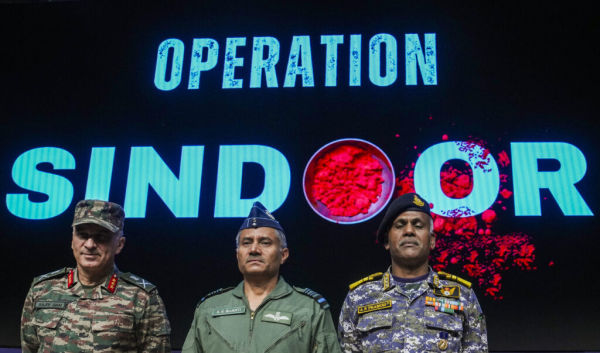
The Indian Air Force, in its anniversary post, kept its message unambiguous. “Operation Sindoor Justice served. Precise in action, eternal in memory—Operation Sindoor continues. India forgets nothing-India forgives nothing,” it said, along with a video detailing the attack.
Prime Minister Narendra Modi, along with Home Minister Amit Shah, Defence Minister Rajnath Singh, External Affairs Minister S Jaishankar and several other Cabinet ministers changed their social media profile pictures to a commemorative Operation Sindoor image.
“A year ago, the armed forces displayed unparalleled courage, precision and resolve,” Modi said, adding that India remains “steadfast in its resolve to defeat terrorism and destroy its enabling ecosystem.”
Home Minister Shah called it an “epochal mission” that would serve as a permanent warning to India’s enemies, while Defence Minister Singh saluted the “unmatched precision, seamless jointness and deep synergy” demonstrated by the armed forces.
Jammmu and Kashmir Lieutenant Governor Manoj Sinha described the operation as “a declaration etched in resolve,” and Uttar Pradesh Chief Minister Yogi Adityanath called it “a powerful symbol of the confidence, courage and decisive leadership of New India.”
On the anniversary, Defence Minister Singh chaired a Joint Commanders’ Conference in Jaipur, reviewing national security challenges and military readiness in light of evolving threats including cyber, space and artificial intelligence (AI)-driven warfare.
The Congress party, however, used the occasion to raise pointed questions. Party general secretary Jairam Ramesh noted that the first announcement of the ceasefire was made by US Secretary of State Marco Rubio, who credited President Trump’s intervention. This claim, Ramesh said, Modi has never publicly refuted. He also pointed to CDS Chauhan’s acknowledgment of early tactical errors and China’s role in supporting Pakistan during the conflict, arguing that Pakistan had not been as diplomatically isolated as it was after the 2008 Mumbai attacks.
(With inputs from PTI and IANS)