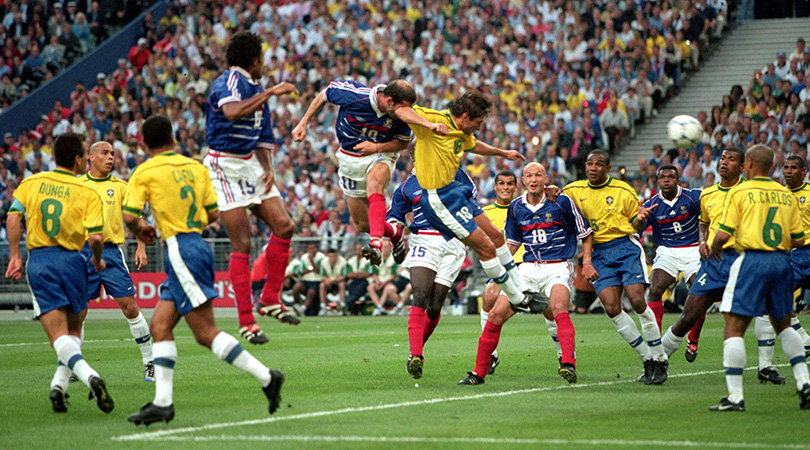
After revisiting the France 98 World Cup Final on Saturday afternoon, we delved into the archives to rediscover Jonathan Wilson’s retrospective on the stars who illuminated that unforgettable tournament.
10. Zinedine Zidane, France
Zidane’s two headed goals in the final have often led to the belief that France 98 belonged to him. While he was indeed impressive, his peak performance arguably came later at Euro 2000. During the 1998 campaign, Zidane set up Christophe Dugarry’s goal in France’s opener against South Africa and played a key role in Thierry Henry’s strike versus Saudi Arabia with a deft flick to Bixente Lizarazu. However, his red card for stamping on Fuad Amin marred that match, and his influence waned in the quarter-final and semi-final before he re-emerged spectacularly in the final against Brazil.
9. Dunga, Brazil
Dunga rarely receives the admiration he deserves – perhaps because his game was about composure and intelligence rather than flair. Though this wasn’t quite his tournament as 1994 had been, his leadership remained crucial, especially during the semi-final against the Netherlands, where his calm presence was vital amid chaos. Critics who questioned his technical skill were silenced when he again demonstrated nerves of steel to score in a tense penalty shootout. A selfless leader and exemplary captain, Dunga’s contribution cannot be overstated.
8. Edgar Davids, Netherlands
After being dismissed from Euro '96 for publicly criticising coach Guus Hiddink, Davids returned to France 98 with a point to prove. The pair reconciled ahead of the tournament, and Davids repaid that faith with relentless, high-energy performances. His aggression and determination freed up Frank de Boer to dictate play from deeper positions, while Davids also showcased his technical ability – notably scoring a decisive last-minute winner against Yugoslavia in the Round of 16 with a powerful strike from the edge of the box.
7. Juan Sebastian Veron, Argentina
Veron’s brilliance in 1998 serves as a reminder that a player should never be judged solely by Premier League form. In France, he displayed creativity and exceptional passing range, allowing Argentina to deploy him in a deeper playmaking role. His one-two with Diego Simeone that set up Ariel Ortega’s first goal against Jamaica was sublime, and his clever short free-kick to Javier Zanetti against England demonstrated his innovation. His finest moment came against the Netherlands, delivering a perfect long ball for Claudio Lopez’s goal.
6. Christian Vieri, Italy
At his peak, Vieri’s mix of power and finesse made him a nightmare for defenders, and France 98 saw him near that level. He opened Italy’s campaign with a side-footed finish against Chile, followed by goals against Cameroon and Austria. In the Round of 16, he netted the only goal against Norway with his weaker right foot. Though Marcel Desailly effectively marked him out in the quarter-final, Vieri still converted his penalty in the shootout.
5. Dennis Bergkamp, Netherlands
Bergkamp’s unforgettable quarter-final winner against Argentina—controlling Frank de Boer’s long pass, cutting inside Roberto Ayala, and finishing into the top corner—cemented his place in World Cup history and made him the Netherlands’ all-time leading scorer at that point. But beyond that iconic goal, he contributed significantly throughout, including assisting Patrick Kluivert’s opener in the same match. His intelligence and composure led the Dutch attack, and his physical resilience was evident, particularly in an unpunished stamp on Sinisa Mihajlovic in the Round of 16.
4. Marcel Desailly, France
Though his red card in the final for a foul on Cafu was a blemish, Desailly’s overall consistency was outstanding. Partnering Laurent Blanc, he brought strength and authority to France’s defence. With only Davor Suker managing to score against Les Bleus in open play, Desailly’s leadership was immense. After Blanc’s suspension in the semi-final, Desailly even made Frank Leboeuf look formidable in the final. It remains unfortunate that Ronaldo’s health issues denied fans a true duel between the tournament’s best striker and best defender.
3. Davor Suker, Croatia
Croatia’s creative midfield was exceptional, but it was Suker’s clinical finishing that carried them to the semi-finals. Far more than a poacher, he was intelligent in movement and capable of stunning finishes. Although he didn’t replicate his Euro '96 wonder goal against Peter Schmeichel, his prolific scoring compensated. He opened his account against Jamaica, struck the winner versus Japan, and twice converted a retaken penalty against Romania with trademark calmness. He scored again against Germany and netted in the semi-final versus France. His goal in the third-place match secured him the Golden Boot.
2. Ronaldo, Brazil
Had Ronaldo not suffered his mysterious pre-final episode, Brazil might well have lifted the trophy. Before his knee injury, he was a phenomenon—blending speed, strength, and technique to devastating effect. Only 21, he was instrumental in Brazil’s record 45-match unbeaten streak leading into the tournament. He scored a low volley against Morocco, dazzled against Chile with two goals, assisted twice in the 3-2 victory over Denmark, and scored in the semi-final draw with the Netherlands. In the final, however, clearly unwell, he was a shadow of himself.
1. Lilian Thuram, France
While Zinedine Zidane often gets the spotlight, France’s triumph was built on defensive discipline and timely contributions from the back. With Didier Deschamps, Emmanuel Petit, and Christian Karembeu forming a compact midfield, full-backs Bixente Lizarazu and Lilian Thuram were tasked with providing width. Thuram rose spectacularly to the occasion in the semi-final against Croatia. Though he inadvertently played Davor Suker onside for Croatia’s opener, he redeemed himself with two stunning goals—his only strikes in 142 appearances for France—turning the game around. His defensive dominance was equally crucial, as France conceded just once in his six appearances.