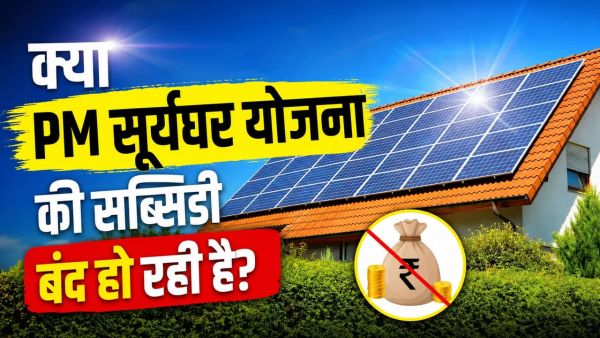
Solar Panel New Rules 1 June 2026: If you too are thinking of installing solar panels on the roof of your house in this scorching summer, then this news is very important for you. The government is going to implement a new rule from the first of next month i.e. 1st June 2026. With the arrival of this new rule, solar panels of some companies may become expensive. This rumor has also started spreading on social media that the government is going to stop the subsidy on solar. But how much truth is there in this and how much impact is it going to have on your pocket after June 1? Let us know...

Till now the government used to only check whether the solar panel installed at your house is of good quality or not, but from June 1, the rules are becoming a little stricter. Now, along with the panel, the small 'solar cells' installed inside it are also required to be from the approved list of the government. The government is doing this so that poor quality solar cells are not sold in the market, substandard goods coming from China are banned and things made in our own country (Make in India) are promoted.
Experts believe that after this new rule there may be a slight increase in the prices of solar panels. If you get solar installed after June 1, it may cost you extra per kilowatt (kW). A 1 kilowatt (1 kW) system can cost around ₹3,000. A 2 kilowatt (2 kW) system can cost around ₹6,000 and a 3 kilowatt (3 kW) system can cost around ₹9,000.
This new rule and increased expenditure will be applicable only to those who want to take government subsidy or want to get net-metering done (selling electricity to the government). If you are installing solar at your own expense without subsidy, then you do not need to worry much.
Do not trust rumors on social media at all. The subsidy available under PM Suryaghar Yojana will not be stopped at all. The government will continue to give money like before. Subsidy of ₹ 30,000 on 1 kilowatt will continue. Apart from this, the government will give up to ₹60,000 on 2 KW and ₹78,000 on 3 KW. The only change from the new month will be that to get the subsidy money, you will have to follow the rules of paper work and investigation a little more strictly.
1. Subsidy Option
This is best suited for those people whose main objective is to reduce or reduce the huge electricity bill every month. On-grid or hybrid system is installed in this. In this, you get a strong subsidy (rebate) of up to ₹ 78,000 from the government, which does not put much burden on your pocket in the beginning. However, it also has disadvantages. In this, you have to choose only a few brands and limited technology approved by the government. Also, a lot of paper work and long wait is required for the subsidy money to come into the account.
2. Freedom Option
This is perfect for those who want a system of their own choice without any government restrictions or paperwork. If there are frequent power cuts in your area and you need a strong power backup or off-grid system, then this is the best. In this, you get complete freedom to choose the latest and advanced technology of the market, such as high-tech HJT-HDT panel, lithium battery and hybrid inverter. It gives excellent performance and backup in the long run. The disadvantage in this is that there is no subsidy from the government, so in the beginning you have to bear the entire cost of installing the solar system yourself.