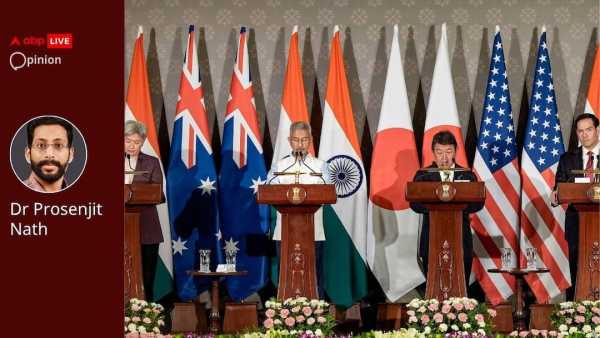
For many countries across Asia, the purpose of the Quadrilateral Security Dialogue, or Quad, remains a subject of debate. Critics often ask: What problem does the Quad solve that existing regional institutions cannot? Why does it exist when organisations such as ASEAN already provide forums for dialogue? And what future does it envision for the Indo-Pacific?
From a nationalist and strategic realist perspective, these questions have straightforward answers. The Quad exists because the geopolitical realities of the 21st century have exposed the limitations of existing institutions in dealing with an increasingly assertive China. More importantly, the Quad has emerged because India, Japan, Australia, and the United States recognise that preserving a free, open, and multipolar Indo-Pacific requires proactive cooperation rather than passive diplomacy.
The Quad was not created in a vacuum. Its revival was a direct response to Beijing’s growing attempts to alter the strategic balance of Asia. Whether in the South China Sea, the East China Sea, the Indian Ocean Region, or along India’s Himalayan borders, China has repeatedly demonstrated a willingness to use military, economic, and diplomatic pressure to advance its interests.
For India, the lesson has been particularly stark. The 2020 Galwan Valley clash shattered decades of assumptions that economic engagement alone could stabilise relations with China. Despite extensive trade ties and diplomatic dialogue, Beijing pursued aggressive actions along the Line of Actual Control. The incident reinforced a reality that Indian strategic thinkers had long warned about: peace cannot be sustained merely through goodwill when one side seeks to alter the status quo through coercion.
In this context, the Quad is not an alliance of convenience but a strategic necessity.
Critics frequently argue that the Quad defines itself primarily through opposition to China. This criticism misunderstands the nature of strategic partnerships. Throughout history, nations have formed coalitions not merely because they share common values but because they face common challenges. NATO emerged to deter Soviet expansionism. ASEAN strengthened itself in response to regional instability. Similarly, the Quad has gained relevance because of growing concerns about Chinese expansionism.
There is nothing illegitimate about this.
In fact, acknowledging the China challenge openly would make the Quad more credible. Excessive diplomatic caution often creates confusion about the grouping's purpose. Asian nations already understand the strategic reality. They see China's military build-up, its debt-trap diplomacy, its coercive economic practices, and its attempts to dominate critical sea lanes. Pretending that these developments are unrelated to the Quad's emergence convinces no one.
The real question is not whether the Quad is responding to China. The real question is whether it can effectively shape an alternative future for the region.
For India, the answer must be yes.
A China-centric Asian order would fundamentally undermine India's long-term interests. Beijing's vision of regional hierarchy leaves little room for independent centres of power. Through initiatives such as the Belt and Road Initiative, the expansion of strategic ports, and growing military presence across the Indian Ocean, China seeks to establish political and economic leverage over smaller states while constraining competitors.
India's rise as a major power therefore depends on preventing the emergence of such a unipolar Asian order.
The Quad serves as an important instrument in this effort. It strengthens maritime cooperation, enhances intelligence sharing, improves technological collaboration, and creates opportunities for economic resilience. Unlike traditional military alliances, it allows India to retain its strategic autonomy while benefiting from partnerships with other major democracies.
This distinction is crucial.
For decades, Indian foreign policy was shaped by the legacy of non-alignment. While that doctrine served a purpose during the Cold War, the contemporary strategic environment demands greater realism. Strategic autonomy should not mean strategic isolation. India cannot secure its interests alone against an increasingly powerful and aggressive China.
The Quad represents a modern interpretation of strategic autonomy—one based on partnerships rather than dependence.
From a civilizational perspective, the grouping also reflects a deeper convergence. India, Japan, Australia, and the United States may differ in culture and political traditions, but they share a commitment to democratic governance, rule of law, freedom of navigation, and national sovereignty. These principles are increasingly under challenge from authoritarian models of governance that prioritize state control over individual freedoms and international norms.
The contest unfolding across the Indo-Pacific is therefore not merely about territory or trade routes. It is also about competing visions of political order.
India has a vital stake in ensuring that Asia's future is not dictated by authoritarian power structures. As the world's largest democracy and an emerging civilizational state, India carries a responsibility to contribute to the preservation of a rules-based regional order.
This does not mean the Quad should become an Asian NATO. Such proposals ignore regional realities and would likely alienate many countries in Southeast Asia. India must continue resisting efforts to transform the grouping into a formal military alliance.
However, avoiding a military alliance does not require avoiding strategic clarity.
The Quad should openly position itself as the principal platform for safeguarding the Indo-Pacific against coercion. It should expand cooperation in maritime security, critical technologies, semiconductor supply chains, cybersecurity, artificial intelligence, and infrastructure development. It should offer developing nations transparent alternatives to predatory lending and strategic dependency.
Most importantly, it should demonstrate that democratic cooperation can deliver tangible benefits.
Many nations in Asia do not want to choose between China and the West. What they seek is strategic space, economic opportunity, and protection from coercion. The Quad can help provide that space if it focuses on practical outcomes rather than diplomatic rhetoric.
For India, the stakes are especially high. A stable balance of power in the Indo-Pacific is essential for economic growth, energy security, maritime trade, and national defence. Nearly all of India's strategic ambitions, from becoming a manufacturing hub to expanding its influence in the Indian Ocean, depend on preventing any single power from dominating the region.
That is why the Quad should not be viewed merely as a reaction to China's rise. It should be understood as a framework for preserving a multipolar Asia in which sovereign nations retain the freedom to make independent choices.
The future of the Quad will ultimately depend on whether its members possess the political will to translate shared concerns into sustained action. If they succeed, the Quad could become one of the most consequential strategic partnerships of the century. If they fail, the Indo-Pacific may drift toward a regional order increasingly shaped by Chinese power and influence.
For India, the choice is clear. The Quad is not simply a diplomatic forum. It is an essential pillar of a broader strategy to ensure that Asia's future is determined by free nations acting in concert rather than by the ambitions of a single hegemonic power. In that sense, the Quad's relevance is not diminishing it is only beginning.
(The writer is a technocrat, political analyst, and author)