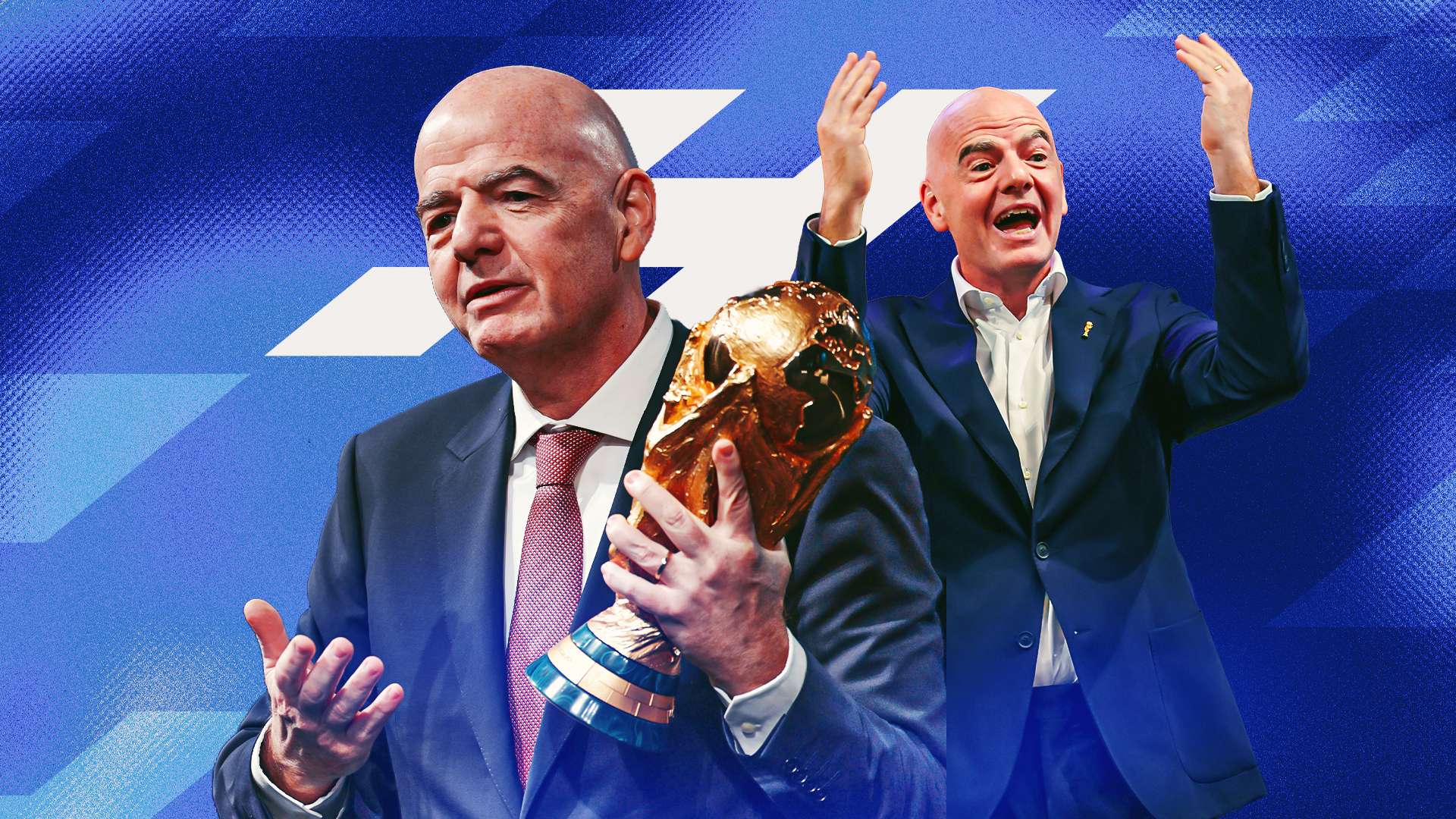
Is Gianni Infantino now football’s most disliked man? The FIFA president’s apparent failure to grasp what truly makes the World Cup special has turned supporters against the game’s most powerful administrator.
At last December’s World Cup draw held at the Kennedy Centre in Washington D.C., Gianni Infantino was introduced on stage as “football’s No.1 fan.” Many supporters laughed at the description, though Infantino genuinely considers himself a lifelong fan of the sport. Like millions around the world, his passion began with his first World Cup — the 1982 edition in Spain — which he recalls as “spectacular.”
“I was a 12-year-old boy at the time,” Infantino told AS in March. “Italy won, with Paolo Rossi and that whole team of great players. I remember Alessandro Altobelli scoring in the final. His third goal and the celebrations against Germany were incredible. That Italy team and that moment are engraved in my heart.”
It’s easy to see why the tournament meant so much to him. In his much-criticised ‘Today I feel Qatari’ speech before the 2022 World Cup, Infantino revealed that as a child growing up in Switzerland, he was bullied for being a red-haired, freckled kid of Italian descent — which only made Italy’s 1982 triumph even more special for him.
But that deep-rooted affection for the World Cup only raises more questions about why, as FIFA president, Infantino has allowed a tournament he believes can “bring people together” to become so divisive and exclusionary.
‘Everyone will be welcome...’
At a press conference in Kenya last August, a South African journalist voiced concerns to Infantino and FIFA vice-president Patrice Motsepe about the upcoming World Cup being co-hosted by the United States — “a country where some of us do not feel welcome.”
“I think the onus is on you,” the journalist added, “to ensure Africa and all the people of the world do not feel like outcasts or second-class citizens in a world where equality should prevail.”
Infantino dismissed concerns about Donald Trump’s travel bans and strict visa policies. “Everyone will be welcome in Canada, Mexico and the United States for the FIFA World Cup next year,” he said. “There is a process to go through to get visas, but it will be smooth...” However, reality has proved very different.
Just three days before the World Cup’s opening match, Somali referee Omar Artan became the most high-profile figure so far denied entry to the U.S., joining a long list of fans from around the globe whose visa applications were rejected — a direct contradiction of Infantino’s assurances.
“We want to unite the world and we will unite the world. Be positive,” Infantino had told African journalists in Kenya. “You will see, it will be a great celebration of the greatest FIFA World Cup ever.”
What we’re witnessing instead is the most exclusive World Cup in history — a predictable outcome of Infantino’s eagerness to court some of the world’s most controversial political leaders.
‘He loves dictators and billionaires’
Michel Platini, who has filed a criminal complaint against Infantino and several Swiss officials over a 2015 corruption case, is hardly unbiased. Yet many share his blunt assessment of Infantino’s character. “He likes the rich and powerful people, the ones with money,” the former France No.10 told The Guardian. “It’s his character.”
An anonymous FIFA Council member told Politico: “Personally, I have nothing against Infantino — he is not a crook — but the problem is his self-confidence. He loves dictators and billionaires. When he sees people with money, he melts.”
Infantino’s defenders say cultivating relationships with the wealthy and influential is part of his job — to secure funds for FIFA’s 211 member associations. Since his election in 2016, FIFA’s annual revenue has increased eightfold, largely thanks to record investments from nations like Saudi Arabia. His expansion of the World Cup to 48 teams is projected to generate $9 billion — a record for the organisation.
Still, the methods used to achieve such financial success have done little to fulfil another of Infantino’s election promises: “To restore the image of FIFA.”
Football’s Nero
Eleven years after Sepp Blatter’s fall from grace amid corruption scandals, many believe Infantino now runs FIFA with unchecked power and little regard for the sport’s integrity. FIFPRO president Sergio Marchi even compared him to the infamous Roman emperor Nero before last year’s Club World Cup.
While Infantino insists he can handle criticism, he has shown frustration at the constant scrutiny. “I don’t understand why some of you are so mean,” he told reporters at a FIFA Congress in Rwanda in 2023. “We work hard, I work hard, the whole FIFA team works hard. We don’t steal, we don’t profit. Maybe I don’t speak much to the media, but FIFA is about football, not about money.”
‘Monopoly over ticket sales’
That statement rang hollow after FIFA introduced ‘dynamic pricing’ and a 30 percent fee on resold tickets — measures seen as blatant money-grabs. Infantino defended the move during a conference in Beverly Hills, joking, “If someone buys a ticket for the final for $2 million, I will personally bring him a hotdog and a Coke to make sure he has a great experience!”
He continued, “We have to look at the market — entertainment is highly developed in the U.S. So we apply market rates. Even if people say ticket prices are high, they end up being resold for even higher prices.”
Critics accused him of abdicating responsibility, adopting a capitalist logic that priced ordinary fans out of the event. Football Supporters Europe (FSE) noted that “FIFA holds a monopoly over ticket sales for the 2026 World Cup and has used that power to impose conditions that would never be acceptable in a competitive market. Loyal fans have no choice — pay up or lose out.”
Peace prize for a war-monger
Ironically, even Donald Trump admitted he wouldn’t pay $1,000 (£736) for a ticket to the U.S.’s opening game against Paraguay — further highlighting the absurdity of FIFA’s pricing. Infantino’s closeness to Trump has drawn heavy criticism, with accusations that he has breached FIFA’s political neutrality. Borrowing slogans from Trump’s “Make America Great Again” movement, Infantino even presented him with a peace prize at the World Cup draw, a gesture that unsettled even his allies.
“We want to see hope, we want to see unity, we want to see a future,” Infantino told Trump. “You definitely deserve the first FIFA Peace Prize.”
Since then, Trump’s administration has launched an illegal war against Iran — making the U.S. the first host nation in World Cup history to bomb another participating country. Despite repeatedly insisting that politics should stay out of football, Infantino has presided over the most politicised tournament yet, rivaling the propaganda-driven events of Mussolini’s Italy, Argentina’s junta, Putin’s Russia, and Qatar’s monarchy.
Trump has also effectively barred fans from Iran, Haiti, Senegal, and Ivory Coast from attending, forcing Iran’s team to base themselves in Mexico even though their group matches are in the U.S.
Backlash
As the World Cup begins, one wonders how Infantino truly feels. Four years ago he said he felt “African.” Today, his indifference to those denied entry to the U.S. — or priced out of tickets — suggests otherwise.
Infantino may still command support among FIFA’s power brokers, but the World Cup was supposed to be his crowning moment. Instead, his reputation as “The King of Soccer” — a nickname gifted by Trump — has been tarnished by controversy.
He may have delivered record revenues, but at a great reputational cost. Before the Club World Cup, Infantino declared that “football belongs to the people.” Yet his actions over the past year have distanced the game from its fans — something that has not gone unnoticed.
As investigations into ticketing practices begin in New York and New Jersey, and the FairSquare advocacy group launches its ‘Reboot FIFA’ campaign, the backlash is growing. Ironically, Infantino has managed to unite football fans — just not in the way he intended. Those who once shared his childhood passion for the World Cup are now united in their disillusionment with the man running, and damaging, the game they love.