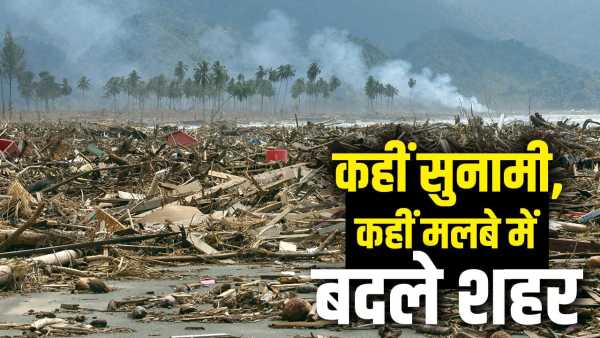
When the tectonic plates present inside the earth collide or slide against each other, an earthquake occurs. Sometimes it lasts for a few seconds, but its effect is so terrible that entire cities are destroyed. Whenever the intensity of an earthquake ranges from 7 to 9.5 on the Richter scale, huge devastation occurs. Every increase of 1 point on the Richter scale means 10 times more vibrations and the release of approximately 32 times more energy. There have been many such earthquakes in history, which changed the lives of millions of people. Let us know about the 10 biggest earthquakes in the world…
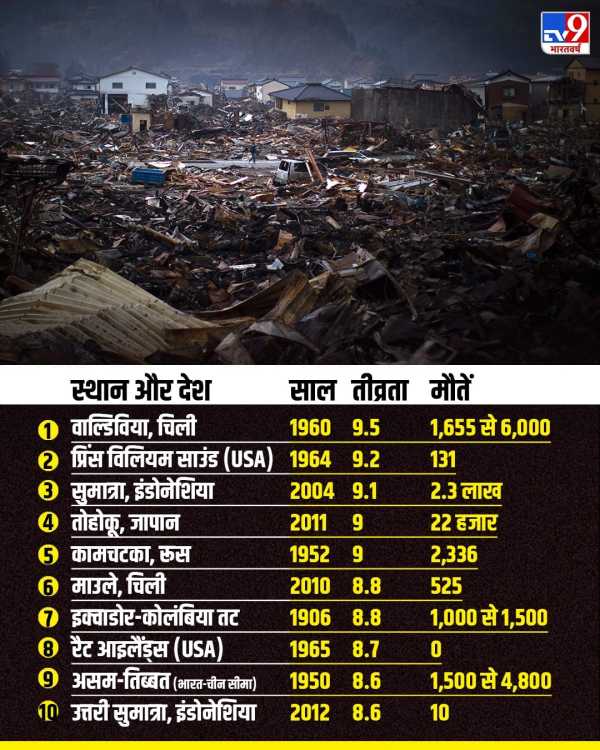
This is considered to be the most powerful earthquake ever. Its intensity was 9.5. After the earthquake, a tsunami up to 25 meters high occurred, whose waves reached Hawaii, Japan and the Philippines, thousands of kilometers away from Chile. In this disaster, 1,655 to 6,000 people died, about 2 million people were made homeless and there was a loss of about 550 million dollars at that time.
This earthquake that occurred in Alaska is known as 'Great Alaska Earthquake'. After this there were major landslides and a tsunami also occurred. The area where the earthquake occurred was less populated, hence 131 people died. However, the city of Anchorage suffered extensive damage to its roads, buildings, port, and other infrastructure.
It was one of the biggest natural disasters in modern history. After this undersea earthquake, a massive tsunami occurred in the Indian Ocean. Its waves caused massive devastation in 14 countries including India, Sri Lanka, Indonesia, Thailand. About 2,27,898 people died in this disaster. Millions of people became homeless and many countries suffered losses worth billions of dollars.
After this earthquake, a tsunami up to 40 meters high occurred, which destroyed many coastal cities of Japan. For this reason, radioactive leakage also occurred in the Fukushima nuclear plant. More than 22 thousand people died or went missing in this disaster. According to the World Bank, it caused a loss of approximately 235 billion dollars, which is considered to be the largest economic loss caused by any natural disaster.
After this earthquake in the far eastern region of Russia, a 13 meter high tsunami arose. The tsunami almost completely destroyed the city of Severo-Kurilsk. About 2,336 people lost their lives in this accident. It is counted among the largest marine earthquakes of the 20th century.
The tremors of this earthquake were felt by about 80 percent of the population of Chile. The tsunami that followed caused further damage to the coastal areas. About 525 people died and there was an economic loss of about $30 billion. Thousands of houses, roads and bridges were damaged.
This earthquake occurred on the coast of the Pacific Ocean. The tsunami that followed caused huge damage to the coastal areas of Ecuador and Colombia. According to historical records, 1,000 to 1,500 people died in this disaster. Due to lack of modern warning system at that time, people did not get a chance to escape.
This earthquake occurred in a remote and almost empty area near the sea. After this, a tsunami about 10 meters high arose, but due to the very low population there, no one died. Some buildings and ports suffered minor damage. This is an example of the fact that despite a strong earthquake, if the population is less then the loss of life can be reduced.
This was one of the most powerful earthquakes in the history of India. Its center was near the border of Tibet, but the maximum impact was in Assam and North-East India. Heavy landslides occurred, many rivers were filled with debris and subsequently flooded. About 1,500 to 4,800 people died in this disaster. Many villages were completely destroyed and thousands of people had to leave their homes.
This was a very powerful earthquake that occurred under the sea. Its intensity was 8.6, but it was a different type of earthquake, hence no major tsunami occurred. Despite this, tsunami alert was issued in many countries of the Indian Ocean. Only 10 people died in this accident and major damage was averted.
Hundreds of earthquakes occur in Japan every year, but fewer people die there compared to other countries. The biggest reason for this is better preparation. Japan has installed a modern sensor network under the sea called S-Net, which detects earthquakes and tsunamis in advance. This gives people time ranging from a few seconds to several minutes.
Apart from this, all big buildings in Japan are built under strict anti-seismic rules. Special steel structures and rubber dampers are installed in these, due to which the buildings do not collapse even during strong earthquakes. Earthquake safety drills are conducted regularly in schools and offices. This is the reason why despite major earthquakes, Japan is successful in reducing the loss of life and property to a great extent.